
血清和支气管肺泡灌洗液中 Krebs von den Lungen-6、表面活性剂蛋白 A、表面活性剂蛋白 D 水平对慢性纤维化间质性肺炎的预后价值:一项回顾性研究。
Prognostic performance of Krebs von den Lungen-6, surfactant protein A, surfactant protein D levels in the serum and bronchoalveolar lavage fluid in chronic fibrosing interstitial pneumonia: a retrospective study.
机构信息
Department of Respiratory Medicine, National Hospital Organization Omuta National Hospital, 1044-1 Oaza, Tachibana, Omuta City, Fukuoka, 837-0911, Japan.
Department of Respiratory Medicine, Fukuoka Sanno Hospital, Fukuoka, Japan.
出版信息
BMC Pulm Med. 2024 Aug 22;24(1):404. doi: 10.1186/s12890-024-03224-1.
BACKGROUND
The serum markers Krebs von den Lungen-6 (KL-6), surfactant protein A (SP-A), and surfactant protein D (SP-D) have been used for the diagnosis, differential diagnosis, and prognosis prediction of interstitial pneumonia. However, the significance of measuring the serum and bronchoalveolar lavage fluid (BALF) KL-6, SP-D, and SP-A levels in predicting the prognosis of chronic fibrosing interstitial pneumonia (CFIP), idiopathic pulmonary fibrosis, and idiopathic nonspecific interstitial pneumonia remains unclear. We aimed to clarify the significance of measuring the serum and BALF KL-6, SP-A, and SP-D levels in predicting the prognosis of patients with CFIP.
METHODS
Among 173 patients who were diagnosed with CFIP between September 2008 and February 2021, 39 who underwent bronchoalveolar lavage were included in this study. Among these, patients experiencing an annual decrease in forced vital capacity (FVC) of ≥10% or those facing challenges in undergoing follow-up pulmonary function tests owing to significant deterioration in pulmonary function were categorized as the rapidly progress group. Conversely, individuals with an annual decrease in the FVC of <10% were classified into the slowly progress group. The serum and BALF KL-6, SP-D, and SP-A levels, as well as BALF/serum SP-D and SP-A ratios were compared between the two groups.
RESULTS
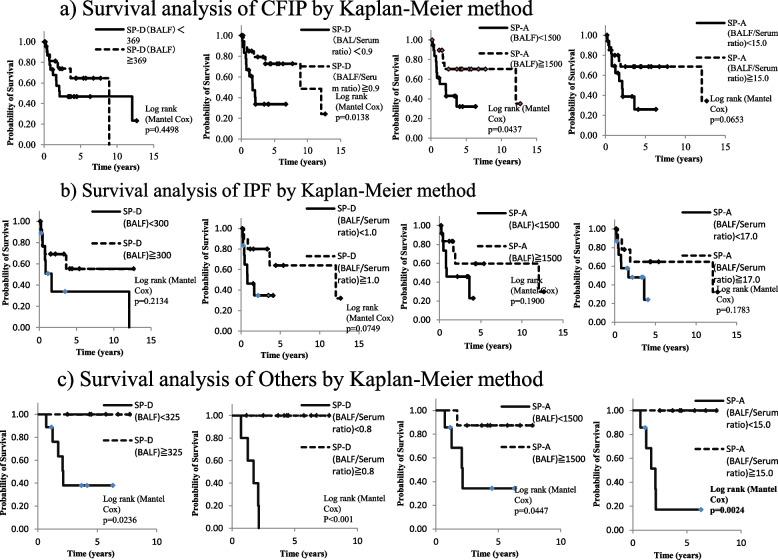
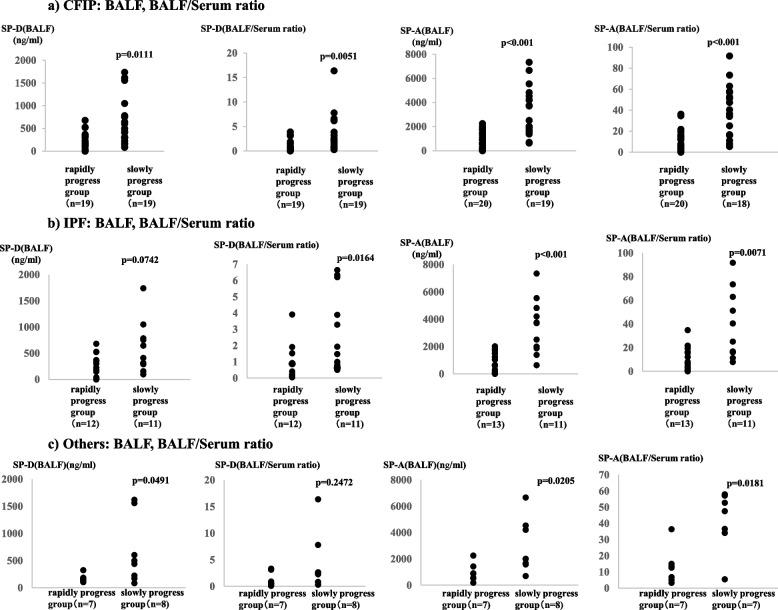
Among the patients with CFIP, the BALF SP-D level (p=0.0111), BALF SP-A level (p<0.0010), BALF/serum SP-D ratio (p=0.0051), and BALF/serum SP-A ratio (p<0.0010) were significantly lower in the rapidly than in the slowly progress group (p<0.0010). The receiver operating characteristics analysis results demonstrated excellent performance for diagnosing patients with CFIP, with the BALF SP-D level (area under the curve [AUC], 0.7424), BALF SP-A level (AUC, 0.8842), BALF/serum SP-D ratio (AUC, 0.7673), and BALF/serum SP-A ratio (AUC, 0.8556). Moreover, the BALF SP-A level showed a notably superior CFIP diagnostic capability. Survival analysis using the Kaplan-Meier method revealed that patients with a BALF SP-A level of <1500 ng/mL and BALF/serum SP-A ratio of <15.0 had poor prognoses.
CONCLUSIONS
Our results suggest that BALF SP-A measurement may be useful for predicting the prognosis in patients with CFIP.
背景
血清标志物 Krebs von den Lungen-6(KL-6)、表面活性蛋白 A(SP-A)和表面活性蛋白 D(SP-D)已被用于间质性肺炎的诊断、鉴别诊断和预后预测。然而,测量血清和支气管肺泡灌洗液(BALF)KL-6、SP-D 和 SP-A 水平对预测慢性纤维化间质性肺炎(CFIP)、特发性肺纤维化和特发性非特异性间质性肺炎预后的意义尚不清楚。我们旨在阐明测量 CFIP 患者血清和 BALF KL-6、SP-A 和 SP-D 水平对预测预后的意义。
方法
在 2008 年 9 月至 2021 年 2 月期间诊断为 CFIP 的 173 名患者中,有 39 名接受了支气管肺泡灌洗,其中有 39 名患者接受了支气管肺泡灌洗。在这些患者中,每年用力肺活量(FVC)下降≥10%的患者或由于肺功能显著恶化而难以进行随访肺功能测试的患者被归类为快速进展组。相反,FVC 每年下降<10%的患者被归类为缓慢进展组。比较两组患者的血清和 BALF KL-6、SP-D 和 SP-A 水平以及 BALF/血清 SP-D 和 SP-A 比值。
结果
在 CFIP 患者中,快速进展组的 BALF SP-D 水平(p=0.0111)、BALF SP-A 水平(p<0.0010)、BALF/血清 SP-D 比值(p=0.0051)和 BALF/血清 SP-A 比值(p<0.0010)均显著低于缓慢进展组(p<0.0010)。受试者工作特征分析结果表明,BALF SP-D 水平(曲线下面积[AUC],0.7424)、BALF SP-A 水平(AUC,0.8842)、BALF/血清 SP-D 比值(AUC,0.7673)和 BALF/血清 SP-A 比值(AUC,0.8556)对 CFIP 的诊断性能均较好。此外,BALF SP-A 水平对 CFIP 的诊断能力明显优于其他指标。Kaplan-Meier 生存分析显示,BALF SP-A 水平<1500ng/ml 和 BALF/血清 SP-A 比值<15.0 的患者预后较差。
结论
我们的研究结果表明,BALF SP-A 测量可能有助于预测 CFIP 患者的预后。
 Zotero 插件