
雌性小鼠通过筛板淋巴管清除蛛网膜下腔中的红细胞。
Clearance of erythrocytes from the subarachnoid space through cribriform plate lymphatics in female mice.
机构信息
Theodor Kocher Institute, University of Bern, Bern, Switzerland.
Theodor Kocher Institute, University of Bern, Bern, Switzerland.
出版信息
EBioMedicine. 2024 Sep;107:105295. doi: 10.1016/j.ebiom.2024.105295. Epub 2024 Aug 22.
BACKGROUND
Atraumatic subarachnoid haemorrhage (SAH) is associated with high morbidity and mortality. Proposed mechanisms for red blood cell (RBC) clearance from the subarachnoid space (SAS) are erythrolysis, erythrophagocytosis or through efflux along cerebrospinal fluid (CSF) drainage routes. We aimed to elucidate the mechanisms of RBC clearance from the SAS to identify targetable efflux pathways.
METHODS
Autologous fluorescently-labelled RBCs along with PEGylated 40 kDa near-infrared tracer (P40D800) were infused via the cisterna magna (i.c.m.) in female reporter mice for lymphatics or for resident phagocytes. Drainage pathways for RBCs to extracranial lymphatics were evaluated by in vivo and in situ near-infrared imaging and by immunofluorescent staining on decalcified cranial tissue or dural whole-mounts.
FINDINGS
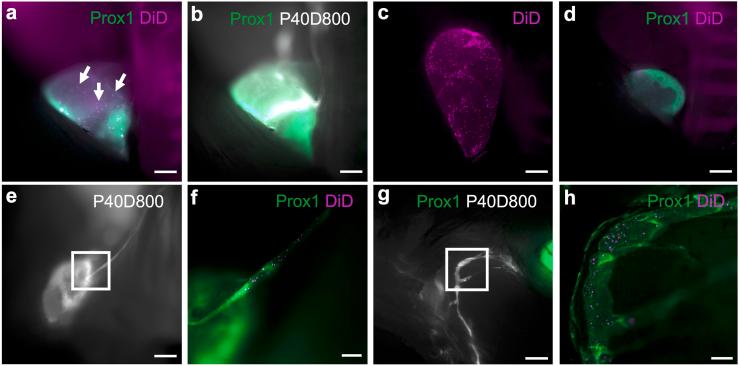
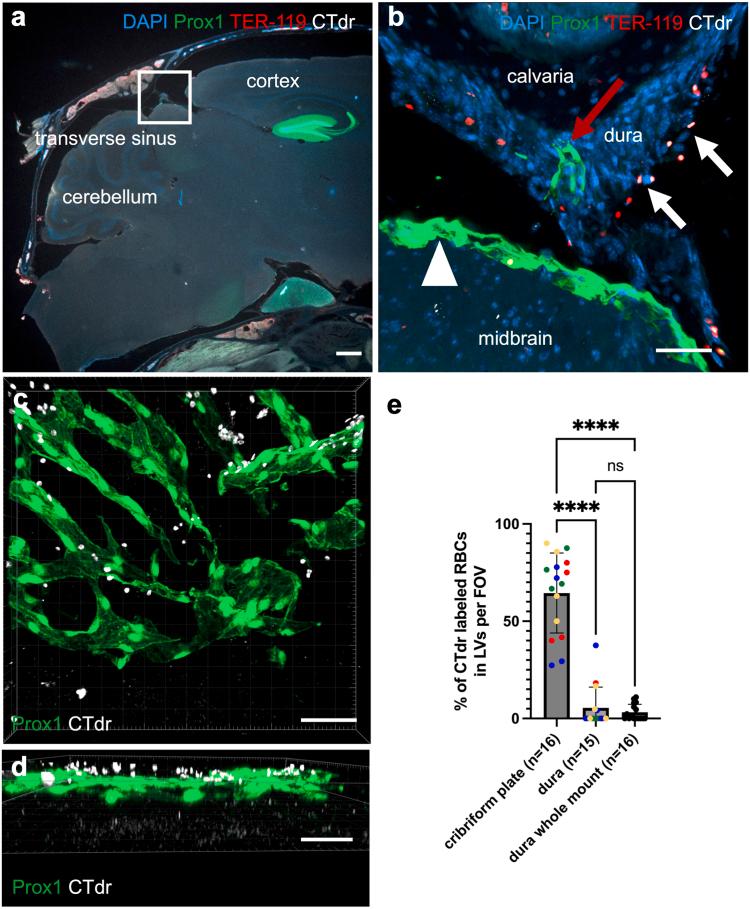
RBCs drained to the deep cervical lymph nodes 15 min post i.c.m. infusion, showing similar dynamics as P40D800 tracer. Postmortem in situ imaging and histology showed perineural accumulations of RBCs around the optic and olfactory nerves. Numerous RBCs cleared through the lymphatics of the cribriform plate, whilst histology showed no relevant fast RBC clearance through dorsal dural lymphatics or by tissue-resident macrophage-mediated phagocytosis.
INTERPRETATION
This study provides evidence for rapid RBC drainage through the cribriform plate lymphatic vessels, whilst neither fast RBC clearance through dorsal dural lymphatics nor through spinal CSF efflux or phagocytosis was observed. Similar dynamics of P40D800 and RBCs imply open pathways for clearance that do not impose a barrier for RBCs. This finding suggests further evaluation of the cribriform plate lymphatic function and potential pharmacological targeting in models of SAH.
FUNDING
Swiss National Science Foundation (310030_189226), SwissHeart (FF191155).
背景
非创伤性蛛网膜下腔出血(SAH)与高发病率和死亡率相关。红细胞(RBC)从蛛网膜下腔(SAS)清除的机制包括红细胞溶解、红细胞吞噬或通过沿脑脊液(CSF)引流途径的流出。我们旨在阐明 RBC 从 SAS 清除的机制,以确定可靶向的流出途径。
方法
通过枕骨大孔(i.c.m.)向雌性报告小鼠体内注入自体荧光标记 RBC 与聚乙二醇化 40 kDa 近红外示踪剂(P40D800),用于淋巴管或驻留吞噬细胞。通过体内和原位近红外成像以及对脱钙颅骨组织或硬脑膜全层的免疫荧光染色,评估 RBC 向颅外淋巴管的引流途径。
发现
RBC 在 i.c.m. 输注后 15 分钟引流到深部颈淋巴结,其动力学与 P40D800 示踪剂相似。死后原位成像和组织学显示 RBC 沿视神经和嗅神经周围的神经周围积聚。大量 RBC 通过筛板的淋巴管清除,而组织学显示没有通过背侧硬脑膜淋巴管或组织驻留巨噬细胞介导的吞噬作用进行相关的快速 RBC 清除。
解释
这项研究提供了证据表明 RBC 通过筛板淋巴管快速引流,而没有观察到快速通过背侧硬脑膜淋巴管或通过脊髓 CSF 流出或吞噬作用的 RBC 清除。P40D800 和 RBC 的相似动力学表明清除途径是开放的,不会对 RBC 造成障碍。这一发现表明,在 SAH 模型中进一步评估筛板淋巴管功能和潜在的药物靶向治疗。
资金
瑞士国家科学基金会(310030_189226),瑞士心脏(FF191155)。


 Zotero 插件