
身体活动水平与中国中老年人群糖尿病发病的关系:来自中国健康与养老追踪调查的一项横断面研究。
Association between physical activity level and diabetes incidence among Chinese middle-aged and older adults: a cross-sectional study from the China health and retirement longitudinal study.
机构信息
China Basketball College, Beijing Sport University, Beijing, China.
School of Strength and Conditioning, Beijing Sport University, Beijing, China.
出版信息
Front Public Health. 2024 Aug 9;12:1430229. doi: 10.3389/fpubh.2024.1430229. eCollection 2024.
BACKGROUND
It has been shown that diabetes is associated with insufficient physical activity among middle-aged and older adults, but the association between different physical activity levels (PAL) and diabetes incidence needs to be further explored.
OBJECTIVE
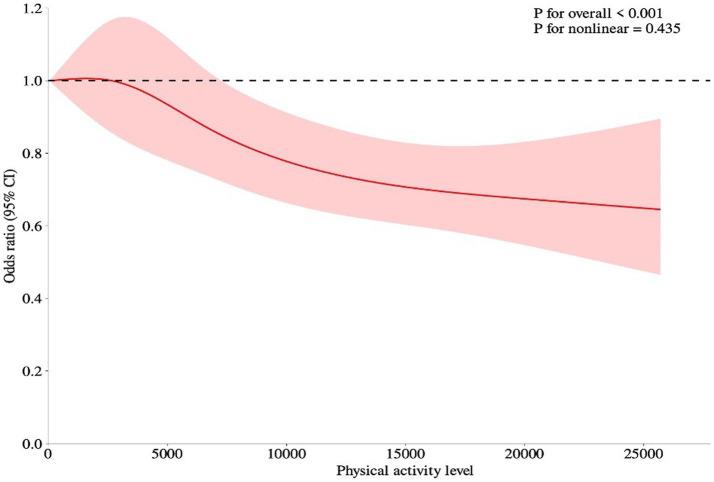
This study aims to explore the correlation and dose-response relationship between different PAL and the diabetes incidence in middle-aged and older adults.
METHODS
Utilizing data from the 2018 China Health and Retirement Longitudinal Study (CHARLS), this cross-sectional analysis included 17,226 middle-aged and older adults aged 45 and above. Binary logistic regression models and restricted cubic spline (RCS) were used to explore the correlation and dose-response relationship between different PAL and the incidence of diabetes in the total middle-aged and older adults population as well as in subgroups. Sensitivity analyses were also performed to verify the robustness of the findings.
RESULTS
In the entire study population, compared with the lowest PAL, participants in the third and fourth quartiles PAL saw diabetes incidence significantly reduced by 16% ( = 0.005) and 33% ( < 0.001), respectively ( < 0.001). In subgroup analyses, the fourth quartile PAL significantly reduced the diabetes incidence among females, individuals aged 60-69, and rural residents by 25% ( = 0.011), 38% ( < 0.001) and 28% ( < 0.001), respectively. For males, middle-aged (45-59 years), and urban residents, the third quartile PAL reduced diabetes incidence by 22% ( = 0.004), 24% ( = 0.012), 21% ( = 0.013), respectively. When the fourth quartile PAL was reached, the diabetes incidence was significantly reduced in these populations by 41% ( < 0.001), 39% ( < 0.001), and 41% ( < 0.001), respectively. There was a negative dose-response relationship between physical activity and diabetes incidence in specific Chinese middle-aged and older adults population. In addition, sensitivity analyses indicated the robustness of the findings.
CONCLUSION
Higher PAL was associated with lower diabetes incidence in specific Chinese middle-aged and older adults population. It is feasible to use physical activity to predict diabetes incidence in this demographic, and high PAL may be an effective means of preventing and controlling diabetes.
背景
研究表明,糖尿病与中年和老年人身体活动不足有关,但不同身体活动水平(PAL)与糖尿病发病率之间的关联仍需进一步探讨。
目的
本研究旨在探讨不同 PAL 与中年和老年人糖尿病发病率之间的相关性和剂量反应关系。
方法
利用 2018 年中国健康与退休纵向研究(CHARLS)的数据,本横断面分析纳入了 17226 名 45 岁及以上的中年和老年人。采用二元逻辑回归模型和限制立方样条(RCS)探索不同 PAL 与总体中年和老年人群以及亚组中糖尿病发病率之间的相关性和剂量反应关系。还进行了敏感性分析以验证研究结果的稳健性。
结果
在整个研究人群中,与最低 PAL 相比,第三和第四四分位 PAL 的参与者糖尿病发病率分别显著降低 16%( = 0.005)和 33%( < 0.001)( < 0.001)。在亚组分析中,第四四分位 PAL 显著降低了女性、60-69 岁人群和农村居民的糖尿病发病率,分别降低了 25%( = 0.011)、38%( < 0.001)和 28%( < 0.001)。对于男性、中年(45-59 岁)和城市居民,第三四分位 PAL 分别降低了 22%( = 0.004)、24%( = 0.012)和 21%( = 0.013)的糖尿病发病率。当达到第四四分位 PAL 时,这些人群的糖尿病发病率分别显著降低了 41%( < 0.001)、39%( < 0.001)和 41%( < 0.001)。身体活动与糖尿病发病率之间存在负相关关系。此外,敏感性分析表明研究结果稳健。
结论
较高的 PAL 与特定中国中年和老年人人群中较低的糖尿病发病率相关。在这一人群中,使用身体活动来预测糖尿病发病率是可行的,较高的 PAL 可能是预防和控制糖尿病的有效手段。
 Zotero 插件