
手术后或创伤后新的持续性阿片类药物使用相关结局:一项基于人群的队列研究。
Outcomes Related to New Persistent Opioid Use After Surgery or Trauma: A Population-based Cohort Study.
作者信息
Gong Jiayi, Jones Peter, Beyene Kebede, Frampton Chris, Chan Amy Hai Yan
机构信息
School of Pharmacy, The University of Auckland Faculty of Medical and Health Sciences, Auckland, New Zealand.
Department of Surgery, The University of Auckland Faculty of Medical and Health Sciences, Auckland, New Zealand.
出版信息
Ann Surg. 2025 Mar 1;281(3):354-360. doi: 10.1097/SLA.0000000000006509. Epub 2024 Aug 27.
OBJECTIVES
To evaluate the impact of persistent opioid use (POU) following surgery or trauma on health outcomes using linked data.
BACKGROUND
Surgery and trauma can lead to POU, characterized by continuous opioid consumption following hospital discharge. Outside the United States, there is a lack of population-based studies on POU outcomes in opioid-naive patients following these events.
METHODS
We included opioid-naïve patients who have dispensed opioids after being discharged following admission for surgery or trauma to any New Zealand (NZ) hospital from 2007 to 2019. Differences in outcomes between individuals with and without POU were assessed between 180 and 360 days after discharge. The primary outcome was all-cause mortality, the secondary outcomes were all-cause and opioid-related hospitalization, and Days Alive and Out of Hospital (DAOH). Cox and quantile multivariable regression models were used to examine the association between POU and outcomes.
RESULTS
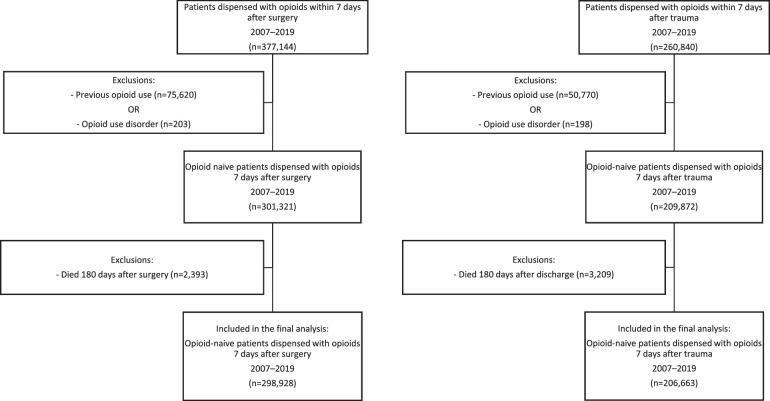
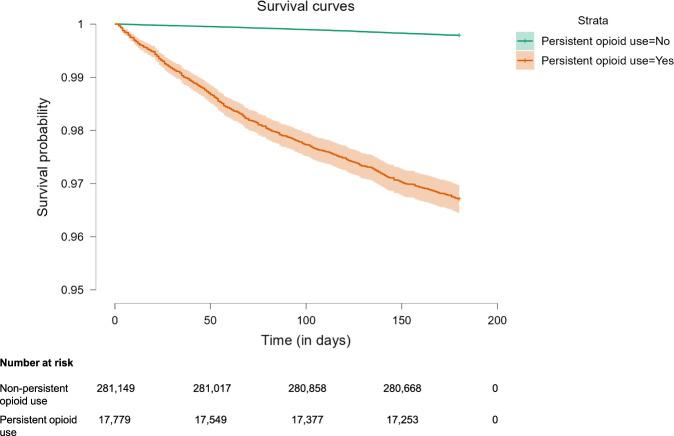
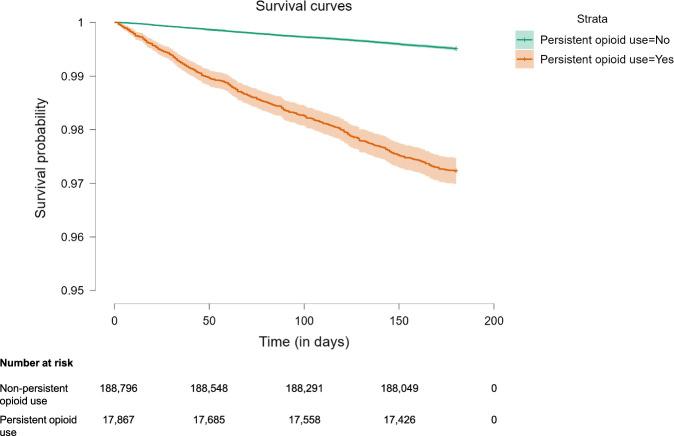
Overall, 298,928 surgical and 206,663 trauma patients were included in the final analyses, and 17,779 (5.9%) surgical and 17,867 (8.6%) trauma patients developed POU. POU was significantly associated with increased risk of all-cause mortality (surgical, aHR=6.59; 95% CI: 5.82-7.46; trauma, aHR=2.77; 95% CI: 2.47-3.11), all-cause hospitalization (surgical, aHR=2.02; 95% CI: 1.95-2.08; trauma, aHR=1.57; 95% CI: 1.52-1.62), opioid-related hospitalization (surgical, aHR=2.49; 95% CI: 2.24-2.76; trauma, aHR=1.89; 95% CI: 1.73-2.05) and reduced DAOH.
CONCLUSIONS
Among opioid-naive patients who received opioids after surgery or trauma, POU was associated with worse outcomes, including increased mortality. Further investigation is warranted to understand the reasons for continued opioid use beyond 90 days and mechanisms associated with harm.
目的
利用关联数据评估手术或创伤后持续使用阿片类药物(POU)对健康结局的影响。
背景
手术和创伤可导致POU,其特征为出院后持续使用阿片类药物。在美国以外地区,缺乏关于这些事件后未使用过阿片类药物的患者POU结局的基于人群的研究。
方法
我们纳入了2007年至2019年期间因手术或创伤入住任何新西兰(NZ)医院后出院并已配用阿片类药物的未使用过阿片类药物的患者。在出院后180至360天评估有POU和无POU个体之间的结局差异。主要结局是全因死亡率,次要结局是全因和阿片类药物相关住院率以及存活且未住院天数(DAOH)。使用Cox和分位数多变量回归模型来检验POU与结局之间的关联。
结果
总体而言,最终分析纳入了298,928例手术患者和206,663例创伤患者,其中17,779例(5.9%)手术患者和17,867例(8.6%)创伤患者出现了POU。POU与全因死亡率增加(手术患者,调整后风险比[aHR]=6.59;95%置信区间[CI]:5.82-7.46;创伤患者,aHR=2.77;95%CI:2.47-3.11)、全因住院率增加(手术患者,aHR=2.02;95%CI:1.95-2.08;创伤患者,aHR=1.57;95%CI:1.52-1.62)、阿片类药物相关住院率增加(手术患者,aHR=2.49;95%CI:2.24-2.76;创伤患者,aHR=1.89;95%CI:1.73-2.05)以及DAOH降低显著相关。
结论
在手术或创伤后使用阿片类药物的未使用过阿片类药物的患者中,POU与更差的结局相关,包括死亡率增加。有必要进一步调查以了解术后90天以上持续使用阿片类药物的原因以及与危害相关的机制。
 Zotero 插件