
孕期母体免疫反应与神经发育结局:一项纵向研究方法
Maternal immune response during pregnancy and neurodevelopmental outcomes: A longitudinal approach.
作者信息
Euclydes Veronica, Braga Caio I S, Gouveia Gisele, Martinez Raquel C R, Camilo Caroline, Simões Sergio N, Martins-Jr David C, Fracolli Lislaine, Argeu Adriana, Ferraro Alexandre, Matijasevich Alicia, Fatori Daniel, Miguel Euripedes C, Polanczyk Guilherme V, Brentani Helena
机构信息
Instituto e Departamento de Psiquiatria, Faculdade de Medicina FMUSP, LIM/23, Universidade de Sao Paulo, Sao Paulo, SP, Brazil.
Center for Mathematics, Computation and Cognition, Federal University of ABC (UFABC), Santo André, SP, Brazil.
出版信息
Brain Behav Immun Health. 2024 Aug 3;40:100832. doi: 10.1016/j.bbih.2024.100832. eCollection 2024 Oct.
BACKGROUND AND OBJECTIVES
The neurodevelopment of the offspring is suggested to be influenced by the maternal immune system's responses throughout pregnancy, which in turn is also vulnerable to maternal psychosocial stress conditions. Therefore, our main goal was to investigate whether maternal peripheral immunological biomarkers (IB) during two stages of gestation are associated with distinct neurodevelopmental trajectories in the first two years of life. As a second goal, we also explored the association between maternal distal (childhood) and proximal (gestation) stressful experiences and the immunological markers assessed during pregnancy.
METHODS
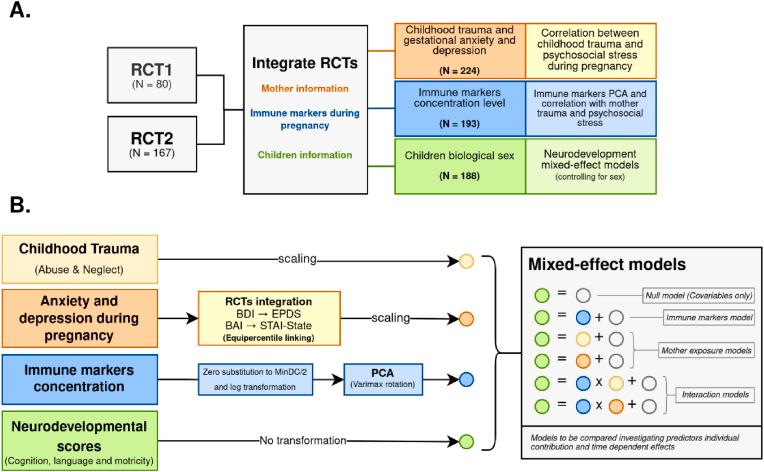
Maternal childhood trauma, depressive and anxiety symptoms, and peripheral IB (IFNγ, IL-10, IL1β, IL6, IL8, TNFα, EGF, IL13, IL17, IL1Ra and IL4) were measured at baseline (8-16 weeks of pregnancy) and at 30 weeks of pregnancy in 160 women. The participants had the blood samples collected from two randomized clinical trials conducted by the same team and methods in the same community. A Principal Component Analysis (PCA) was implemented to create meaningful composite variables that describe the cytokines joint variation. Finally, linear mixed-effects modeling was used to investigate the influence of inflammatory biomarkers, maternal childhood trauma, anxiety, and depressive symptoms on Bayley's III scores trajectories.
RESULTS
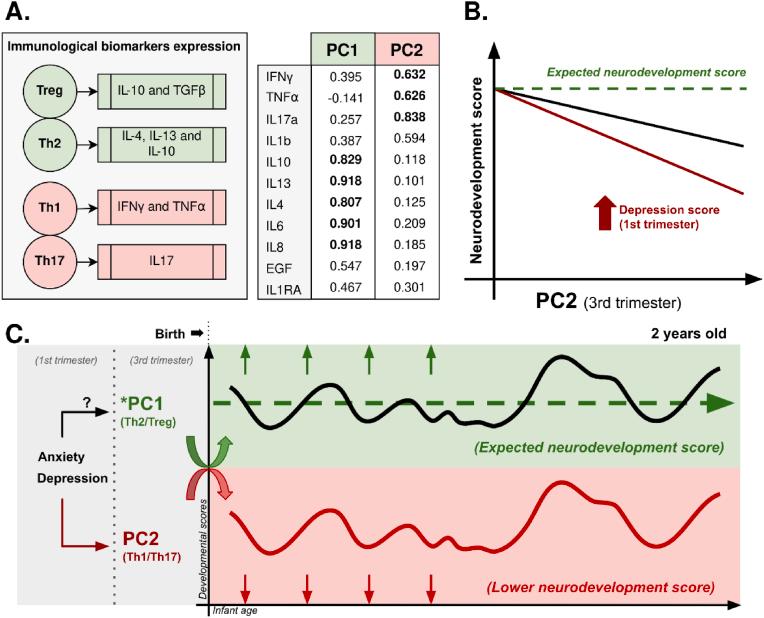
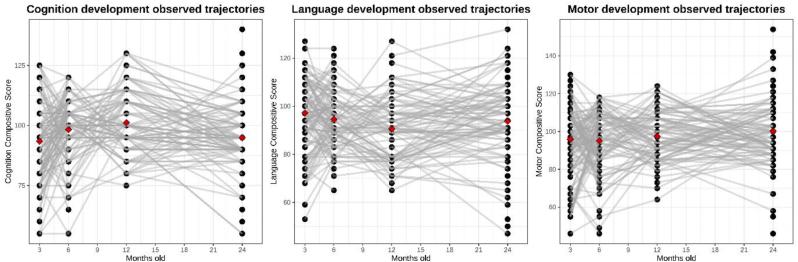
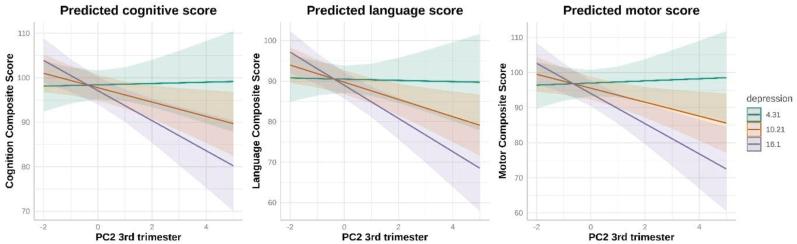
The IB profile during the 3rd trimester of pregnancy predicted the offspring's neurodevelopmental trajectories in the first two years of life. The components derived from PCA were important predictors and captured different immune responses, reflecting both pro- and anti-inflammatory states. Maternal stressful experiences did not correlate with the immunological markers. Although not a reliable predictor alone, maternal psychosocial stress at the 1st trimester of pregnancy interacted with the mother's immune response while predicting the neurodevelopmental scores during the first two years of life.
CONCLUSIONS
Our results underscore the importance of the maternal immune response during pregnancy in shaping the neurodevelopmental trajectory of the offspring. Additionally, we observed that the maternal distress at the early stages of pregnancy has an incremental effect on the neurodevelopmental outcome but depends upon the immune response.
背景与目的
研究表明,孕期母亲免疫系统的反应会影响后代的神经发育,而母亲的心理社会应激状况也会对其产生影响。因此,我们的主要目标是调查孕期两个阶段母亲外周免疫生物标志物(IB)是否与生命最初两年不同的神经发育轨迹相关。作为第二个目标,我们还探讨了母亲童年期(远期)和孕期(近期)应激经历与孕期评估的免疫标志物之间的关联。
方法
对160名女性在基线期(妊娠8 - 16周)和妊娠30周时测量其童年期创伤、抑郁和焦虑症状以及外周IB(IFNγ、IL - 10、IL1β、IL6、IL8、TNFα、EGF、IL13、IL17、IL1Ra和IL4)。参与者的血样来自同一团队在同一社区采用相同方法进行的两项随机临床试验。实施主成分分析(PCA)以创建描述细胞因子联合变化的有意义的复合变量。最后,使用线性混合效应模型研究炎症生物标志物、母亲童年期创伤、焦虑和抑郁症状对贝利婴幼儿发育量表第三版(Bayley's III)评分轨迹的影响。
结果
妊娠晚期的IB谱可预测后代生命最初两年的神经发育轨迹。PCA得出的成分是重要的预测因子,可捕捉不同的免疫反应,反映促炎和抗炎状态。母亲的应激经历与免疫标志物无相关性。虽然妊娠早期母亲的心理社会应激单独不是一个可靠的预测因子,但在预测生命最初两年的神经发育评分时,它与母亲的免疫反应相互作用。
结论
我们的结果强调了孕期母亲免疫反应在塑造后代神经发育轨迹中的重要性。此外,我们观察到妊娠早期母亲的困扰对神经发育结果有累加效应,但这取决于免疫反应。
 Zotero 插件