
波罗的海北部季节性冰层中的微塑料颗粒和纤维。
Microplastic Particles and Fibers in Seasonal Ice of the Northern Baltic Sea.
作者信息
Reineccius Janika, Heck Mareike, Waniek Joanna J
机构信息
Leibniz Institute for Baltic Sea Research, Warnemünde, Seestraße 15, 18119 Rostock, Germany.
Institute of Biosciences, University of Rostock, Albert-Einstein-Straße 3, 18059 Rostock, Germany.
出版信息
Toxics. 2024 Jul 26;12(8):542. doi: 10.3390/toxics12080542.
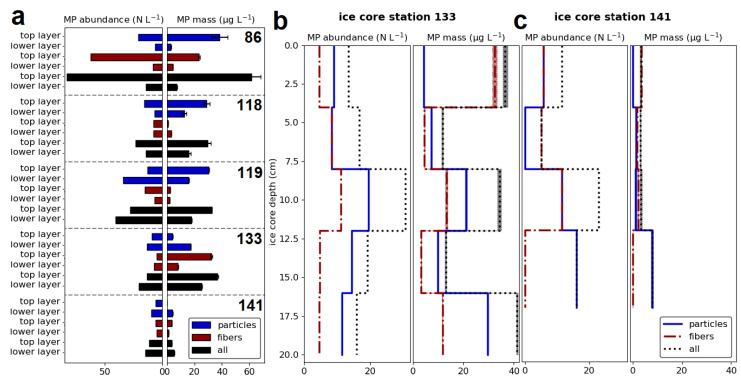
Microplastic pollution is a pervasive issue, with remarkably high concentrations observed even in the most remote locations such as Arctic sea ice and snow. The reason for such large microplastic abundances in sea ice is still speculative and applies mainly to saline or freshwater conditions. In this study, we investigated seasonal ice core samples collected in March 2021 from the northern Baltic Sea (Gulf of Bothnia) for their microplastic distributions. The Baltic Sea is characterized by low salinity and can be ice-covered for up to six months annually. Microplastics were analyzed in the melted ice samples using an adsorption technique and Raman microscopy to identify their abundances, colors, shapes, and sizes to calculate their masses. Due to the strong dynamic of the ice layer and the repeated melting and freezing processes during the ice formation, no discernible trends in microplastic abundances, masses, or polymer types were observed throughout the ice core length. The average microplastic abundance (±SD) in the Baltic Sea ice was determined to be 22.3 ± 8.6 N L, with 64.9% of the particles exhibiting a particulate shape and 35.1% having a fibrous shape. The most prevalent polymer type was polyethylene terephthalate (PET), accounting for 44.4% of all polymers. This is likely due to the high proportion of PET fibers (93.8%). The majority of particle-shaped microplastics were identified as polyethylene (PE; 37.2%), followed by PET (17.2%), polyvinyl chloride (PVC; 15.9%), and polypropylene (PP; 15.9%). No correlations were found between microplastic concentrations and proximity to land, cities, industries, or rivers, except for PP mass concentrations and particle sizes, which correlated with distances to industries in Luleå, Sweden.
微塑料污染是一个普遍存在的问题,即使在北极海冰和积雪等最偏远的地区,也观察到了极高的浓度。海冰中微塑料含量如此之高的原因仍具有推测性,主要适用于咸水或淡水环境。在本研究中,我们调查了2021年3月从波罗的海北部(波的尼亚湾)采集的季节性冰芯样本中的微塑料分布情况。波罗的海的特点是盐度低,每年有长达六个月的时间被冰层覆盖。使用吸附技术和拉曼显微镜对融化后的冰样中的微塑料进行分析,以确定其丰度、颜色、形状和大小,从而计算其质量。由于冰层的强烈动态变化以及结冰过程中反复的融化和冻结过程,在整个冰芯长度上未观察到微塑料丰度、质量或聚合物类型的明显趋势。波罗的海冰中微塑料的平均丰度(±标准差)为22.3±8.6个/升,其中64.9%的颗粒呈颗粒状,35.1%呈纤维状。最常见的聚合物类型是聚对苯二甲酸乙二酯(PET),占所有聚合物的44.4%。这可能是由于PET纤维的比例很高(93.8%)。大多数颗粒状微塑料被鉴定为聚乙烯(PE;37.2%),其次是PET(17.2%)、聚氯乙烯(PVC;15.9%)和聚丙烯(PP;15.9%)。除了PP的质量浓度和粒径与瑞典吕勒奥的工业距离相关外,未发现微塑料浓度与靠近陆地、城市、工业或河流之间存在相关性。


 Zotero 插件