
产后抑郁症的神经生物学见解与临床生物标志物的关联:综述。
Bridging Neurobiological Insights and Clinical Biomarkers in Postpartum Depression: A Narrative Review.
机构信息
Department of Anatomy, School of Medicine, Shenzhen Campus of Sun Yat-sen University, Sun Yat-sen University, Shenzhen 518107, China.
Department of Anesthesiology, Pharmacology, Physiology & Neuroscience, Rutgers, The State University of New Jersey, New Jersey Medical School, Newark, NJ 07103, USA.
出版信息
Int J Mol Sci. 2024 Aug 14;25(16):8835. doi: 10.3390/ijms25168835.
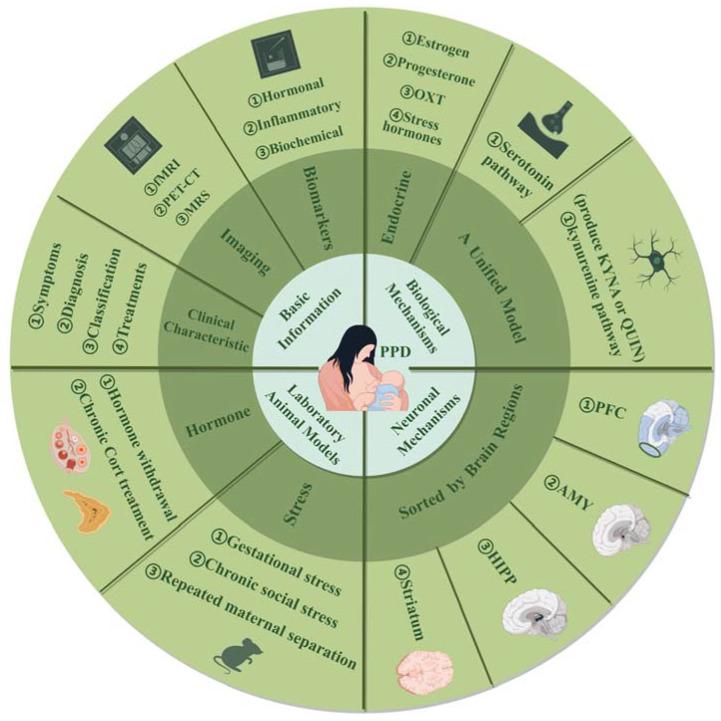
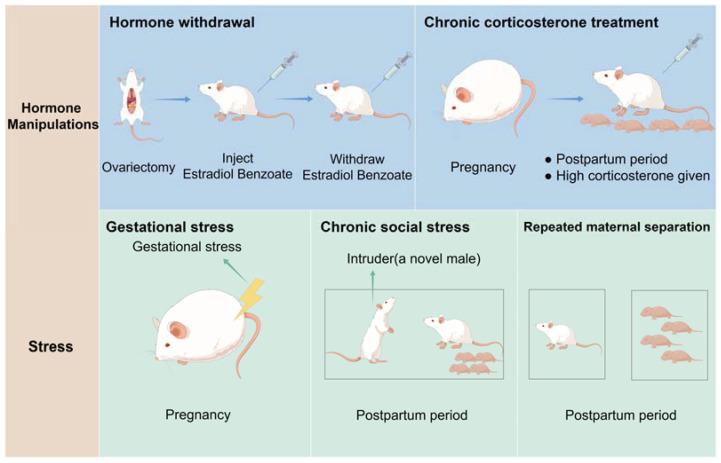
Postpartum depression (PPD) affects 174 million women worldwide and is characterized by profound sadness, anxiety, irritability, and debilitating fatigue, which disrupt maternal caregiving and the mother-infant relationship. Limited pharmacological interventions are currently available. Our understanding of the neurobiological pathophysiology of PPD remains incomplete, potentially hindering the development of novel treatment strategies. Recent hypotheses suggest that PPD is driven by a complex interplay of hormonal changes, neurotransmitter imbalances, inflammation, genetic factors, psychosocial stressors, and hypothalamic-pituitary-adrenal (HPA) axis dysregulation. This narrative review examines recent clinical studies on PPD within the past 15 years, emphasizing advancements in neuroimaging findings and blood biomarker detection. Additionally, we summarize recent laboratory work using animal models to mimic PPD, focusing on hormone withdrawal, HPA axis dysfunction, and perinatal stress theories. We also revisit neurobiological results from several brain regions associated with negative emotions, such as the amygdala, prefrontal cortex, hippocampus, and striatum. These insights aim to improve our understanding of PPD's neurobiological mechanisms, guiding future research for better early detection, prevention, and personalized treatment strategies for women affected by PPD and their families.
产后抑郁症(PPD)影响着全球 1.74 亿女性,其特征为严重的悲伤、焦虑、易怒和使人虚弱的疲劳,这些会扰乱母婴护理和母婴关系。目前可用的药物干预措施有限。我们对 PPD 的神经生物学发病机制的理解仍然不完整,这可能会阻碍新的治疗策略的发展。最近的假说表明,PPD 是由激素变化、神经递质失衡、炎症、遗传因素、心理社会压力源和下丘脑-垂体-肾上腺(HPA)轴失调的复杂相互作用驱动的。本综述性研究回顾了过去 15 年内有关 PPD 的最新临床研究,强调了神经影像学发现和血液生物标志物检测方面的进展。此外,我们总结了最近使用动物模型模拟 PPD 的实验室工作,重点关注激素撤退、HPA 轴功能障碍和围产期应激理论。我们还重新审视了与负面情绪相关的几个大脑区域的神经生物学结果,如杏仁核、前额叶皮层、海马体和纹状体。这些见解旨在提高我们对 PPD 神经生物学机制的理解,为受 PPD 影响的女性及其家庭的更好的早期检测、预防和个性化治疗策略提供指导。
 Zotero 插件