
从农场到餐桌的健康威胁:产志贺毒素大肠杆菌在食品供应链各环节中的共栖及存在情况
A Health Threat from Farm to Fork: Shiga Toxin-Producing Co-Harboring and in Various Sources of the Food Supply Chain.
作者信息
Sarwar Ayesha, Aslam Bilal, Rasool Muhammad Hidayat, Bekhit Mounir M Salem, Sasanya James
机构信息
Institute of Microbiology, Government College University Faisalabad, Faisalabad 38000, Pakistan.
Department of Pharmaceutics, College of Pharmacy, King Saud University, P.O. Box 2457, Riyadh 11451, Saudi Arabia.
出版信息
Pathogens. 2024 Aug 6;13(8):659. doi: 10.3390/pathogens13080659.
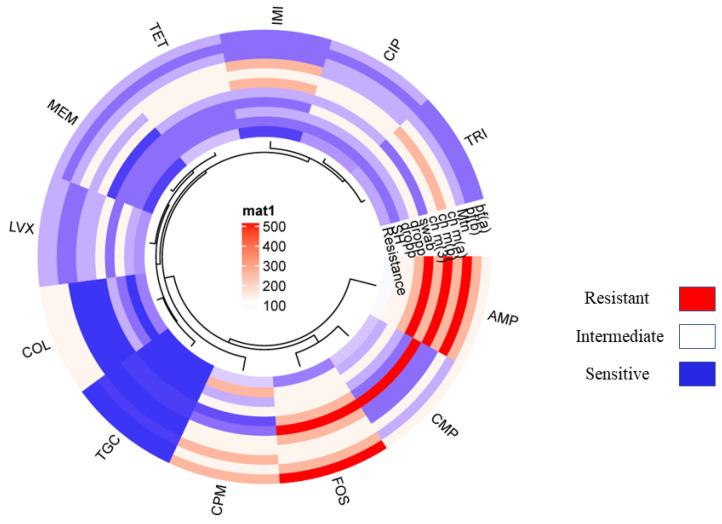
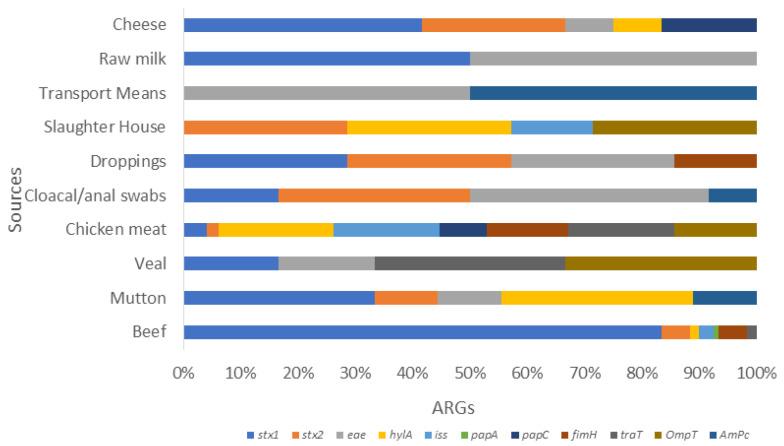
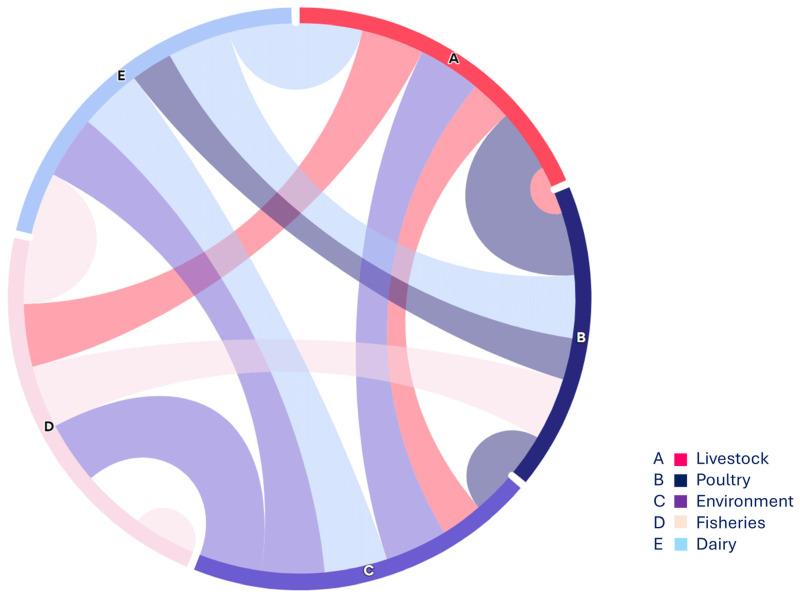
The dissemination of resistant pathogens through food supply chains poses a significant public health risk, spanning from farm to fork. This study analyzed the distribution of Shiga toxin-producing (STEC) across various sources within the animal-based food supply chain. A total of 500 samples were collected from livestock, poultry, the environment, fisheries, and dairy. Standard microbiological procedures were employed to isolate and identify isolates, which were further confirmed using MALDI-TOF and virulence-associated genes (VAGs) such as . The phenotypic resistance patterns of the isolates were determined using the disc diffusion method, followed by molecular identification of antibiotic resistance genes (ARGs) through PCR. STEC were subjected to PCR-based O typing using specific primers for different O types. Overall, 154 (30.5%) samples were confirmed as , of which 77 (50%) were multidrug-resistant (MDR) . Among these, 52 (67.53%) isolates exhibited an array of VAGs, and 21 (40.38%) were confirmed as STEC based on the presence of and . Additionally, 12 out of 52 (23.07%) isolates were identified as non-O157 STEC co-harbouring and . O26 STEC was found to be the most prevalent among the non-O157 types. The results suggest that the detection of STEC in food supply chains may lead to serious health consequences, particularly in developing countries with limited healthcare resources.
耐药病原体通过食品供应链传播构成了重大的公共卫生风险,从农场到餐桌都有涉及。本研究分析了产志贺毒素大肠杆菌(STEC)在动物性食品供应链中各种来源的分布情况。总共从家畜、家禽、环境、渔业和乳制品中采集了500个样本。采用标准微生物学程序分离和鉴定菌株,并用基质辅助激光解吸电离飞行时间质谱(MALDI-TOF)和诸如……等毒力相关基因(VAGs)进行进一步确认。使用纸片扩散法确定菌株的表型耐药模式,随后通过聚合酶链反应(PCR)对耐药基因(ARG)进行分子鉴定。使用针对不同O型的特异性引物对STEC进行基于PCR的O分型。总体而言,154个(30.5%)样本被确认为……,其中77个(50%)是多重耐药(MDR)……。在这些样本中,52个(67.53%)菌株表现出一系列VAGs,并且基于……和……的存在,21个(40.38%)被确认为STEC。此外,52个菌株中有12个(23.07%)被鉴定为同时携带……和……的非O157 STEC。发现O26 STEC在非O157类型中最为普遍。结果表明,在食品供应链中检测到STEC可能会导致严重的健康后果,特别是在医疗资源有限的发展中国家。


 Zotero 插件