
以更少的资源实现更多:高级人体活动识别的轻量级深度学习解决方案。
Achieving More with Less: A Lightweight Deep Learning Solution for Advanced Human Activity Recognition (HAR).
机构信息
Department of Computer Science, College of Computer and Information Sciences, King Saud University, P.O. Box 266, Riyadh 11362, Saudi Arabia.
出版信息
Sensors (Basel). 2024 Aug 22;24(16):5436. doi: 10.3390/s24165436.
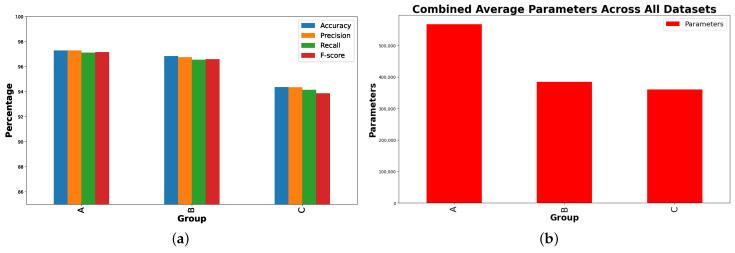
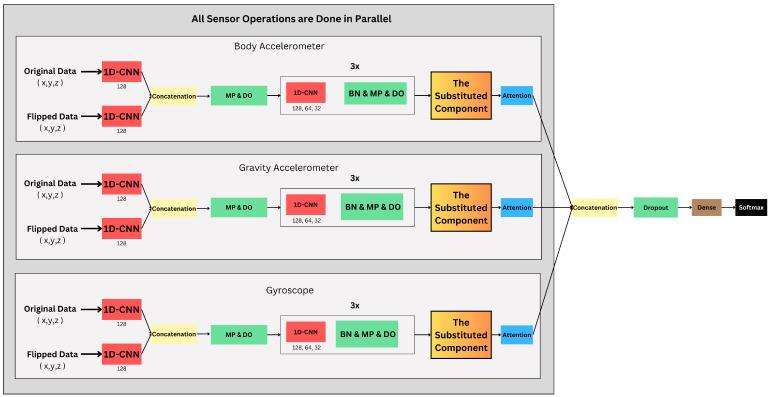
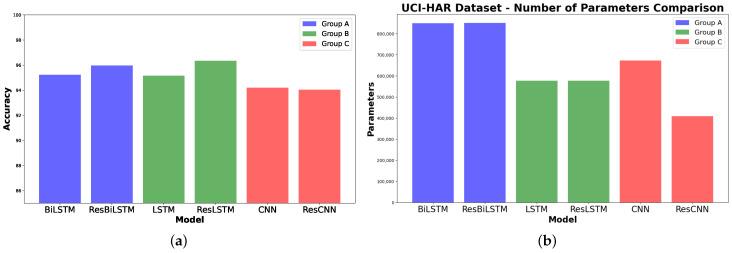
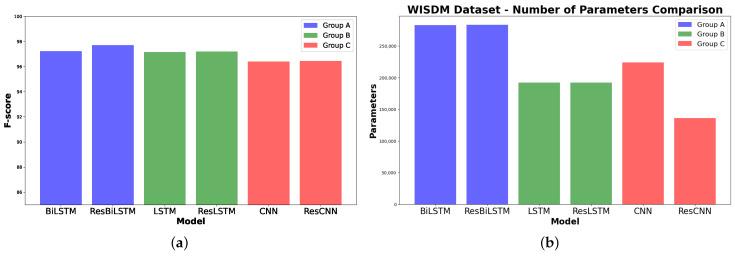
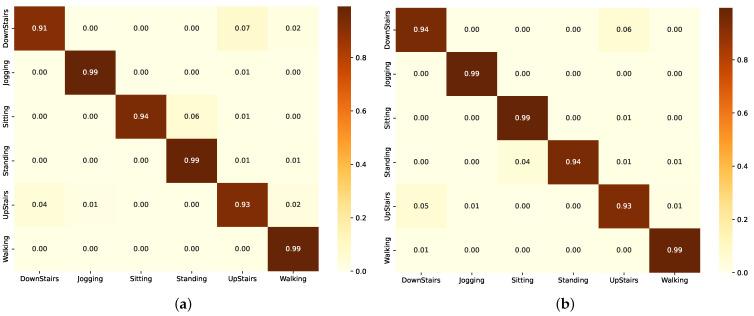
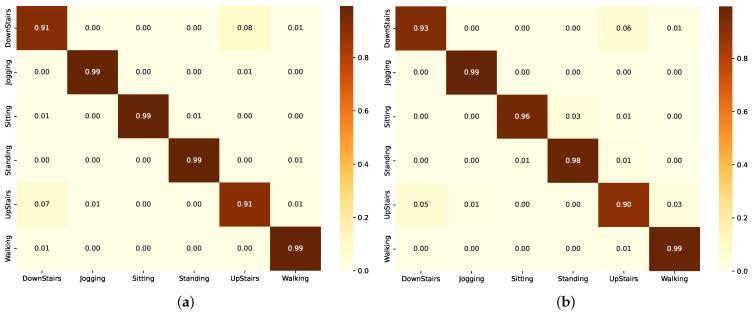
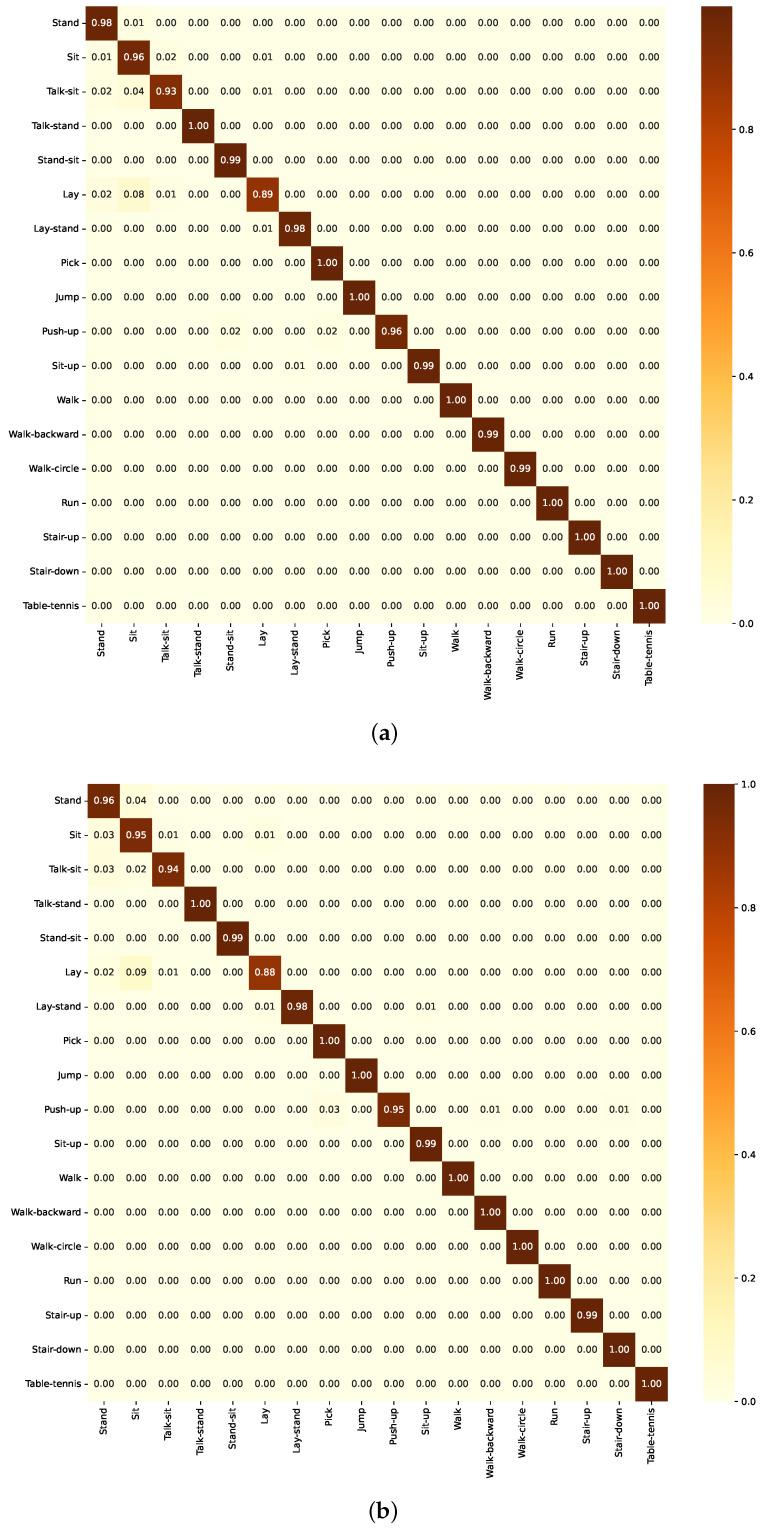
Human activity recognition (HAR) is a crucial task in various applications, including healthcare, fitness, and the military. Deep learning models have revolutionized HAR, however, their computational complexity, particularly those involving BiLSTMs, poses significant challenges for deployment on resource-constrained devices like smartphones. While BiLSTMs effectively capture long-term dependencies by processing inputs bidirectionally, their high parameter count and computational demands hinder practical applications in real-time HAR. This study investigates the approximation of the computationally intensive BiLSTM component in a HAR model by using a combination of alternative model components and data flipping augmentation. The proposed modifications to an existing hybrid model architecture replace the BiLSTM with standard and residual LSTM, along with convolutional networks, supplemented by data flipping augmentation to replicate the context awareness typically provided by BiLSTM networks. The results demonstrate that the residual LSTM (ResLSTM) model achieves superior performance while maintaining a lower computational complexity compared to the traditional BiLSTM model. Specifically, on the UCI-HAR dataset, the ResLSTM model attains an accuracy of 96.34% with 576,702 parameters, outperforming the BiLSTM model's accuracy of 95.22% with 849,534 parameters. On the WISDM dataset, the ResLSTM achieves an accuracy of 97.20% with 192,238 parameters, compared to the BiLSTM's 97.23% accuracy with 283,182 parameters, demonstrating a more efficient architecture with minimal performance trade-off. For the KU-HAR dataset, the ResLSTM model achieves an accuracy of 97.05% with 386,038 parameters, showing comparable performance to the BiLSTM model's 98.63% accuracy with 569,462 parameters, but with significantly fewer parameters.
人体活动识别(HAR)是各种应用中的一项关键任务,包括医疗保健、健身和军事。深度学习模型已经彻底改变了 HAR,但它们的计算复杂性,特别是涉及 BiLSTM 的复杂性,对在智能手机等资源受限的设备上进行部署构成了重大挑战。虽然 BiLSTM 通过双向处理输入有效地捕获长期依赖关系,但它们的高参数计数和计算需求阻碍了实时 HAR 中的实际应用。本研究通过使用替代模型组件和数据翻转增强来研究 HAR 模型中计算密集型 BiLSTM 组件的近似。对现有混合模型架构的修改用标准和残差 LSTM 以及卷积网络代替 BiLSTM,并通过数据翻转增强来复制 BiLSTM 网络通常提供的上下文意识。结果表明,残差 LSTM(ResLSTM)模型在保持较低计算复杂度的同时实现了比传统 BiLSTM 模型更好的性能。具体来说,在 UCI-HAR 数据集上,ResLSTM 模型的准确率为 96.34%,参数为 576702 个,优于 BiLSTM 模型的准确率为 95.22%,参数为 849534 个。在 WISDM 数据集上,ResLSTM 的准确率为 97.20%,参数为 192238 个,而 BiLSTM 的准确率为 97.23%,参数为 283182 个,证明了具有最小性能折衷的更高效架构。在 KU-HAR 数据集上,ResLSTM 模型的准确率为 97.05%,参数为 386038 个,与 BiLSTM 模型的准确率为 98.63%,参数为 569462 个相当,但参数要少得多。









 Zotero 插件