
巴基斯坦的健康保险、社会安全网和孕产妇保健服务利用情况:基于人群的横断面研究。
Health insurance, social safety net and maternal health service utilisation in Pakistan: a population based cross-sectional study.
机构信息
Applied Economics Research Centre, University of Karachi, Karachi, Sindh, Pakistan
School of Public Health, Dow University of Health Sciences, Karachi, Sindh, Pakistan.
出版信息
BMJ Open. 2024 Aug 28;14(8):e079646. doi: 10.1136/bmjopen-2023-079646.
OBJECTIVE
The objective of the study is to examine the impact of health insurance and social safety net programmes on maternal health service utilisation (MHSU) in Pakistan.
DESIGN
Cross-sectional.
SETTINGS
Data were obtained from Pakistan Demographic Health Survey 2017-2018.
PARTICIPANTS
Out of 12 364 Pakistani ever-married women aged 15-49 years included in the survey sample, 7752 were included in the study.
MAIN OUTCOME MEASURES
Three response variables (antenatal care (ANC) by skilled attendants (<4 visits=inadequate vs 4 or more visits=adequate), health facility-based delivery (home vs health) and postnatal care (yes vs no) were combined to assess MHSU. Health insurance was derived from the question 'are you covered with any health insurance?' and social safety net was derived from enrolment in social safety net programmes. Logistic regression analyses were conducted, and results were reported as ORs with 95% CIs. Results of adjusted logistic regression models were fit to control for individual and community-level factors.
RESULT
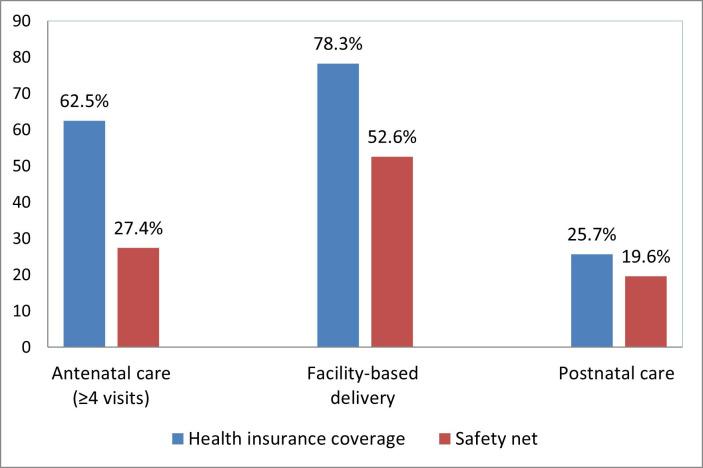
Prevalence of social safety net was larger than health insurance (7.7% vs 2.0%) while attendance of ANC+4, facility-based delivery and postnatal care was 48.5% (n=3760), 65.9% (n=5097) and 22.6% (n=1745) respectively, among respondents. Women were twice more likely to access maternal health services when they were covered by health insurance (adjusted OR 2.61, 95% CI 1.19 to 5.74, p<0.017) after adjusting for age at marriage, education level, wealth index, rural/urban area, parity, employment, empowerment status, exposure to media, visits and distance to health facility while no significant association of social safety net programmes with MHSU was found.
CONCLUSION
Expanding access to health insurance can provide comprehensive coverage for maternal healthcare services. Social safety net programmes can be made conditional, subject to regular health checkups for mothers and children to improve maternal and child health outcomes.
目的
本研究旨在探讨医疗保险和社会安全网计划对巴基斯坦产妇保健服务利用(MHSU)的影响。
设计
横断面研究。
设置
数据来自 2017-2018 年巴基斯坦人口健康调查。
参与者
在调查样本中,12364 名年龄在 15-49 岁的已婚巴基斯坦女性中,有 7752 名被纳入研究。
主要观察指标
三个因变量(由熟练医护人员进行的产前护理(ANC)(<4 次就诊=不足,≥4 次就诊=充分)、医疗机构分娩(家中分娩与医疗机构分娩)和产后护理(是与否)被合并用于评估 MHSU。医疗保险来自于问题“你是否参加了任何医疗保险?”,社会安全网来自于参加社会安全网计划的情况。进行了逻辑回归分析,并以 95%置信区间(CI)的比值比(OR)报告结果。调整后的逻辑回归模型的结果拟合用于控制个体和社区层面的因素。
结果
社会安全网的患病率大于医疗保险(7.7%比 2.0%),而 ANC+4、医疗机构分娩和产后护理的比例分别为 48.5%(n=3760)、65.9%(n=5097)和 22.6%(n=1745)。在调整了婚姻年龄、教育水平、财富指数、城乡地区、生育次数、就业状况、赋权状况、媒体接触、就诊次数和到卫生机构的距离等因素后,参加医疗保险的女性接受产妇保健服务的可能性是未参加者的两倍(调整后的 OR 2.61,95%CI 1.19 至 5.74,p<0.017)。而社会安全网计划与 MHSU 之间没有显著关联。
结论
扩大医疗保险的覆盖面可以为产妇保健服务提供全面保障。社会安全网计划可以附加条件,要求母亲和儿童定期进行健康检查,以改善母婴健康结果。
 Zotero 插件