
通过挖掘电子健康平台的数据来预测非正式痴呆症护理者的机构化意愿。
Predicting informal dementia caregivers' desire to institutionalize through mining data from an eHealth platform.
机构信息
Department of Behavioral Sciences, School of Medicine and Biomedical Sciences, University of Porto (ICBAS-UP), Rua de Jorge Viterbo Ferreira, 228, Porto, 4050-313, Portugal.
Center for Health Technology and Services Research at Health Research Network (CINTESIS@RISE), Rua Dr. Plácido da Costa, Porto, 4200-450, Portugal.
出版信息
BMC Geriatr. 2024 Aug 30;24(1):721. doi: 10.1186/s12877-024-05128-5.
BACKGROUND
Dementia is a leading factor in the institutionalization of older adults. Informal caregivers' desire to institutionalize (DI) their care recipient with dementia (PwD) is a primary predictor of institutionalization. This study aims to develop a prediction model for caregivers' DI by mining data from an eHealth platform in a high-prevalence dementia country.
METHODS
Cross-sectional data were collected from caregivers registering on isupport-portugal.pt. One hundred and four caregivers completed the Desire to Institutionalize Scale (DIS) and were grouped into DI (DIS score ≥ 1) and no DI (DIS score = 0). Participants completed a comprehensive set of sociodemographic, clinical, and psychosocial measures, pertaining to the caregiver and the PwD, which were accounted as model predictors. The selected model was a classification tree, enabling the visualization of rules for predictions.
RESULTS
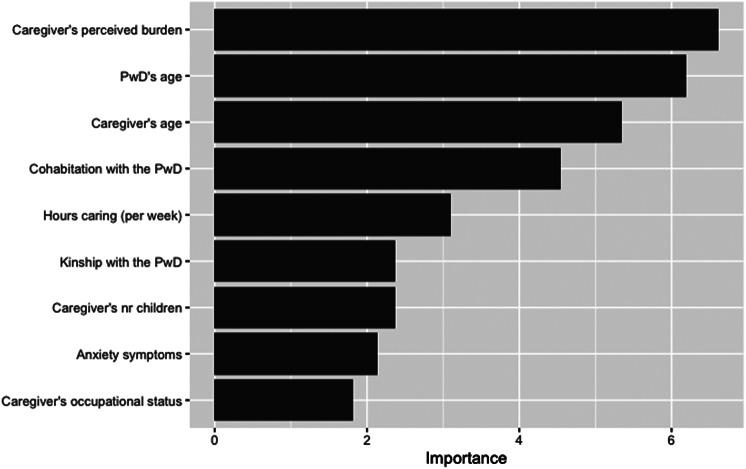
Caregivers, mostly female (82.5%), offspring of the PwD (70.2), employed (65.4%), and highly educated (M 15 years of schooling), provided intensive care (Mdn 24 h. week) over a median course of 2.8 years. Two-thirds (66.3%) endorsed at least one item on the DIS (DI group). The model, with caregivers' perceived stress as the root of the classification tree (split at 28.5 points on the Zarit Burden Interview) and including the ages of caregivers and PwD (split at 46 and 88 years, respectively), as well as cohabitation, employed five rules to predict DI. Caregivers scoring 28.5 and above on burden and caring for PwD under 88 are more prone to DI than those caring for older PwD (rules 1-2), suggesting the influence of expectations on caregiving duration. The model demonstrated high accuracy (0.83, 95%CI 0.75, 0.89), sensitivity (0.88, 95%CI 0.81, 0.95), and good specificity (0.71, 95%CI 0.56, 0.86).
CONCLUSIONS
This study distilled a comprehensive range of modifiable and non-modifiable variables into a simplified, interpretable, and accurate model, particularly useful at identifying caregivers with actual DI. Considering the nature of variables within the prediction rules, this model holds promise for application to other existing datasets and as a proxy for actual institutionalization. Predicting the institutional placement of PwD is crucial for intervening on modifiable factors as caregiver burden, and for care planning and financing.
背景
痴呆是导致老年人入院的主要因素。非专业照护者将其患有痴呆症(PwD)的照护对象送入院的愿望(DI)是入院的主要预测因素。本研究旨在通过挖掘高痴呆发病率国家电子健康平台的数据,为照护者的 DI 建立预测模型。
方法
从 isupport-portugal.pt 注册的照护者处收集横断面数据。104 名照护者完成了愿望量表(DIS),并根据得分分为 DI 组(DIS 得分≥1)和非 DI 组(DIS 得分=0)。参与者完成了一整套关于照护者和 PwD 的社会人口学、临床和心理社会措施,这些措施被视为模型预测因素。所选模型为分类树,可用于可视化预测规则。
结果
照护者主要为女性(82.5%),PwD 的子女(70.2%),有工作(65.4%),受教育程度高(平均 15 年教育年限),每周提供 24 小时的密集护理(Mdn),中位数病程为 2.8 年。三分之二(66.3%)的人对 DIS 至少有一个项目表示赞同(DI 组)。该模型以照护者的感知压力为分类树的根(Zarit 负担访谈中 28.5 分处分裂),包括照护者和 PwD 的年龄(分别在 46 岁和 88 岁处分裂)以及共同居住,用五个规则来预测 DI。负担得分 28.5 分及以上且照护者年龄在 88 岁以下的照护者比照护年龄较大的 PwD 的照护者更有可能选择 DI(规则 1-2),这表明期望对照护时间的影响。该模型具有较高的准确性(0.83,95%CI 0.75,0.89)、敏感性(0.88,95%CI 0.81,0.95)和较好的特异性(0.71,95%CI 0.56,0.86)。
结论
本研究将一系列可修改和不可修改的变量提炼成一个简单、可解释和准确的模型,特别适用于识别有实际 DI 意愿的照护者。考虑到预测规则中变量的性质,该模型有望应用于其他现有数据集,并作为实际入院的替代指标。预测 PwD 的入院对干预照护者负担等可修改因素以及照护计划和资金规划具有重要意义。


 Zotero 插件