
CycPeptMP:利用多层次分子特征和数据增强提高环状肽的膜通透性预测。
CycPeptMP: enhancing membrane permeability prediction of cyclic peptides with multi-level molecular features and data augmentation.
机构信息
Department of Computer Science, School of Computing, Tokyo Institute of Technology, Tokyo 1528550, Japan.
Middle-Molecule ITbased Drug Discovery Laboratory (MIDL), Tokyo Institute of Technology, Tokyo 1528550, Japan.
出版信息
Brief Bioinform. 2024 Jul 25;25(5). doi: 10.1093/bib/bbae417.
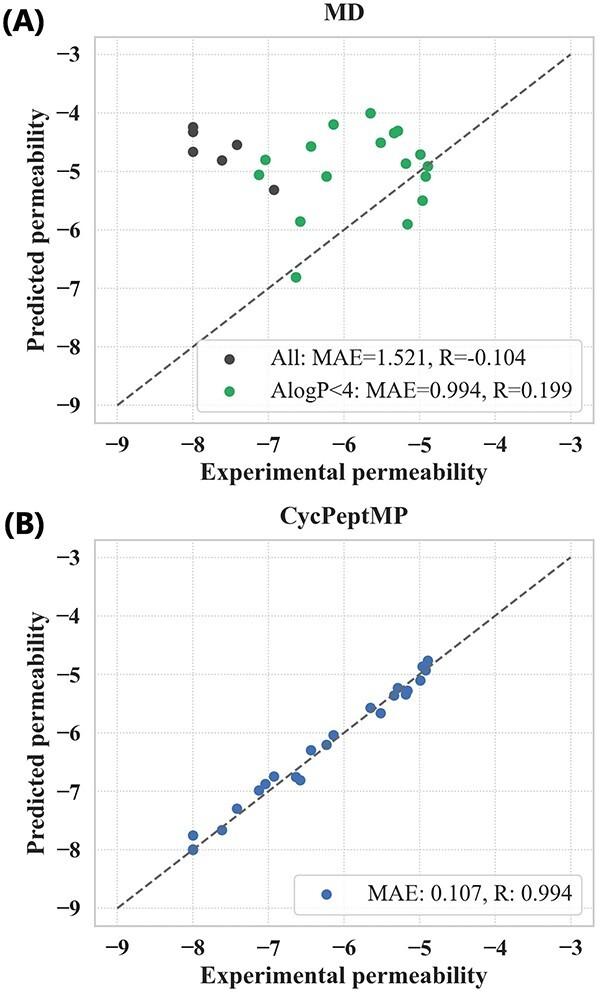
Cyclic peptides are versatile therapeutic agents that boast high binding affinity, minimal toxicity, and the potential to engage challenging protein targets. However, the pharmaceutical utility of cyclic peptides is limited by their low membrane permeability-an essential indicator of oral bioavailability and intracellular targeting. Current machine learning-based models of cyclic peptide permeability show variable performance owing to the limitations of experimental data. Furthermore, these methods use features derived from the whole molecule that have traditionally been used to predict small molecules and ignore the unique structural properties of cyclic peptides. This study presents CycPeptMP: an accurate and efficient method to predict cyclic peptide membrane permeability. We designed features for cyclic peptides at the atom-, monomer-, and peptide-levels and seamlessly integrated these into a fusion model using deep learning technology. Additionally, we applied various data augmentation techniques to enhance model training efficiency using the latest data. The fusion model exhibited excellent prediction performance for the logarithm of permeability, with a mean absolute error of $0.355$ and correlation coefficient of $0.883$. Ablation studies demonstrated that all feature levels contributed and were relatively essential to predicting membrane permeability, confirming the effectiveness of augmentation to improve prediction accuracy. A comparison with a molecular dynamics-based method showed that CycPeptMP accurately predicted peptide permeability, which is otherwise difficult to predict using simulations.
环状肽是一类用途广泛的治疗药物,具有高结合亲和力、低毒性以及与挑战性蛋白靶标结合的潜力。然而,环状肽的药物应用受到其低膜通透性的限制,而膜通透性是口服生物利用度和细胞内靶向性的重要指标。目前基于机器学习的环状肽通透性模型由于实验数据的限制,表现出不同的性能。此外,这些方法使用从整个分子中提取的特征来预测小分子,而忽略了环状肽的独特结构特性。本研究提出了一种预测环状肽膜通透性的准确且高效的方法:CycPeptMP。我们在原子、单体和肽水平上为环状肽设计了特征,并使用深度学习技术将这些特征无缝集成到融合模型中。此外,我们应用了各种数据增强技术,使用最新的数据提高模型训练效率。融合模型对通透性的对数值的预测表现出优异的性能,平均绝对误差为 0.355,相关系数为 0.883。消融研究表明,所有特征级别都有贡献,并且对预测膜通透性相对重要,这证实了增强的有效性可以提高预测准确性。与基于分子动力学的方法相比,CycPeptMP 可以准确预测肽的通透性,而使用模拟则很难预测。


 Zotero 插件