
基质结合和质子转运的变构偶联在. 中的 MmpL3 转运蛋白中
Allosteric coupling of substrate binding and proton translocation in MmpL3 transporter from .
机构信息
Department of Chemistry and Biochemistry, University of Oklahoma, Norman, Oklahoma, USA.
Mycobacteria Research Laboratories, Department of Microbiology, Immunology and Pathology, Colorado State University, Fort Collins, Colorado, USA.
出版信息
mBio. 2024 Oct 16;15(10):e0218324. doi: 10.1128/mbio.02183-24. Epub 2024 Aug 30.
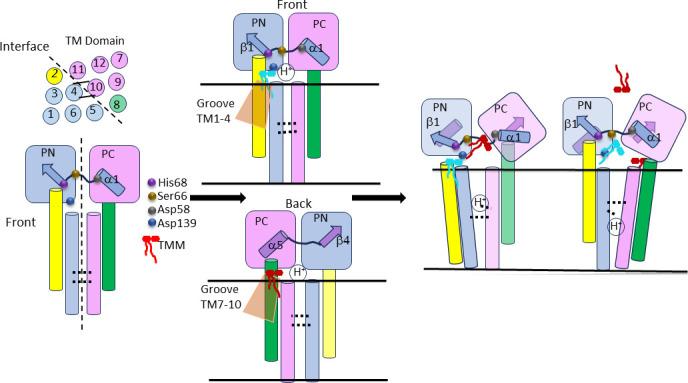
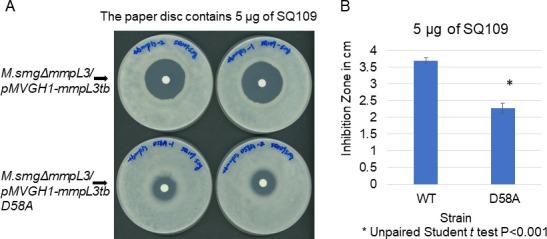
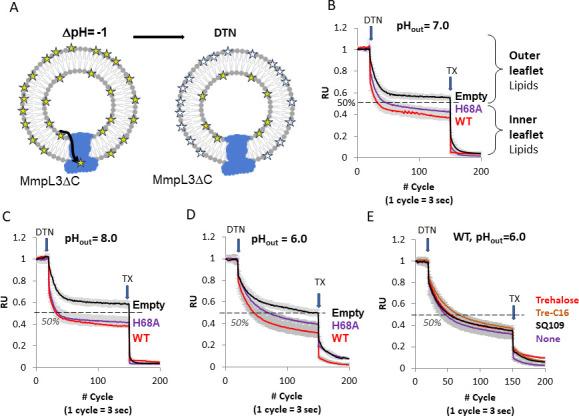
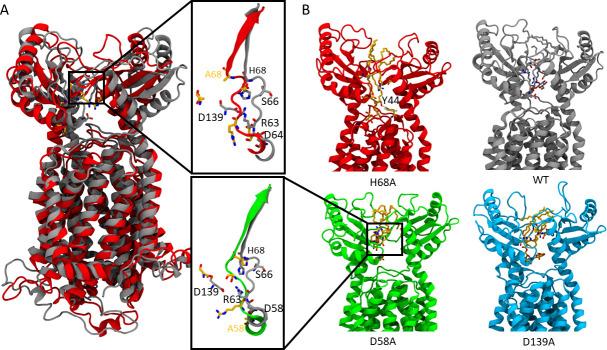
Infections caused by spp. are very challenging to treat, and multidrug-resistant strains rapidly spread in human populations. Major contributing factors include the unique physiological features of these bacteria, drug efflux, and the low permeability barrier of their outer membrane. Here, we focus on MmpL3 from , an essential inner membrane transporter of the resistance-nodulation-division superfamily required for the translocation of mycolic acids in the form of trehalose monomycolates (TMM) from the cytoplasm or plasma membrane to the periplasm or outer membrane. The MmpL3-dependent transport of TMM is essential for the growth of , inside macrophages, and in infected mice. MmpL3 is also a validated target for several recently identified anti-mycobacterial agents. In this study, we reconstituted the lipid transport activity of the purified MmpL3 using a two-lipid vesicle system and established the ability of MmpL3 to actively extract phospholipids from the outer leaflet of a lipid bilayer. In contrast, we found that MmpL3 lacks the ability to translocate the same phospholipid substrate across the plasma membrane indicating that it is not an energy-dependent flippase. The lipid extraction activity was modulated by substitutions in critical charged and polar residues of the periplasmic substrate-binding pocket of MmpL3, coupled to the proton transfer activity of MmpL3 and inhibited by a small molecule inhibitor SQ109. Based on the results, we propose a mechanism of allosteric coupling wherein substrate translocation by MmpL3 is coupled to the energy provided by the downhill transfer of protons. The reconstituted activities will facilitate understanding the mechanism of MmpL3-dependent transport of lipids and the discovery of new therapeutic options for spp. infections.IMPORTANCEMmpL3 from is an essential transporter involved in the assembly of the mycobacterial outer membrane. It is also an important target in undergoing efforts to discover new anti-tuberculosis drugs effective against multidrug-resistant strains spreading in human populations. The recent breakthrough structural studies uncovered features of MmpL3 that suggested a possible lipid transport mechanism. In this study, we reconstituted and characterized the lipid transport activity of MmpL3 and demonstrated that this activity is blocked by MmpL3 inhibitors and substrate mimics. We further uncovered the mechanism of how the binding of a substrate in the periplasmic domain is communicated to the transmembrane proton relay of MmpL3. The uncovered mechanism and the developed assays provide new opportunities for mechanistic analyses of MmpL3 function and its inhibition.
spp. 引起的感染非常难以治疗,并且多药耐药菌株在人类中迅速传播。主要促成因素包括这些细菌的独特生理特征、药物外排以及它们外膜的低通透性屏障。在这里,我们专注于 中的 MmpL3,它是抗性结节分裂超级家族的必需内膜转运蛋白,用于以海藻糖单酯(TMM)的形式将类脂酸从细胞质或质膜转运到周质或外膜。MmpL3 依赖的 TMM 转运对于 在巨噬细胞内和感染小鼠中的生长至关重要。MmpL3 也是最近发现的几种抗分枝杆菌药物的有效靶标。在这项研究中,我们使用双脂质囊泡系统重建了纯化的 MmpL3 的脂质转运活性,并确定了 MmpL3 从脂质双层的外叶主动提取磷脂的能力。相比之下,我们发现 MmpL3 缺乏跨质膜转运相同磷脂底物的能力,表明它不是能量依赖性的翻转酶。脂质提取活性可通过 MmpL3 周质底物结合口袋中的关键带电和极性残基的取代来调节,与 MmpL3 的质子转移活性偶联,并被小分子抑制剂 SQ109 抑制。基于这些结果,我们提出了一种变构偶联的机制,其中 MmpL3 的底物转运与质子的下坡转移提供的能量偶联。重建的活性将有助于理解 MmpL3 依赖的脂质转运机制,并为 spp. 感染的新治疗选择提供依据。
重要性:来自 的 MmpL3 是参与分枝杆菌外膜组装的必需转运蛋白。它也是正在进行的发现针对在人类中传播的多药耐药菌株有效的新型抗结核药物的努力中的重要靶标。最近的突破性结构研究揭示了 MmpL3 的一些特征,这些特征表明可能存在脂质转运机制。在这项研究中,我们重建并表征了 MmpL3 的脂质转运活性,并证明该活性被 MmpL3 抑制剂和底物类似物阻断。我们进一步揭示了周质域中底物结合如何与 MmpL3 的跨膜质子传递相沟通的机制。揭示的机制和开发的测定法为 MmpL3 功能及其抑制的机制分析提供了新的机会。


 Zotero 插件