Vanneste Thibaut, Belba Amy, Oei Gezina T M L, Emans Pieter, Fonkoue Loic, Kallewaard Jan Willem, Kapural Leonardo, Peng Philip, Sommer Michael, Vanneste Bert, Cohen Steven P, Van Zundert Jan
Department of Anesthesiology, Intensive Care Medicine, Emergency Medicine and Multidisciplinary Pain Center, Genk, Belgium.
Department of Anesthesiology and Pain Medicine, Maastricht University Medical Center+, Maastricht, The Netherlands.
Pain Pract. 2025 Jan;25(1):e13408. doi: 10.1111/papr.13408. Epub 2024 Sep 1.
Chronic knee pain is defined as pain that persists or recurs over 3 months. The most common is degenerative osteoarthritis (OA). This review represents a comprehensive description of the pathology, diagnosis, and treatment of OA of the knee.
The literature on the diagnosis and treatment of chronic knee pain was retrieved and summarized. A modified Delphi approach was used to formulate recommendations on interventional treatments.
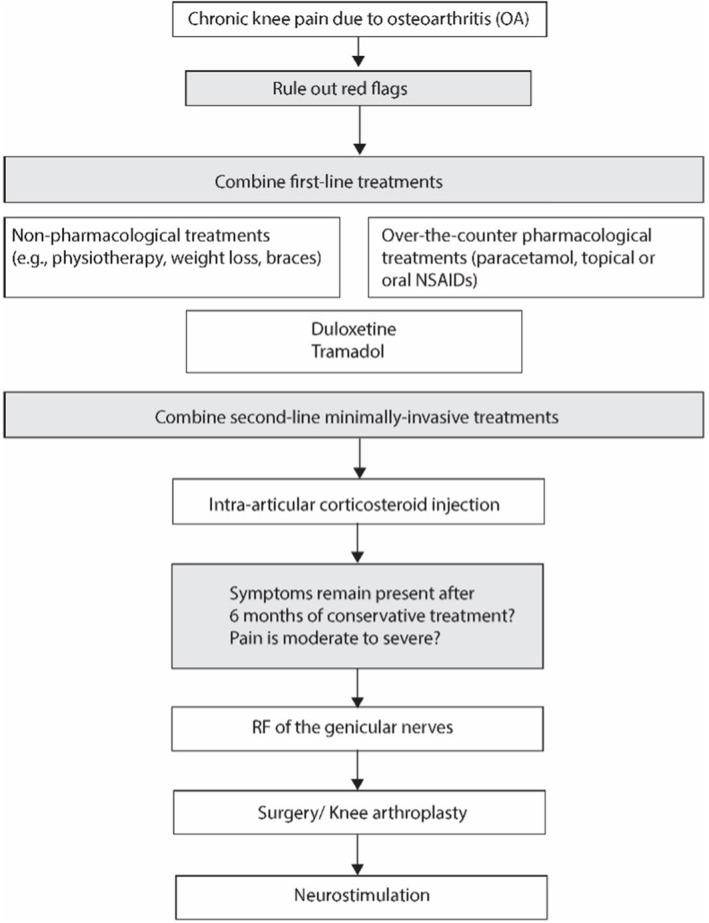
Patients with knee OA commonly present with insidious, chronic knee pain that gradually worsens. Pain caused by knee OA is predominantly nociceptive pain, with occasional nociplastic and infrequent neuropathic characteristics occurring in a diseased knee. A standard musculoskeletal and neurological examination is required for the diagnosis of knee OA. Although typical clinical OA findings are sufficient for diagnosis, medical imaging may be performed to improve specificity. The differential diagnosis should exclude other causes of knee pain including bone and joint disorders such as rheumatoid arthritis, spondylo- and other arthropathies, and infections. When conservative treatment fails, intra-articular injections of corticosteroids and radiofrequency (conventional and cooled) of the genicular nerves have been shown to be effective. Hyaluronic acid infiltrations are conditionally recommended. Platelet-rich plasma infiltrations, chemical ablation of genicular nerves, and neurostimulation have, at the moment, not enough evidence and can be considered in a study setting. The decision to perform joint-preserving and joint-replacement options should be made multidisciplinary.
When conservative measures fail to provide satisfactory pain relief, a multidisciplinary approach is recommended including psychological therapy, integrative treatments, and procedural options such as intra-articular injections, radiofrequency ablation, and surgery.
慢性膝关节疼痛被定义为持续或反复超过3个月的疼痛。最常见的是退行性骨关节炎(OA)。本综述全面描述了膝关节OA的病理学、诊断和治疗。
检索并总结了关于慢性膝关节疼痛诊断和治疗的文献。采用改良德尔菲法制定关于介入治疗的建议。
膝关节OA患者通常表现为隐匿性、慢性膝关节疼痛,且逐渐加重。膝关节OA引起的疼痛主要是伤害感受性疼痛,患病膝关节偶尔会出现神经病理性疼痛和罕见的神经可塑性疼痛特征。诊断膝关节OA需要进行标准的肌肉骨骼和神经系统检查。虽然典型的临床OA表现足以诊断,但可进行医学成像以提高特异性。鉴别诊断应排除膝关节疼痛的其他原因,包括类风湿关节炎、脊柱关节病和其他关节炎等骨与关节疾病以及感染。当保守治疗失败时,关节内注射皮质类固醇以及膝神经的射频(传统和冷却)治疗已被证明是有效的。有条件地推荐透明质酸注射。目前,富血小板血浆注射、膝神经化学消融和神经刺激的证据不足,可在研究环境中考虑。保留关节和关节置换方案的决策应多学科进行。
当保守措施未能提供满意的疼痛缓解时,建议采用多学科方法,包括心理治疗、综合治疗以及关节内注射、射频消融和手术等程序选择。

 Zotero 插件