
肠道微生物群与精神分裂症:来自两样本孟德尔随机化研究的见解
Gut microbiome and schizophrenia: insights from two-sample Mendelian randomization.
作者信息
Zhou Keer, Baranova Ancha, Cao Hongbao, Sun Jing, Zhang Fuquan
机构信息
Department of Psychiatry, The Affiliated Brain Hospital of Nanjing Medical University, Nanjing, China.
School of Systems Biology, George Mason University, Manassas, VA, USA.
出版信息
Schizophrenia (Heidelb). 2024 Sep 2;10(1):75. doi: 10.1038/s41537-024-00497-7.
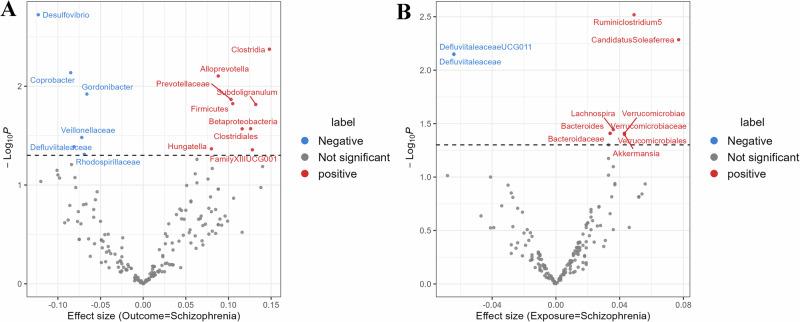
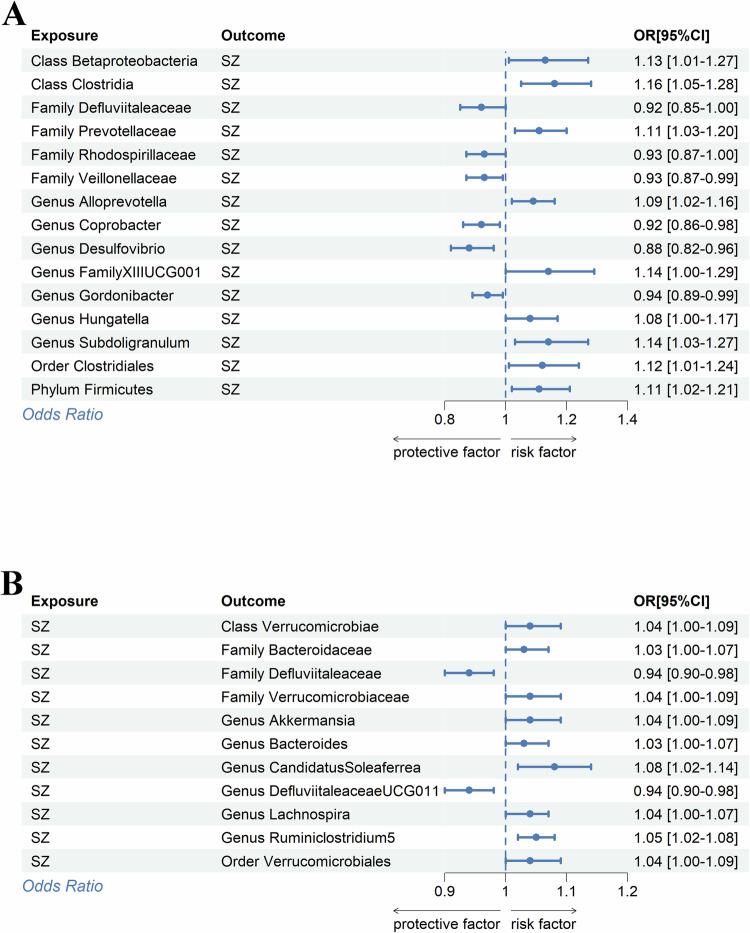
Growing evidence suggests a potential link between the gut microbiome and schizophrenia. However, it is unclear whether the gut microbiome is causally associated with schizophrenia. We performed two-sample bidirectional Mendelian randomization to detect bidirectional causal relationships between gut microbiome and schizophrenia. Summary genome-wide association study (GWAS) datasets of the gut microbiome from the MiBioGen consortium (n = 18,340) and schizophrenia (n = 130,644) were utilized in our study. Then a cohort of sensitive analyses was followed to validate the robustness of MR results. We identified nine taxa that exerted positive causal effects on schizophrenia (OR: 1.08-1.16) and six taxa that conferred negative causal effects on schizophrenia (OR: 0.88-0.94). On the other hand, the reverse MR analysis showed that schizophrenia may increase the abundance of nine taxa (OR: 1.03-1.08) and reduce the abundance of two taxa (OR: 0.94). Our study unveiled mutual causal relationships between gut microbiome and schizophrenia. The findings may provide evidence for the treatment potential of gut microbiomes in schizophrenia.
越来越多的证据表明肠道微生物群与精神分裂症之间存在潜在联系。然而,尚不清楚肠道微生物群与精神分裂症是否存在因果关系。我们进行了两样本双向孟德尔随机化,以检测肠道微生物群与精神分裂症之间的双向因果关系。我们的研究使用了来自MiBioGen联盟的肠道微生物群(n = 18340)和精神分裂症(n = 130644)的全基因组关联研究(GWAS)汇总数据集。随后进行了一系列敏感性分析,以验证孟德尔随机化结果的稳健性。我们确定了9个对精神分裂症有正向因果效应的分类群(比值比:1.08 - 1.16)和6个对精神分裂症有负向因果效应的分类群(比值比:0.88 - 0.94)。另一方面,反向孟德尔随机化分析表明,精神分裂症可能会增加9个分类群的丰度(比值比:1.03 - 1.08)并降低2个分类群的丰度(比值比:0.94)。我们的研究揭示了肠道微生物群与精神分裂症之间的相互因果关系。这些发现可能为肠道微生物群在精神分裂症治疗中的潜力提供证据。
 Zotero 插件