
星球大战对抗白血病:攻击白血病细胞。
Star wars against leukemia: attacking the clones.
机构信息
Fels Cancer Institute for Personalized Medicine, Lewis Katz School of Medicine, Temple University, Philadelphia, PA, 19140, USA.
Department of Cancer and Cellular Biology, Lewis Katz School of Medicine, Temple University, Philadelphia, PA, USA.
出版信息
Leukemia. 2024 Nov;38(11):2293-2302. doi: 10.1038/s41375-024-02369-6. Epub 2024 Sep 2.
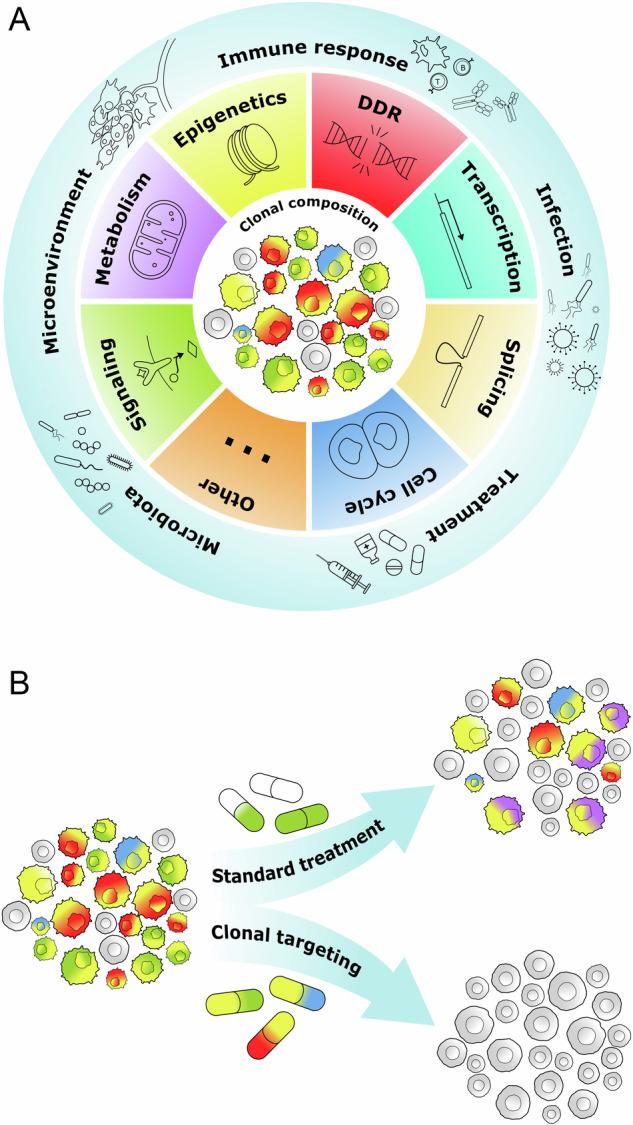
Leukemia, although most likely starts as a monoclonal genetic/epigenetic anomaly, is a polyclonal disease at manifestation. This polyclonal nature results from ongoing evolutionary changes in the genome/epigenome of leukemia cells to promote their survival and proliferation advantages. We discuss here how genetic and/or epigenetic aberrations alter intracellular microenvironment in individual leukemia clones and how extracellular microenvironment selects the best fitted clones. This dynamic polyclonal composition of leukemia makes designing an effective therapy a challenging task especially because individual leukemia clones often display substantial differences in response to treatment. Here, we discuss novel therapeutic approach employing single cell multiomics to identify and eradicate all individual clones in a patient.
白血病虽然最初很可能是单克隆遗传/表观遗传异常,但在发病时是一种多克隆疾病。这种多克隆特性是由于白血病细胞的基因组/表观基因组不断发生进化改变,从而促进其生存和增殖优势。我们在这里讨论了遗传和/或表观遗传异常如何改变单个白血病克隆的细胞内微环境,以及细胞外微环境如何选择最合适的克隆。白血病的这种动态多克隆组成使得设计有效的治疗方法成为一项具有挑战性的任务,特别是因为单个白血病克隆对治疗的反应往往存在很大差异。在这里,我们讨论了一种新的治疗方法,即利用单细胞多组学来识别和根除患者体内的所有个体克隆。
 Zotero 插件