
TKI治疗失败后,基于免疫疗法的联合方案用于EGFR突变的晚期非小细胞肺癌患者的疗效分析
Efficacy analysis of immunotherapy‑based combinations for patients with EGFR‑mutant advanced non‑small cell lung cancer after TKI failure.
作者信息
Li Meifang, Lin Cheng, Lin Jinghui, Chen Shijie, Weng Lihong, He Zhiyong
机构信息
Department of Thoracic Medical Oncology, Clinical Oncology School of Fujian Medical University, Fujian Cancer Hospital, Fuzhou, Fujian 350014, P.R. China.
Department of Radiation Oncology, Clinical Oncology School of Fujian Medical University, Fujian Cancer Hospital, Fuzhou, Fujian 350014, P.R. China.
出版信息
Oncol Lett. 2024 Aug 20;28(5):504. doi: 10.3892/ol.2024.14637. eCollection 2024 Nov.
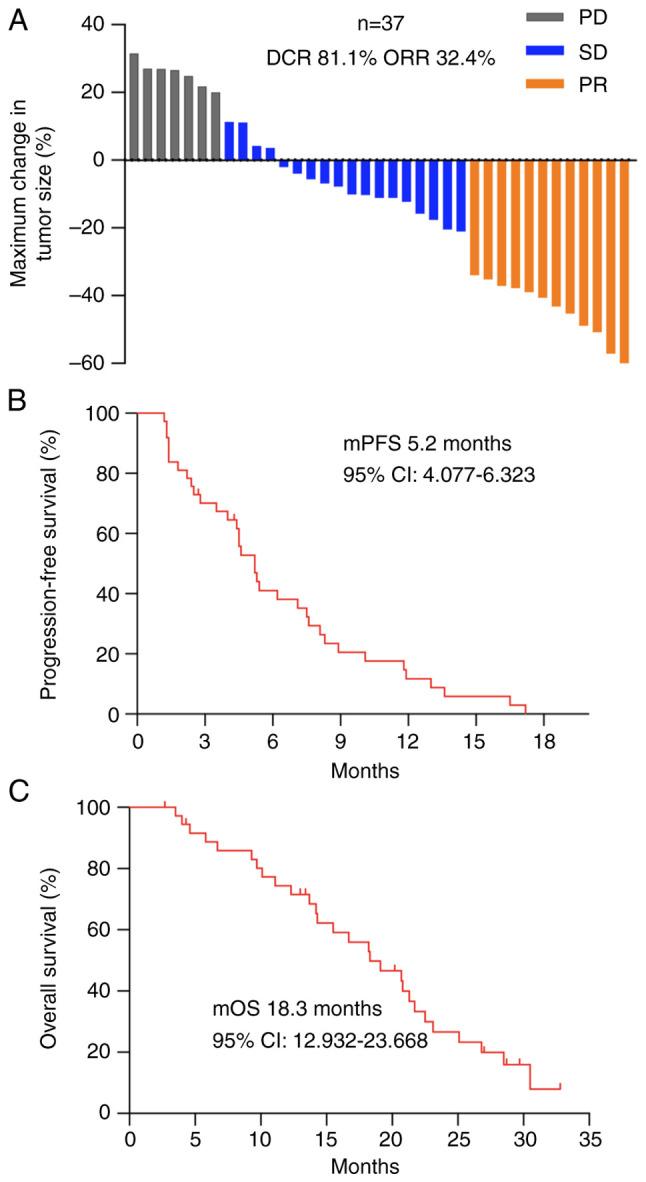
Treatment options for epidermal growth factor receptor (EGFR)-mutant advanced non-small cell lung cancer (NSCLC) following tyrosine kinase inhibitor (TKI) failure are limited, and platinum-based chemotherapy remains the main treatment. The development of effective immunotherapy for this disease has been challenging. In the present study, 37 patients with EGFR-mutant advanced NSCLC who were treated with programmed cell death-1 (PD-1) inhibitor-based combinations after TKI failure were reviewed. The total cohort had a median progression-free survival (mPFS) of 5.2 months (95% CI, 4.077-6.323 months) and a median overall survival (mOS) of 18.3 months (95% CI, 12.932-23.668 months). Patients with Eastern Cooperative Oncology Group performance-status (ECOG-PS) scores of 0 or 1 had longer mPFS than those with ECOG-PS scores of 2 (5.4 vs. 2.4 months; P=0.006). In addition, a PFS benefit was observed in patients with EGFR T790M-negative compared with EGFR T790M-positive tumors (mPFS 6.2 vs. 4.4 months; P=0.041). Patients treated with immunotherapy-based combinations as a front-line therapy had a longer mPFS than those in which the combinations were used as a late-line therapy (6.2 vs. 2.4 months; P<0.001). PD-1 inhibitor combined with chemotherapy and bevacizumab did not show a clear advantage over PD-1 inhibitor combined with chemotherapy alone (mPFS, 6.2 vs. 4.4 months; P=0.681), although it resulted in an improved overall response rate (ORR) and disease control rate. Notably, the 7 patients with a programmed cell death ligand-1 (PD-L1) tumor proportion score of ≥50% had an ORR of 100% and an mPFS of 8.3 months. Therefore, it is suggested that PD-1 inhibitor-based combinations should be a priority treatment option in selective populations, such as those with low ECOG-PS scores, T790M-negative status or high PD-L1 expression in EGFR-mutant NSCLC after TKI failure. The use of immunotherapy and chemotherapy in combination with antiangiogenic agents appears to be a promising combination therapy for such patients.
表皮生长因子受体(EGFR)突变的晚期非小细胞肺癌(NSCLC)在酪氨酸激酶抑制剂(TKI)治疗失败后的治疗选择有限,铂类化疗仍是主要治疗方法。开发针对这种疾病的有效免疫疗法一直具有挑战性。在本研究中,回顾了37例EGFR突变的晚期NSCLC患者,这些患者在TKI治疗失败后接受了基于程序性细胞死亡蛋白1(PD-1)抑制剂的联合治疗。整个队列的中位无进展生存期(mPFS)为5.2个月(95%CI,4.077-6.323个月),中位总生存期(mOS)为18.3个月(95%CI,12.932-23.668个月)。东部肿瘤协作组体能状态(ECOG-PS)评分为0或1的患者的mPFS长于ECOG-PS评分为2的患者(5.4对2.4个月;P=0.006)。此外,与EGFR T790M阳性肿瘤患者相比,EGFR T790M阴性患者的无进展生存期有获益(mPFS 6.2对4.4个月;P=0.041)。接受基于免疫疗法的联合治疗作为一线治疗的患者的mPFS长于将联合治疗用作二线治疗的患者(6.2对2.4个月;P<0.001)。PD-1抑制剂联合化疗和贝伐单抗与单独使用PD-1抑制剂联合化疗相比,未显示出明显优势(mPFS,6.2对4.4个月;P=0.681),尽管其提高了总体缓解率(ORR)和疾病控制率。值得注意的是,7例程序性细胞死亡配体1(PD-L1)肿瘤比例评分≥50%的患者的ORR为100%,mPFS为8.3个月。因此,建议在选择性人群中,如ECOG-PS评分低、T790M阴性状态或EGFR突变的NSCLC患者在TKI治疗失败后PD-L1高表达的患者,基于PD-1抑制剂的联合治疗应作为优先治疗选择。免疫疗法和化疗联合抗血管生成药物的使用似乎是这类患者一种有前景的联合治疗方法。



 Zotero 插件