
恩福妥滨上市后药物安全性监测:基于真实世界数据库的观察性药物警戒研究。
Post-marketing drug safety surveillance of enfortumab vedotin: an observational pharmacovigilance study based on a real-world database.
机构信息
Department of Ultrasound in Medicine, Shanghai Jiao Tong University Affiliated Sixth People's Hospital, Shanghai, China.
Department of Urology, Shanghai Children's Hospital, Shanghai Jiao Tong University, Shanghai, China.
出版信息
Front Immunol. 2024 Aug 20;15:1397692. doi: 10.3389/fimmu.2024.1397692. eCollection 2024.
BACKGROUND
Enfortumab vedotin (EV) is an antibody-drug conjugate (ADC) that has been approved by the FDA for patients with locally advanced or metastatic urothelial carcinoma (UC). This study presents a comprehensive pharmacovigilance analysis of the post-marketing safety profile of EV in the real-world based on the US Food and Drug Administration Adverse Event Reporting System (FAERS).
METHODS
Adverse event (AE) reports regarding EV between January 2020 and December 2023 were obtained from the FAERS database. The standardized MedDRA query (SMQ) narrow search AEs on the preferred term (PT) level were used. Disproportionality analysis was performed to identify the AE signals for EV with the reporting odds ratio (ROR), proportional reporting ratio (PRR), multi-item gamma Poisson shrinker (MGPS), and Bayesian confidence propagation neural network (BCPNN).
RESULTS
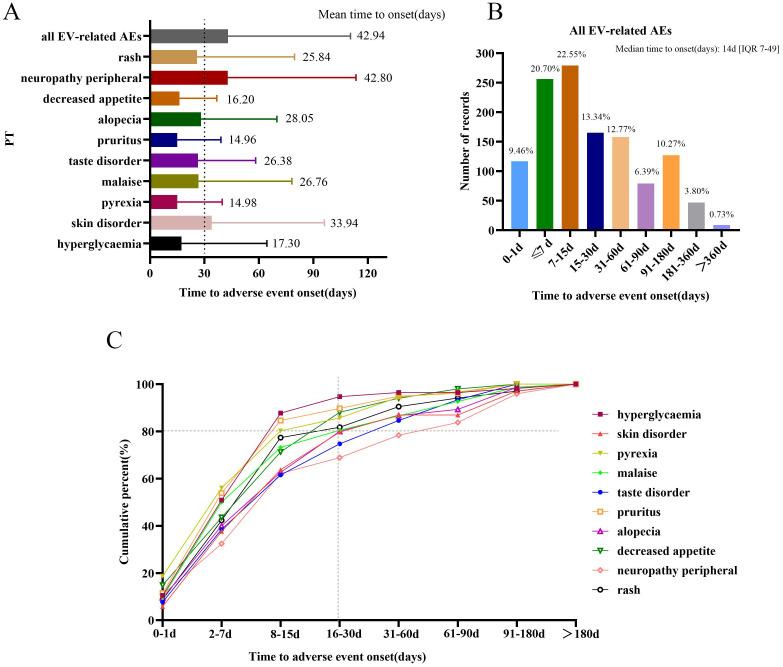
A total of 2,216 reports regarding EV were included in the present study. SMQ analysis results indicated that a stronger strength signal was found in severe cutaneous adverse reactions, retroperitoneal fibrosis, and peripheral neuropathy. A total of 116 significant disproportionality PTs referring to 14 system organ classes (SOCs) were retained by disproportionality analysis, with 49 PTs not listed on the EV drug label. Frequently reported EV-related AEs included rash, peripheral neuropathy, decreased appetite, alopecia, and pruritus. The time to onset of the majority of EV-related AEs was within 30 days (66.05%), with only 0.73% events occurring after 1 year.
CONCLUSION
The disproportionality analysis highlights that dermatologic toxicity and peripheral neuropathy were the major AEs induced by EV. The potential AEs not listed on the drug label were mainly related to gastrointestinal, hepatic, and pulmonary events. Further research is needed to confirm and explore the EV-related AEs in clinical practice.
背景
依维莫司(EV)是一种已被美国食品和药物管理局(FDA)批准用于治疗局部晚期或转移性尿路上皮癌(UC)的抗体药物偶联物(ADC)。本研究基于美国食品和药物管理局不良事件报告系统(FAERS),对 EV 的上市后安全性进行了全面的药物警戒分析。
方法
从 FAERS 数据库中获取 2020 年 1 月至 2023 年 12 月期间关于 EV 的不良事件(AE)报告。使用首选术语(PT)水平上的标准化 MedDRA 查询(SMQ)窄搜索 AE。使用报告比值比(ROR)、比例报告比值(PRR)、多项伽马泊松收缩器(MGPS)和贝叶斯置信传播神经网络(BCPNN)对 EV 的 AE 信号进行了离比例分析。
结果
本研究共纳入 2216 例 EV 报告。SMQ 分析结果表明,严重皮肤不良反应、腹膜后纤维化和周围神经病变的信号更强。通过离比例分析保留了 14 个系统器官类别(SOC)共 116 个具有统计学意义的显著性 PT,其中 49 个 PT 未列在 EV 药物标签上。经常报告的 EV 相关 AE 包括皮疹、周围神经病变、食欲下降、脱发和瘙痒。大多数 EV 相关 AE 的发病时间在 30 天内(66.05%),只有 0.73%的事件发生在 1 年后。
结论
离比例分析强调,皮肤毒性和周围神经病变是 EV 引起的主要 AE。药物标签上未列出的潜在 AE 主要与胃肠道、肝脏和肺部事件有关。需要进一步研究以确认和探讨 EV 在临床实践中的相关 AE。


 Zotero 插件