
生活方式与不同社会经济背景老年人的瓣膜性心脏病进展和预期寿命的关系。
Association of lifestyle with valvular heart disease progression and life expectancy among elderly people from different socioeconomic backgrounds.
机构信息
Department of Cardiology, The Second Affiliated Hospital, School of Medicine, Zhejiang University, Hangzhou, 310009, China.
State Key Laboratory of Transvascular Implantation Devices, Hangzhou, 310009, China.
出版信息
BMC Med. 2024 Sep 5;22(1):367. doi: 10.1186/s12916-024-03576-9.
BACKGROUND
Current cardiovascular prevention strategies are based on studies that seldom include valvular heart disease (VHD). The role of modifiable lifestyle factors on VHD progression and life expectancy among the elderly with different socioeconomic statuses (SES) remains unknown.
METHODS
This cohort study included 164,775 UK Biobank participants aged 60 years and older. Lifestyle was determined using a five-factor scoring system covering smoking status, obesity, physical activity, diet, and sleep patterns. Based on this score, participants were then classified into "poor," "moderate," or "ideal" lifestyle groups. SES was classified as high or low based on the Townsend Deprivation Index. The association of lifestyle with major VHD progression was evaluated using a multistate mode. The life table method was employed to determine life expectancy with VHD and without VHD.
RESULTS
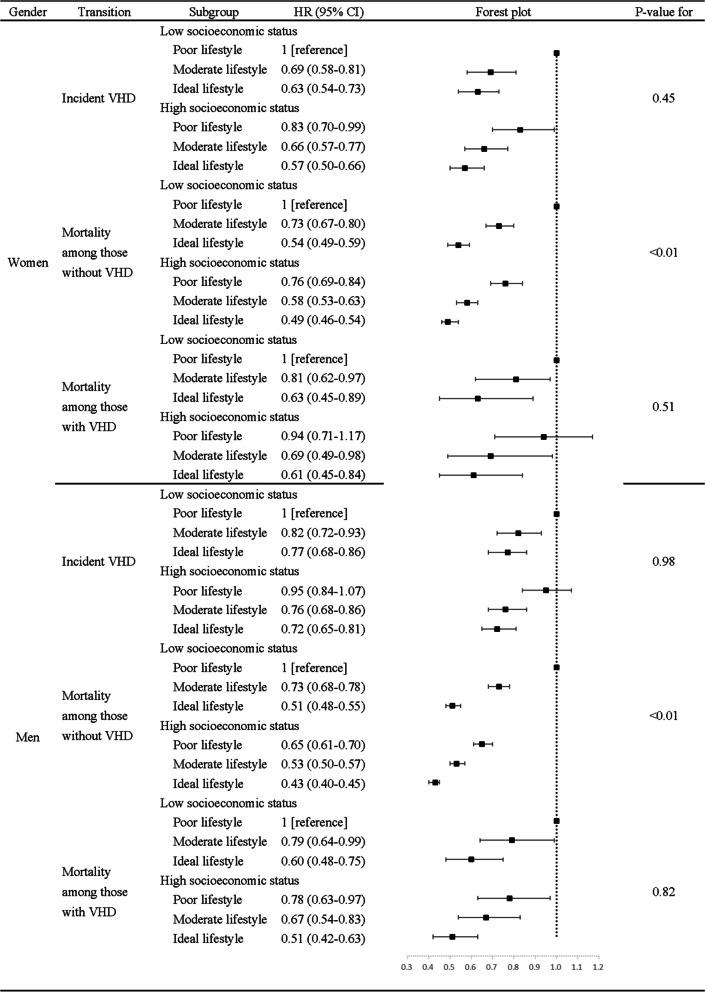
The UK Biobank documented 5132 incident VHD cases with a mean follow-up of 12.3 years and 1418 deaths following VHD with a mean follow-up of 6.0 years. Compared to those with a poor lifestyle, women and men followed an ideal lifestyle had lower hazard ratios for incident VHD (0.66 with 95% CI, 0.59-0.73 for women and 0.77 with 95% CI, 0.71-0.83 for men) and for post-VHD mortality (0.58 for women, 95% CI 0.46-0.74 and 0.62 for men, 95% CI 0.54-0.73). When lifestyle and SES were combined, the lower risk of incident VHD and mortality were observed among participants with an ideal lifestyle and high SES compared to participants with an unhealthy lifestyle and low SES. There was no significant interaction between lifestyle and SES in their correlation with the incidence and subsequent mortality of VHD. Among low SES populations, 60-year-old women and men with VHD who followed ideal lifestyles lived 4.2 years (95% CI, 3.8-4.7) and 5.1 years (95% CI, 4.5-5.6) longer, respectively, compared to those with poor lifestyles. In contrast, the life expectancy gain for those without VHD was 4.4 years (95% CI, 4.0-4.8) for women and 5.3 years (95% CI, 4.8-5.7) for men when adhering to an ideal lifestyle versus a poor one.
CONCLUSIONS
Adopting a healthier lifestyle can significantly slow down the progression from free of VHD to incident VHD and further to death and increase life expectancy for both individuals with and without VHD within diverse socioeconomic elderly populations.
背景
当前的心血管预防策略基于很少包括瓣膜性心脏病(VHD)的研究。在不同社会经济地位(SES)的老年人中,可改变的生活方式因素对 VHD 进展和预期寿命的影响尚不清楚。
方法
本队列研究纳入了 164775 名年龄在 60 岁及以上的英国生物银行参与者。生活方式通过涵盖吸烟状况、肥胖、身体活动、饮食和睡眠模式的五分制评分系统来确定。根据该评分,参与者随后被分为“不良”、“中等”或“理想”生活方式组。SES 根据汤森剥夺指数分为高或低。使用多状态模式评估生活方式与主要 VHD 进展的关系。寿命表法用于确定有和没有 VHD 的预期寿命。
结果
英国生物银行记录了 5132 例新发 VHD 病例,平均随访 12.3 年,1418 例 VHD 后死亡,平均随访 6.0 年。与生活方式不良的人相比,遵循理想生活方式的女性和男性新发 VHD 的风险比(女性为 0.66,95%CI 为 0.59-0.73,男性为 0.77,95%CI 为 0.71-0.83)和 VHD 后死亡率(女性为 0.58,95%CI 为 0.46-0.74,男性为 0.62,95%CI 为 0.54-0.73)较低。当将生活方式和 SES 结合起来时,与生活方式不健康和 SES 较低的参与者相比,SES 较高和生活方式理想的参与者新发 VHD 和死亡率的风险较低。生活方式和 SES 之间没有显著的相互作用,它们与 VHD 的发生和随后的死亡率相关。在 SES 较低的人群中,60 岁的女性和男性 VHD 患者,如果遵循理想的生活方式,分别可多活 4.2 年(95%CI,3.8-4.7)和 5.1 年(95%CI,4.5-5.6),而生活方式不良的患者则分别可多活 4.2 年(95%CI,3.8-4.7)和 5.1 年(95%CI,4.5-5.6)。相比之下,对于没有 VHD 的人,当他们坚持理想的生活方式而不是不良的生活方式时,女性的预期寿命可增加 4.4 年(95%CI,4.0-4.8),男性可增加 5.3 年(95%CI,4.8-5.7)。
结论
采用更健康的生活方式可以显著减缓从无 VHD 到新发 VHD 再到死亡的进展,并在不同社会经济地位的老年人群中增加有和没有 VHD 的预期寿命。

 Zotero 插件