
肥胖个体中全身免疫炎症指数(SII)、全身炎症反应指数(SIRI)与心血管疾病的关联:一项全国性横断面分析。
Associations between SII, SIRI, and cardiovascular disease in obese individuals: a nationwide cross-sectional analysis.
作者信息
Liu Zhou, Zheng Longxuan
机构信息
Department of Cardiology, Huai'an Hospital Affiliated to Yangzhou University (The Fifth People's Hospital of Huai'an), Huai'an, China.
出版信息
Front Cardiovasc Med. 2024 Aug 22;11:1361088. doi: 10.3389/fcvm.2024.1361088. eCollection 2024.
BACKGROUND
Systemic immune-inflammation index (SII) and systemic inflammation response index (SIRI) are comprehensive markers of inflammatory status. However, the correlation between SII and SIRI and the prevalence of cardiovascular disease (CVD) in populations with obesity remains unknown.
METHODS
This is a cross-sectional study with data obtained from the National Health and Nutrition Examination Survey from 1999 to 2018. SII and SIRI were calculated using the following equations: SII = (platelet count × neutrophil count)/lymphocyte count. SIRI = (neutrophil count × monocyte count)/lymphocyte count. Spearman's rank correlation coefficient was used to assess the relationship between SII and SIRI and baseline variables. Logistic regression models and generalized additive model (GAM) with a spline smoothing function were used to evaluate the association between SIRI and CVD prevalence. Nomogram and receiver operating characteristic curve (ROC) analysis were used to assess the value of the risk prediction model.
RESULTS
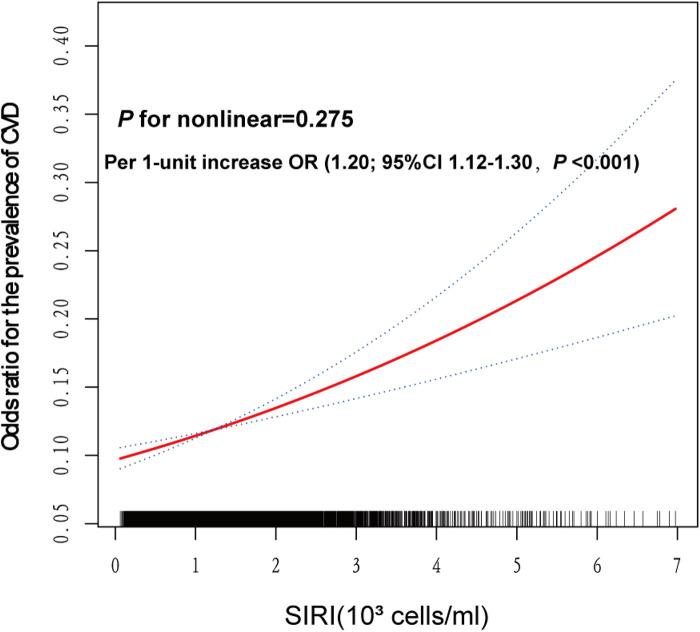
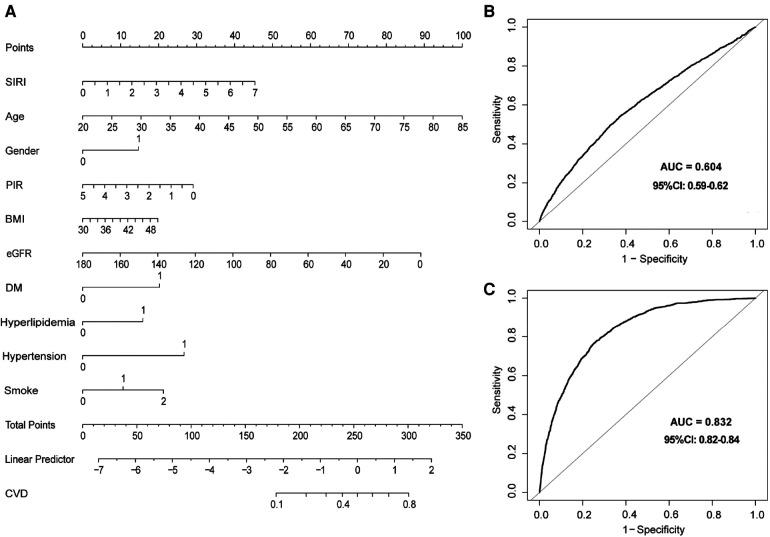
A total of 17,261 participants with obesity and SII and SIRI publicly available data were used for this study. Multivariate logistic regression analysis revealed that SIRI, rather than SII, was an independent risk factor for CVD prevalence. For every standard deviation increase in SIRI, there was a 13%, 15%, and 28% increase in the odds ratios of CVD prevalence (OR = 1.13, 95% CI: 1.04-1.22, = 0.01), coronary heart disease (OR = 1.15, 95% CI: 1.05-1.26, = 0.002), and congestive heart failure (OR = 1.28, 95% CI: 1.16-1.41, < 0.001). ROC results demonstrated that SIRI had a certain accuracy in predicting CVD prevalence (AUC = 0.604), especially when combined with other variables used in the nomogram (AUC = 0.828). The smooth curve fitting regression analysis demonstrated a significant linear association between the risk of SIRI and the odds ratio of CVD prevalence ( for nonlinear = 0.275).
CONCLUSIONS
SIRI is a relatively stable indicator of inflammation and is independently associated with the prevalence of CVD. It may serve as a novel inflammatory indicator to estimate CVD prevalence in populations with obesity.
背景
全身免疫炎症指数(SII)和全身炎症反应指数(SIRI)是炎症状态的综合标志物。然而,SII与SIRI之间的相关性以及肥胖人群中心血管疾病(CVD)的患病率仍不清楚。
方法
这是一项横断面研究,数据来自1999年至2018年的美国国家健康与营养检查调查。SII和SIRI使用以下公式计算:SII =(血小板计数×中性粒细胞计数)/淋巴细胞计数。SIRI =(中性粒细胞计数×单核细胞计数)/淋巴细胞计数。采用Spearman等级相关系数评估SII与SIRI及基线变量之间的关系。使用逻辑回归模型和具有样条平滑函数的广义相加模型(GAM)评估SIRI与CVD患病率之间的关联。使用列线图和受试者工作特征曲线(ROC)分析评估风险预测模型的价值。
结果
本研究共纳入17261名有肥胖症且有公开可用的SII和SIRI数据的参与者。多变量逻辑回归分析显示,SIRI而非SII是CVD患病率的独立危险因素。SIRI每增加一个标准差,CVD患病率(OR = 1.13,95%CI:1.04 - 1.22,P = 0.01)、冠心病(OR = 1.15,95%CI:1.05 - 1.26,P = 0.002)和充血性心力衰竭(OR = 1.28,95%CI:1.16 - 1.41,P < 0.001)的优势比分别增加13%、15%和28%。ROC结果表明,SIRI在预测CVD患病率方面具有一定准确性(AUC = 0.604),特别是与列线图中使用的其他变量结合时(AUC = 0.828)。平滑曲线拟合回归分析表明,SIRI风险与CVD患病率优势比之间存在显著线性关联(非线性P = 0.275)。
结论
SIRI是一种相对稳定的炎症指标,与CVD患病率独立相关。它可能作为一种新的炎症指标来估计肥胖人群中的CVD患病率。

 Zotero 插件