
在嵌合抗原受体 (CAR) T 细胞治疗后复发/进展的大 B 细胞淋巴瘤患者中,有几个可以在细胞给药前确定的预测其预后的因素。
Several factors that predict the outcome of large B-cell lymphoma patients who relapse/progress after chimeric antigen receptor (CAR) T-cell therapy can be identified before cell administration.
机构信息
4th Department of Internal Medicine - Haematology, University Hospital and Faculty of Medicine, Hradec Králové, Czech Republic.
Department of Internal Medicine, Haematology and Oncology, Masaryk University Hospital, Brno, Czech Republic.
出版信息
Cancer Med. 2024 Sep;13(17):e70138. doi: 10.1002/cam4.70138.
AIM
The aim of this study was to analyse the outcomes of patients with large B-cell lymphoma (LBCL) treated with chimeric antigen receptor T-cell therapy (CAR-Tx), with a focus on outcomes after CAR T-cell failure, and to define the risk factors for rapid progression and further treatment.
METHODS
We analysed 107 patients with LBCL from the Czech Republic and Slovakia who were treated in ≥3rd-line with tisagenlecleucel or axicabtagene ciloleucel between 2019 and 2022.
RESULTS
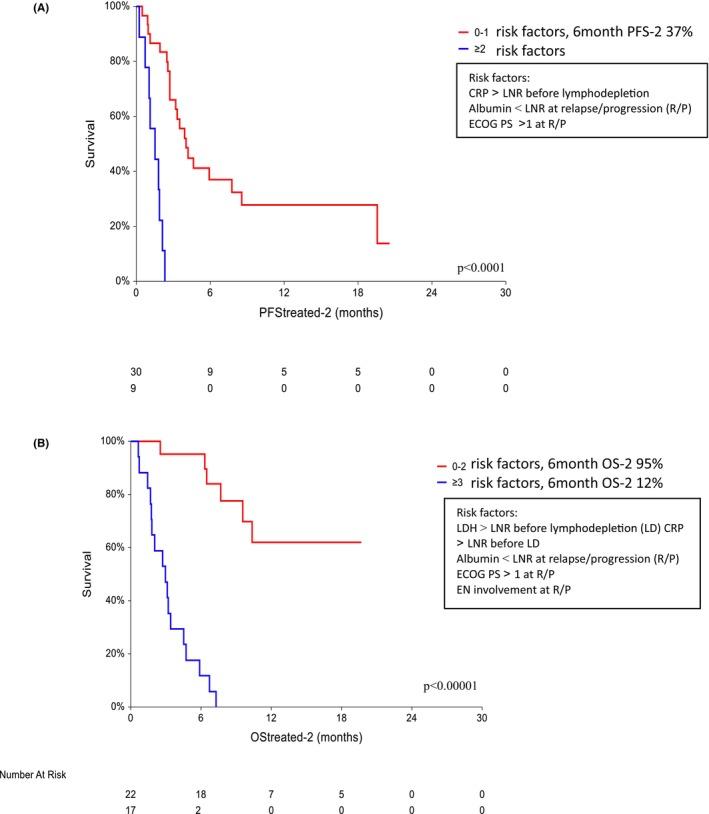
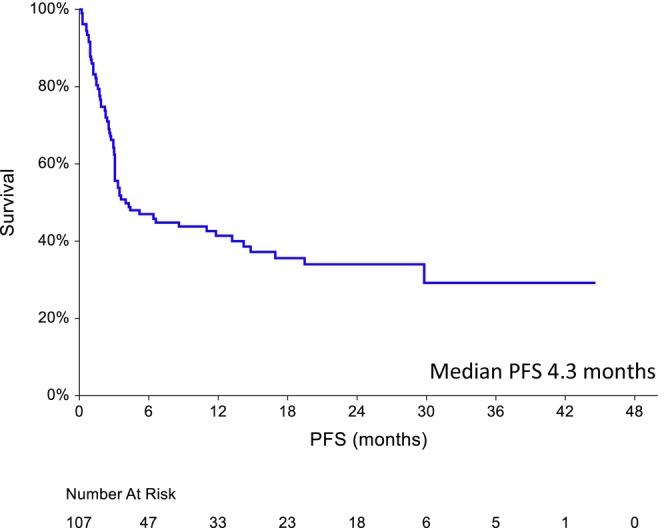
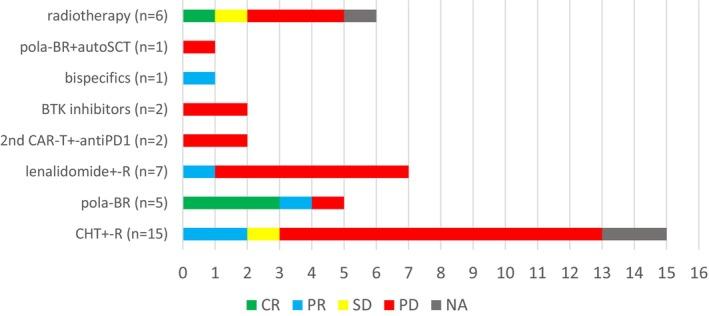
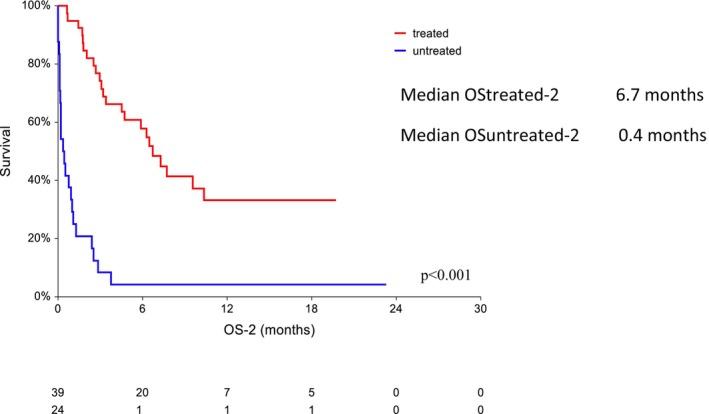
The overall response rate (ORR) was 60%, with a 50% complete response (CR) rate. The median progression-free survival (PFS) and overall survival (OS) were 4.3 and 26.4 months, respectively. Sixty-three patients (59%) were refractory or relapsed after CAR-Tx. Of these patients, 39 received radiotherapy or systemic therapy, with an ORR of 22% (CR 8%). The median follow-up of surviving patients in whom treatment failed was 10.6 months. Several factors predicting further treatment administration and outcomes were present even before CAR-Tx. Risk factors for not receiving further therapy after CAR-Tx failure were high lactate dehydrogenase (LDH) levels before apheresis, extranodal involvement (EN), high ferritin levels before lymphodepletion (LD) and ECOG PS >1 at R/P. The median OS-2 (from R/P after CAR-Tx) was 6.7 months (6-month 57.9%) for treated patients and 0.4 months (6-month 4.2%) for untreated patients (p < 0.001). The median PFS-2 (from R/P after CAR-Tx) was 3.2 months (6-month 28.5%) for treated patients. The risk factors for a shorter PFS-2 (n = 39) included: CRP > limit of the normal range (LNR) before LD, albumin < LNR and ECOG PS > 1 at R/P. All these factors, together with LDH > LNR before LD and EN involvement at R/P, predicted OS-2 for treated patients.
CONCLUSION
Our findings allow better stratification of CAR-Tx candidates and stress the need for a proactive approach (earlier restaging, intervention after partial remission achievement).
目的
本研究旨在分析接受嵌合抗原受体 T 细胞疗法(CAR-Tx)治疗的大 B 细胞淋巴瘤(LBCL)患者的结局,重点关注 CAR-T 细胞治疗失败后的结局,并确定快速进展和进一步治疗的风险因素。
方法
我们分析了 2019 年至 2022 年期间在捷克共和国和斯洛伐克接受≥3 线 tisagenlecleucel 或 axicabtagene ciloleucel 治疗的 107 例 LBCL 患者。
结果
总体缓解率(ORR)为 60%,完全缓解(CR)率为 50%。中位无进展生存期(PFS)和总生存期(OS)分别为 4.3 个月和 26.4 个月。63 例患者(59%)在 CAR-Tx 后出现难治性或复发。其中 39 例接受放疗或全身治疗,缓解率为 22%(CR 8%)。治疗失败后存活患者的中位随访时间为 10.6 个月。甚至在接受 CAR-Tx 治疗之前,就存在预测进一步治疗和结局的多种因素。CAR-Tx 失败后未接受进一步治疗的风险因素包括:在采集前乳酸脱氢酶(LDH)水平升高、结外受累(EN)、在淋巴细胞耗竭(LD)前铁蛋白水平升高和 ECOG PS>1 在 R/P。治疗患者的中位 OS-2(从 R/P 后开始 CAR-Tx)为 6.7 个月(6 个月 57.9%),未治疗患者为 0.4 个月(6 个月 4.2%)(p<0.001)。治疗患者的中位 PFS-2(从 R/P 后开始 CAR-Tx)为 3.2 个月(6 个月 28.5%)。较短的 PFS-2(n=39)的风险因素包括:在 LD 前 CRP>正常范围(LNR)、白蛋白<LNR 和 ECOG PS>R/P>1。所有这些因素,加上在 LD 前 LDH>正常范围和 R/P 处的 EN 受累,都预测了治疗患者的 OS-2。
结论
我们的研究结果使 CAR-Tx 候选者的分层更好,并强调需要采取积极主动的方法(更早的重新分期,在部分缓解后进行干预)。
 Zotero 插件