
γ/δ T 细胞在实体瘤免疫治疗中的潜力。
Potential of gamma/delta T cells for solid tumor immunotherapy.
机构信息
Oncology Department, General Hospital of Northern Theater Command, Shenyang, Liaoning, China.
School of Life Sciences and Biopharmaceuticals, Shenyang Pharmaceutical University, Shenyang, Liaoning, China.
出版信息
Front Immunol. 2024 Aug 26;15:1466266. doi: 10.3389/fimmu.2024.1466266. eCollection 2024.
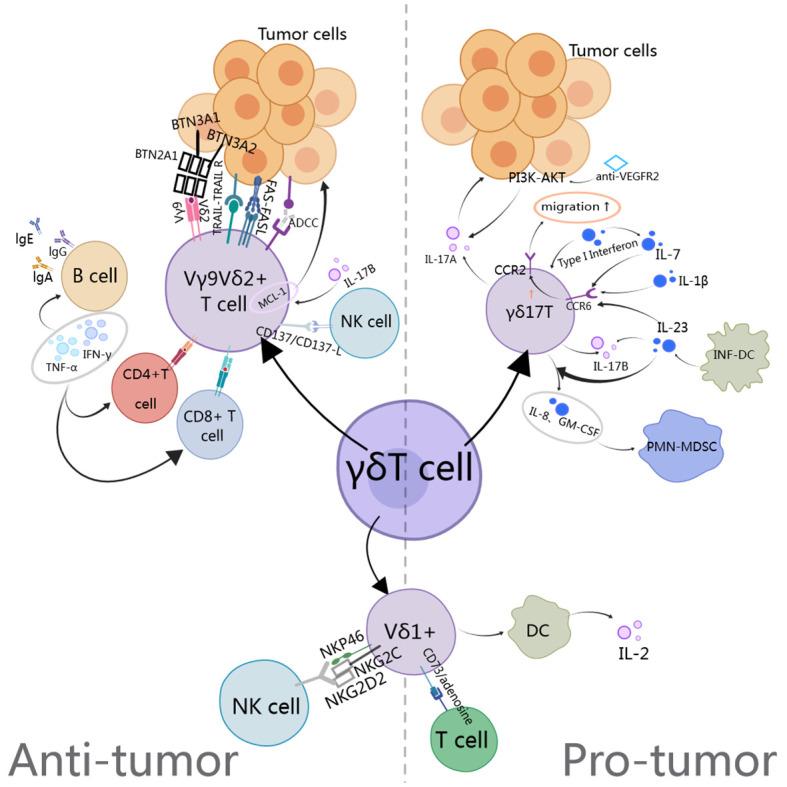
Gamma/delta T (γδ T)cells possess a unique mechanism for killing tumors, making them highly promising and distinguished among various cell therapies for tumor treatment. This review focuses on the major histocompatibility complex (MHC)-independent recognition of antigens and the interaction between γδ T cells and solid tumor cells. A comprehensive review is provided regarding the classification of human gamma-delta T cell subtypes, the characteristics and mechanisms underlying their functions, as well as their r545egulatory effects on tumor cells. The involvement of γδ T cells in tumorigenesis and migration was also investigated, encompassing potential therapeutic targets such as apoptosis-related molecules, the TNF receptor superfamily member 6(FAS)/FAS Ligand (FASL) pathways, butyrophilin 3A-butyrophilin 2A1 (BTN3A-BTN2A1) complexes, and interactions with CD4, CD8, and natural killer (NK) cells. Additionally, immune checkpoint inhibitors such as programmed cell death protein 1/Programmed cell death 1 ligand 1 (PD-1/PD-L1) have the potential to augment the cytotoxicity of γδ T cells. Moreover, a review on gamma-delta T cell therapy products and their corresponding clinical trials reveals that chimeric antigen receptor (CAR) gamma-delta T therapy holds promise as an approach with encouraging preclinical outcomes. However, practical issues pertaining to manufacturing and clinical aspects need resolution, and further research is required to investigate the long-term clinical side effects of CAR T cells. In conclusion, more comprehensive studies are necessary to establish standardized treatment protocols aimed at enhancing the quality of life and survival rates among tumor patients utilizing γδ T cell immunotherapy.
γ/δ T(γδ T)细胞具有独特的杀伤肿瘤机制,使其在各种肿瘤治疗的细胞疗法中极具应用前景和特色。本综述重点关注主要组织相容性复合物(MHC)非依赖性抗原识别以及γδ T 细胞与实体瘤细胞之间的相互作用。全面回顾了人类γδ T 细胞亚群的分类、其功能的特征和机制,以及它们对肿瘤细胞的调节作用。还研究了 γδ T 细胞在肿瘤发生和迁移中的作用,包括与细胞凋亡相关的分子、肿瘤坏死因子受体超家族成员 6(FAS)/FAS 配体(FASL)途径、黏蛋白 3A-黏蛋白 2A1(BTN3A-BTN2A1)复合物以及与 CD4、CD8 和自然杀伤(NK)细胞的相互作用等潜在治疗靶点。此外,免疫检查点抑制剂,如程序性细胞死亡蛋白 1/程序性死亡受体 1 配体 1(PD-1/PD-L1),有可能增强 γδ T 细胞的细胞毒性。此外,综述了 γδ T 细胞治疗产品及其相应的临床试验,表明嵌合抗原受体(CAR)γδ T 治疗具有令人鼓舞的临床前结果,具有应用前景。然而,在制造和临床方面仍存在实际问题需要解决,并且需要进一步研究来调查 CAR T 细胞的长期临床副作用。总之,需要进行更全面的研究,以建立基于 γδ T 细胞免疫治疗的标准化治疗方案,旨在提高肿瘤患者的生活质量和生存率。

 Zotero 插件