
阴道 HPV 自我采样的邀请策略以提高宫颈癌筛查的参与率:随机试验的系统评价和荟萃分析。
Invitation strategy of vaginal HPV self-sampling to improve participation in cervical cancer screening: a systematic review and meta-analysis of randomized trials.
机构信息
The Nethersole School of Nursing, Faculty of Medicine, The Chinese University of Hong Kong, Shatin, New Territories, Hong Kong, China.
Centre for Health Systems and Policy Research, JC School of Public Health and Primary Care, Faculty of Medicine, The Chinese University of Hong Kong, Hong Kong SAR, China.
出版信息
BMC Public Health. 2024 Sep 10;24(1):2461. doi: 10.1186/s12889-024-19881-0.
BACKGROUND
Human papillomavirus (HPV) self-sampling is recognized as a feasible option for enhancing screening for cervical cancer, particularly among hard-to-reach women. The magnitude of the effectiveness of screening participation under different invitation strategies was reported. This review seeks to compare the effectiveness of invitation strategies in increasing screening participation of HPV self-sampling across diverse study settings.
METHODS
A systematic literature search was conducted in Embase, MEDLINE, and PubMed in April 2023. Articles were included if (1) their target participants were aged between 25 and 70 years; (2) participants in the intervention arm were randomized to receive HPV self-sampling devices through various invitation strategies; (3) participants in the control arm who either received invitations for cervical cancer screening other than HPV self-sampling or opportunistic screening as usual care; (4) studies that provided sufficient data on screening participation in HPV self-sampling as outcome measured. The study design of the included articles was limited to randomized controlled trials.
RESULTS
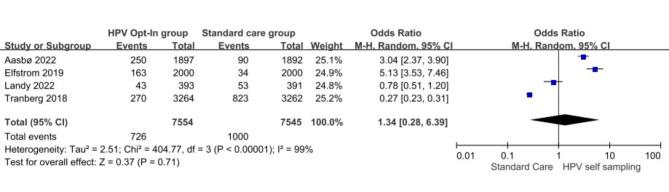
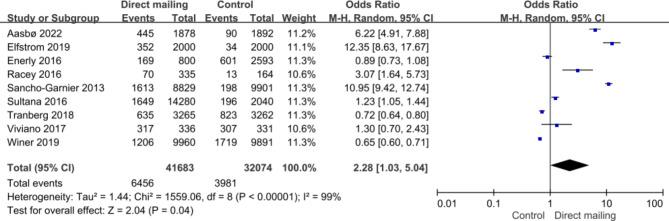
A total of 15 articles were included in this review. Invitation strategies of disseminating HPV self-sampling devices included opt-out and opt-in. Meta-analysis revealed screening participation in the self-sampling group was significantly greater than control arm (OR 3.43, 95% CI 1.59-7.38), irrespective of the invitation strategy employed. Among invitation strategies, opt-out appeared to be more effective on increasing screening participation, compared to control and opt-in strategy (opt-out vs. control OR 3.91, 95% CI 1.82-8.42; opt-in vs. control OR 1.34, 95% CI 0.28-6.39).
CONCLUSIONS
Opt-out strategy is more successful at improving screening participation compared to opt-in and routine invitation to cervical screening. It is therefore a promising way to improve participation in cervical cancer screening. The findings of this review provide important inputs to optimize strategies for inviting women to participate in vaginal HPV self-sampling across the study setting, thus improving participation in cervical cancer screening.
背景
人乳头瘤病毒(HPV)自我采样被认为是增强宫颈癌筛查的可行选择,尤其是在难以接触到的女性中。已经报道了不同邀请策略下筛查参与度的效果大小。本综述旨在比较不同研究环境下,不同邀请策略对增加 HPV 自我采样筛查参与度的效果。
方法
我们于 2023 年 4 月在 Embase、MEDLINE 和 PubMed 中进行了系统文献检索。如果符合以下标准,文章则被纳入:(1)目标参与者年龄在 25 至 70 岁之间;(2)干预组的参与者通过各种邀请策略随机分配到 HPV 自我采样设备;(3)对照组的参与者接受的是宫颈癌筛查的其他邀请,而不是 HPV 自我采样或常规机会性筛查;(4)研究提供了足够的 HPV 自我采样筛查参与度数据作为测量结果。纳入文章的研究设计仅限于随机对照试验。
结果
本综述共纳入 15 篇文章。HPV 自我采样设备的分发邀请策略包括默认同意和选择同意。荟萃分析显示,自我采样组的筛查参与度明显高于对照组(OR 3.43,95%CI 1.59-7.38),无论采用何种邀请策略。在邀请策略中,与对照组和选择同意策略相比,默认同意策略似乎更能有效增加筛查参与度(默认同意与对照组相比,OR 3.91,95%CI 1.82-8.42;选择同意与对照组相比,OR 1.34,95%CI 0.28-6.39)。
结论
与选择同意和常规的宫颈癌筛查邀请相比,默认同意策略在提高筛查参与度方面更成功。因此,这是一种提高宫颈癌筛查参与度的有前途的方法。本综述的结果为优化不同研究环境下邀请女性参与阴道 HPV 自我采样的策略提供了重要依据,从而提高了宫颈癌筛查的参与度。



 Zotero 插件