
通过DNA甲基化分析对烧焦人类遗骸进行年龄估计。
Age estimation of burnt human remains through DNA methylation analysis.
作者信息
Grignani Pierangela, Bertoglio Barbara, Monti Maria Cristina, Cuoghi Costantini Riccardo, Ricci Ugo, Onofri Martina, Fattorini Paolo, Previderè Carlo
机构信息
Dipartimento di Sanità Pubblica, Medicina Sperimentale e Forense, Università di Pavia, Pavia, Italy.
Dipartimento di Scienze Biomediche, Metaboliche e Neuroscienze, Università di Modena e Reggio Emilia, Modena, Italy.
出版信息
Int J Legal Med. 2025 Jan;139(1):175-185. doi: 10.1007/s00414-024-03320-1. Epub 2024 Sep 13.
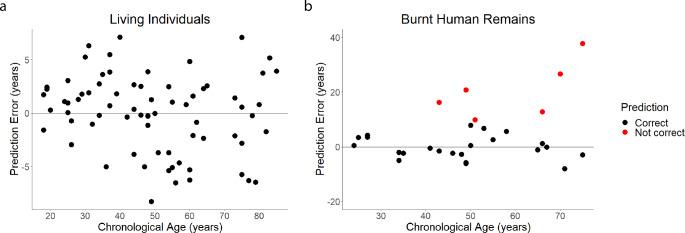
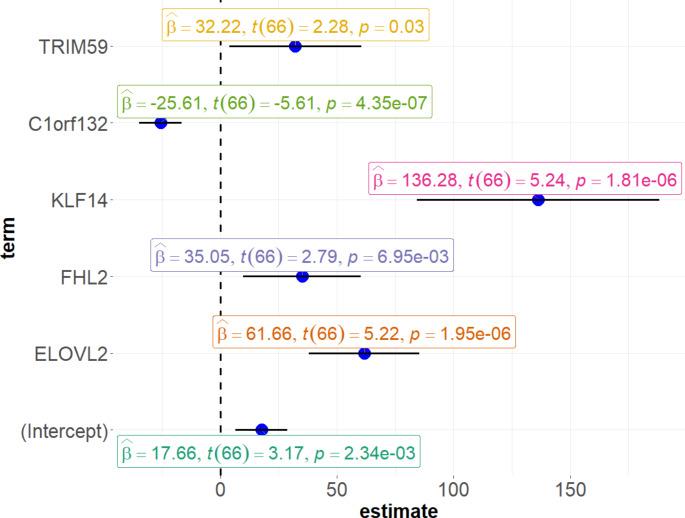
The identification of human fire victims is a challenging task in forensic medicine. The heat-induced alterations of biological tissues can make the conventional anthropological analyses difficult. Even if the DNA profile of the victim is achieved, it is possible that no match can be found in a forensic DNA database, thus hindering positive identification. In such cases, any information useful to nail down a possible identity should be collected, such as DNA methylation analysis which could provide useful investigative leads. In the present study, five age-related epigenetic markers (ELOVL2, FHL2, KLF14, C1orf132, and TRIM59) were initially analysed in blood samples of 72 living Italian individuals of known age, using a Single Base Extension (SBE) assay. An age prediction model was built by multiple linear regression including all the markers (Mean Absolute Error, MAE: 3.15 years). This model was tested on 29 blood samples collected during autopsies from burnt human remains, already identified through DNA analysis, providing a MAE of 6.92 years. The model allowed a correct prediction in 79.3% of the cases (95% prediction interval), while six cases were associated with inaccurate predictions (min-max prediction error: 9.8-37.3 years). Among the different sample variables considered to explain these results, only the DNA degradation index was a relevant factor affecting the reliability of the predictions. In conclusion, the SBE typing of blood from burnt remains proved to be a reliable tool to estimate chronological age of most of the samples, also in consideration of its cost-effectiveness and the availability of CE sequencers in every forensic genetics laboratory.
在法医学中,鉴定人体火灾受害者是一项具有挑战性的任务。热对生物组织造成的改变会使传统的人类学分析变得困难。即便获取了受害者的DNA图谱,也有可能在法医DNA数据库中找不到匹配对象,从而妨碍进行确切身份鉴定。在这种情况下,应收集任何有助于确定可能身份的信息,比如DNA甲基化分析,它能提供有用的调查线索。在本研究中,最初使用单碱基延伸(SBE)分析法,对72名年龄已知的在世意大利人的血液样本中的五个与年龄相关的表观遗传标记(ELOVL2、FHL2、KLF14、C1orf132和TRIM59)进行了分析。通过包含所有标记的多元线性回归建立了年龄预测模型(平均绝对误差,MAE:3.15岁)。该模型在29份从已通过DNA分析鉴定身份的烧焦人体遗骸尸检过程中采集的血液样本上进行了测试,得出的MAE为6.92岁。该模型在79.3%的案例中做出了正确预测(95%预测区间),而有六个案例的预测不准确(最小 - 最大预测误差:9.8 - 37.3岁)。在考虑用来解释这些结果的不同样本变量中,只有DNA降解指数是影响预测可靠性的一个相关因素。总之,对烧焦遗骸血液进行SBE分型被证明是估计大多数样本实际年龄的可靠工具,同时考虑到其成本效益以及每个法医遗传学实验室都具备CE测序仪。
 Zotero 插件