
星形排列聚赖氨酸基抗菌肽聚合物对伤口病原体的抗菌谱和细胞毒性。
Antimicrobial spectrum against wound pathogens and cytotoxicity of star-arranged poly-l-lysine-based antimicrobial peptide polymers.
机构信息
Department of Clinical Microbiology, Royal College of Surgeons in Ireland University of Medicine and Health Sciences, Education and Research Centre, Beaumont Hospital, Dublin 9, Ireland.
Department of Clinical Microbiology, Beaumont Hospital, Dublin 9, Ireland.
出版信息
J Med Microbiol. 2024 Sep;73(9). doi: 10.1099/jmm.0.001886.
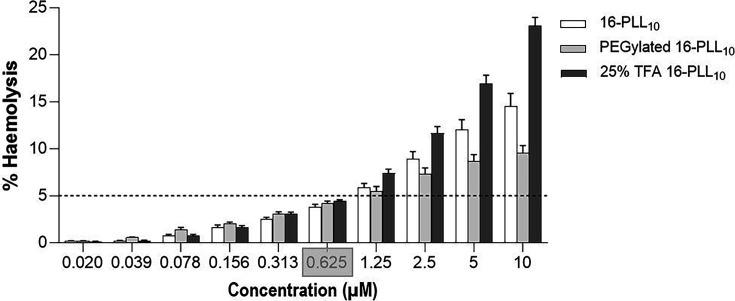
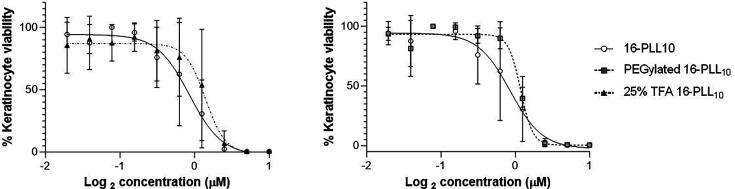
As growing numbers of patients are at higher risk of infection, novel topical broad-spectrum antimicrobials are urgently required for wound infection management. Robust pre-clinical studies should support the development of such novel antimicrobials. To date, evidence of robust investigation of the cytotoxicity and antimicrobial spectrum of activity of antimicrobial peptides (AMP)s is lacking in published literature. Using a more clinical lens, we address this gap in experimental approach, building on our experience with poly-l-lysine (PLL)-based AMP polymers. To evaluate the bactericidal activity and cytotoxicity of a PLL-based 16-armed star AMP polymer, designated 16-PLL, as a novel candidate antimicrobial. Antimicrobial susceptibilities of clinical isolates and reference strains of ESKAPE ( spp., , spp.) pathogens, to 16-PLL were investigated. Human erythrocyte haemolysis and keratinocyte viability assays were used to assess toxicity. Modifications were made to 16-PLL and re-evaluated for improvement. Minimum bactericidal concentration of 16-PLL ranged from 1.25 µM to ≥25 µM. At 2.5 µM, 16-PLL was broadly bactericidal against ESKAPE strains/wound isolates. Log-reduction in colony forming units (c.f.u.) per millilitre after 1 h, ranged from 0.3 () to 5.6 (). At bactericidal concentrations, 16-PLL was toxic to human keratinocyte and erythrocytes. Conjugates of 16-PLL, Trifluoroacetylated (TFA)-16-PLL, and Poly-ethylene glycol (PEG)ylated 16-PLL, synthesised to address toxicity, only moderately reduced cytotoxicity and haemolysis. Due to poor selectivity indices, further development of 16-PLL is unlikely warranted. However, considering the unmet need for novel topical antimicrobials, the ease of AMP polymer synthesises/modification is attractive. To support more rational development, prioritising clinically relevant pathogens and human cells, to establish selective toxicity profiles , is critical. Further characterisation and discovery utilising artificial intelligence and computational screening approaches can accelerate future AMP nanomaterial development.
随着越来越多的患者面临更高的感染风险,急需新型局部广谱抗菌药物来治疗伤口感染。稳健的临床前研究应该支持此类新型抗菌药物的开发。迄今为止,关于抗菌肽 (AMP) 的细胞毒性和抗菌谱活性的强有力的研究在已发表的文献中缺乏证据。我们从聚赖氨酸 (PLL) 为基础的 AMP 聚合物的经验出发,从更临床的角度解决了这一实验方法上的差距。为了评估一种新型候选抗菌药物,命名为 16-PLL 的基于 PLL 的 16 臂星形 AMP 聚合物的杀菌活性和细胞毒性。研究了临床分离株和 ESKAPE( spp.、 、 spp.)病原体参考株对 16-PLL 的抗菌敏感性。用人红细胞溶血和角质形成细胞活力测定法评估毒性。对 16-PLL 进行了修饰并重新评估以进行改进。16-PLL 的最低杀菌浓度范围为 1.25μM 至≥25μM。在 2.5μM 时,16-PLL 对 ESKAPE 株/伤口分离株具有广泛的杀菌作用。1 小时后每毫升菌落形成单位 (c.f.u.) 的对数减少范围为 0.3() 至 5.6()。在杀菌浓度下,16-PLL 对人角质形成细胞和红细胞有毒。为了解决毒性问题,合成了 16-PLL 的三氟乙酰化 (TFA)-16-PLL 和聚乙二醇 (PEG) 化 16-PLL 缀合物,它们仅适度降低了细胞毒性和溶血。由于选择性指数较差,进一步开发 16-PLL 不太可能是合理的。然而,考虑到对新型局部抗菌药物的迫切需求,易于合成/修饰 AMP 聚合物具有吸引力。为了支持更合理的开发,优先考虑与临床相关的病原体和人类细胞,以建立选择性毒性谱,是至关重要的。利用人工智能和计算筛选方法进一步进行特性描述和发现,可以加速未来 AMP 纳米材料的发展。
 Zotero 插件