
伊朗医疗保健自费支出的家庭经济负担:基于横断面调查的研究。
Household financial burden associated with out-of-pocket payments for healthcare in Iran: insights from a cross-sectional survey.
机构信息
Research Center for Environmental Determinants of Health, Health Institute, Kermanshah University of Medical Sciences, Kermanshah, Iran.
Hajar Teaching Hospital, Shahrekord University of Medical Sciences, Shahrekord, Iran.
出版信息
BMC Health Serv Res. 2024 Sep 13;24(1):1062. doi: 10.1186/s12913-024-11477-z.
BACKGROUND
One of the key functions and ultimate goals of health systems is to provide financial protection for individuals when using health services. This study sought to evaluate the level of financial protection and its inequality among individuals covered by the Social Security Organization (SSO) health insurance between September and December 2023 in Iran.
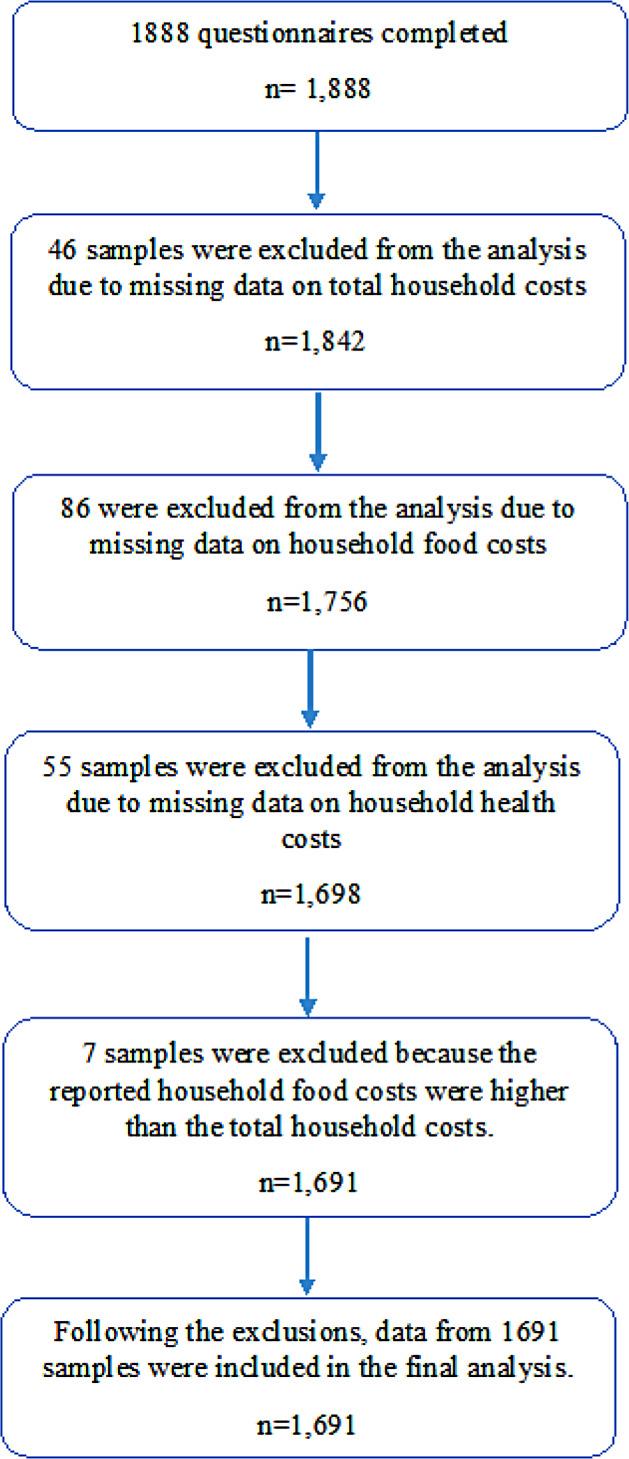
METHODS
We collected data on 1691 households in five provinces using multistage sampling to examine the prevalence of catastrophic healthcare expenditure (CHE) at four different thresholds (10%, 20%, 30%, and 40%) of the household's capacity to pay (CTP). Additionally, we explored the prevalence of impoverishment due to health costs and assessed socioeconomic-related inequality in OOP payments for healthcare using the concentration index and concentration curve. To measure equity in out-of-pocket (OOP) payments for healthcare, we utilized the Kakwani progressivity index (KPI). Furthermore, we employed multiple logistic regression to identify the main factors contributing to households experiencing CHE.
FINDINGS
The study revealed that households in our sample allocated approximately 11% of their budgets to healthcare services. The prevalence of CHE at the thresholds of 10%, 20%, 30%, and 40% was found to be 47.1%, 30.1%, 20.1%, and 15.7%, respectively. Additionally, we observed that about 7.9% of the households experienced impoverishment due to health costs. Multiple logistic regression analysis indicated that the age of the head of the household, place of residence, socioeconomic status, utilization of dental services, utilization of medicine, and province of residence were the main factors influencing CHE. Furthermore, the study demonstrated that while wealthy households spend more money on healthcare, poorer households spend a larger proportion of their total income to healthcare costs. The KPI showed that households with lower total expenditures had higher OOP payments relative to their CTP.
CONCLUSION
The study findings underscore the need for targeted interventions to improve financial protection in healthcare and mitigate inequalities among individuals covered by SSO. It is recommended that these interventions prioritize the expansion of coverage for dental services and medication expenses, particularly for lower socioeconomic status household.
背景
卫生系统的关键功能和最终目标之一是为个人在使用卫生服务时提供财务保护。本研究旨在评估 2023 年 9 月至 12 月期间伊朗社会保障组织(SSO)医疗保险覆盖人群的财务保护水平及其不平等程度。
方法
我们采用多阶段抽样方法,从五个省份的 1691 户家庭中收集数据,以检查四个不同阈值(10%、20%、30%和 40%)下家庭支付能力(CTP)的灾难性医疗支出(CHE)的发生率。此外,我们还研究了因医疗费用导致的贫困情况,并利用集中指数和集中曲线评估了 OOP 支付的社会经济相关不平等。为了衡量 OOP 支付的公平性,我们使用了 Kakwani 累进指数(KPI)。此外,我们还采用多元逻辑回归来确定导致家庭发生 CHE 的主要因素。
结果
研究表明,我们样本中的家庭将其预算的约 11%用于医疗服务。在 10%、20%、30%和 40%的阈值下, CHE 的发生率分别为 47.1%、30.1%、20.1%和 15.7%。此外,我们发现约有 7.9%的家庭因医疗费用而陷入贫困。多元逻辑回归分析表明,户主年龄、居住地、社会经济地位、牙科服务利用、药物利用和居住地省份是影响 CHE 的主要因素。此外,研究表明,富裕家庭在医疗保健方面的支出更多,但贫困家庭的医疗保健支出占总收入的比例更高。KPI 显示,总支出较低的家庭相对于其 CTP,OOP 支付更高。
结论
研究结果强调了需要采取有针对性的干预措施来改善医疗保健的财务保护,并减轻 SSO 覆盖人群的不平等。建议这些干预措施优先扩大牙科服务和药物费用的覆盖范围,特别是针对社会经济地位较低的家庭。

 Zotero 插件