
嘌呤能信号在非实质细胞中的作用。
Purinergic Signaling in Non-Parenchymal Liver Cells.
机构信息
Departamento de Biología Celular y Desarrollo, Instituto de Fisiología Celular, Universidad Nacional Autónoma de México (UNAM), Ciudad Universitaria, Mexico City 04510, Mexico.
Departamento de Neurobiología Celular y Molecular, Instituto de Neurobiología, Universidad Nacional Autónoma de México (UNAM), Boulevard Juriquilla #3001, Querétaro 76230, Mexico.
出版信息
Int J Mol Sci. 2024 Aug 30;25(17):9447. doi: 10.3390/ijms25179447.
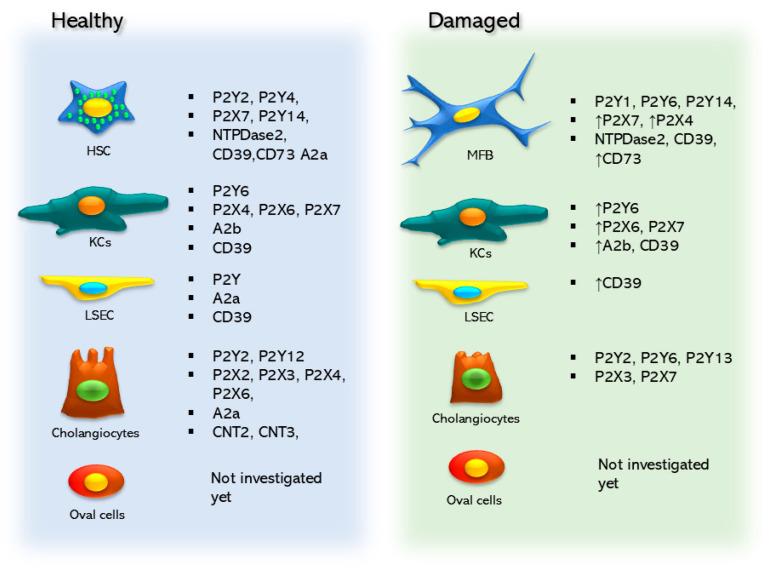
Purinergic signaling has emerged as an important paracrine-autocrine intercellular system that regulates physiological and pathological processes in practically all organs of the body. Although this system has been thoroughly defined since the nineties, recent research has made substantial advances regarding its role in aspects of liver physiology. However, most studies have mainly targeted the entire organ, 70% of which is made up of parenchymal cells or hepatocytes. Because of its physiological role, the liver is exposed to toxic metabolites, such as xenobiotics, drugs, and fatty acids, as well as to pathogens such as viruses and bacteria. Under injury conditions, all cell types within the liver undergo adaptive changes. In this context, the concentration of extracellular ATP has the potential to increase dramatically. Indeed, this purinergic response has not been studied in sufficient detail in non-parenchymal liver cells. In the present review, we systematize the physiopathological adaptations related to the purinergic system in chronic liver diseases of non-parenchymal liver cells, such as hepatic stellate cells, Kupffer cells, sinusoidal endothelial cells, and cholangiocytes. The role played by non-parenchymal liver cells in these circumstances will undoubtedly be strategic in understanding the regenerative activities that support the viability of this organ under stressful conditions.
嘌呤能信号已成为一种重要的旁分泌-自分泌细胞间系统,调节体内几乎所有器官的生理和病理过程。尽管自 90 年代以来,该系统已得到彻底定义,但最近的研究在其在肝脏生理学方面的作用方面取得了重大进展。然而,大多数研究主要针对整个器官,其中 70%由实质细胞或肝细胞组成。由于其生理作用,肝脏会暴露于有毒代谢物,如外源性化学物质、药物和脂肪酸,以及病原体,如病毒和细菌。在损伤条件下,肝脏内的所有细胞类型都会发生适应性变化。在这种情况下,细胞外 ATP 的浓度有可能会大幅增加。事实上,非实质细胞中的嘌呤能反应尚未得到充分研究。在本综述中,我们系统地阐述了非实质细胞(如肝星状细胞、枯否细胞、窦内皮细胞和胆管细胞)在慢性肝脏疾病中与嘌呤能系统相关的生理病理适应。在这些情况下,非实质细胞所起的作用对于理解在应激条件下支持该器官存活的再生活动无疑具有重要的战略意义。

 Zotero 插件