
环境灾难后的自身免疫性疾病:文献综述
Autoimmune Diseases Following Environmental Disasters: A Narrative Review of the Literature.
作者信息
Mpakosi Alexandra, Cholevas Vasileios, Tzouvelekis Ioannis, Passos Ioannis, Kaliouli-Antonopoulou Christiana, Mironidou-Tzouveleki Maria
机构信息
Department of Microbiology, General Hospital of Nikaia "Agios Panteleimon", 18454 Piraeus, Greece.
School of Medicine, University of Bologna, 40126 Bologna, Italy.
出版信息
Healthcare (Basel). 2024 Sep 4;12(17):1767. doi: 10.3390/healthcare12171767.
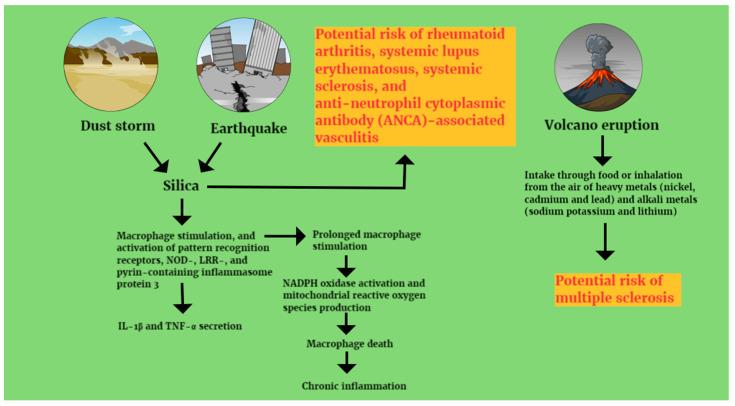
Environmental disasters are extreme environmental processes such as earthquakes, volcanic eruptions, landslides, tsunamis, floods, cyclones, storms, wildfires and droughts that are the consequences of the climate crisis due to human intervention in the environment. Their effects on human health have alarmed the global scientific community. Among them, autoimmune diseases, a heterogeneous group of disorders, have increased dramatically in many parts of the world, likely as a result of changes in our exposure to environmental factors. However, only a limited number of studies have attempted to discover and analyze the complex association between environmental disasters and autoimmune diseases. This narrative review has therefore tried to fill this gap. First of all, the activation pathways of autoimmunity after environmental disasters have been analyzed. It has also been shown that wildfires, earthquakes, desert dust storms and volcanic eruptions may damage human health and induce autoimmune responses to inhaled PM2.5, mainly through oxidative stress pathways, increased pro-inflammatory cytokines and epithelial barrier damage. In addition, it has been shown that heat stress, in addition to increasing pro-inflammatory cytokines, may also disrupt the intestinal barrier, thereby increasing its permeability to toxins and pathogens or inducing epigenetic changes. In addition, toxic volcanic elements may accelerate the progressive destruction of myelin, which may potentially trigger multiple sclerosis. The complex and diverse mechanisms by which vector-borne, water-, food-, and rodent-borne diseases that often follow environmental diseases may also trigger autoimmune responses have also been described. In addition, the association between post-disaster stress and the onset or worsening of autoimmune disease has been demonstrated. Given all of the above, the rapid restoration of post-disaster health services to mitigate the flare-up of autoimmune conditions is critical.
环境灾难是极端的环境过程,如地震、火山爆发、山体滑坡、海啸、洪水、气旋、风暴、野火和干旱,这些都是人类对环境干预导致气候危机的后果。它们对人类健康的影响已引起全球科学界的警觉。其中,自身免疫性疾病是一组异质性疾病,在世界许多地区显著增加,这可能是我们接触环境因素变化的结果。然而,只有少数研究试图发现并分析环境灾难与自身免疫性疾病之间的复杂关联。因此,本叙述性综述试图填补这一空白。首先,分析了环境灾难后自身免疫的激活途径。研究还表明,野火、地震、沙漠沙尘暴和火山爆发可能损害人类健康,并主要通过氧化应激途径、促炎细胞因子增加和上皮屏障损伤,引发对吸入的PM2.5的自身免疫反应。此外,研究表明,热应激除了增加促炎细胞因子外,还可能破坏肠道屏障,从而增加其对毒素和病原体的通透性或诱导表观遗传变化。此外,有毒的火山元素可能加速髓鞘的渐进性破坏,这可能潜在地引发多发性硬化症。文中还描述了环境疾病后常见的媒介传播、水传播、食物传播和啮齿动物传播疾病也可能引发自身免疫反应的复杂多样机制。此外,还证实了灾后应激与自身免疫性疾病的发作或恶化之间的关联。鉴于上述所有情况,迅速恢复灾后卫生服务以减轻自身免疫性疾病的爆发至关重要。


 Zotero 插件