
农村柬埔寨婴儿的粪便微生物群和细胞因子谱与饮食和腹泻发作有关。
Faecal microbiota and cytokine profiles of rural Cambodian infants linked to diet and diarrhoeal episodes.
机构信息
Microbes, Infection and Microbiomes, College of Medicine and Health, University of Birmingham, Birmingham, B15 2TT, UK.
Food, Microbiome & Health, Quadram Institute Bioscience, Norwich Research Park, Norwich, NR4 7UQ, UK.
出版信息
NPJ Biofilms Microbiomes. 2024 Sep 14;10(1):85. doi: 10.1038/s41522-024-00562-0.
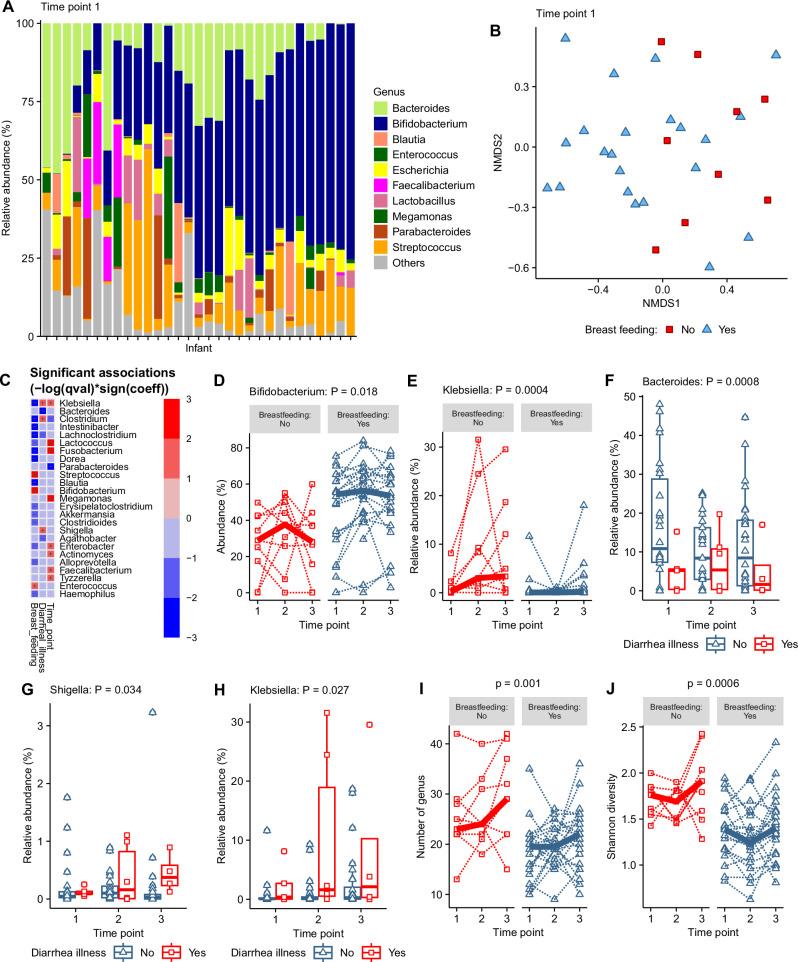
The gut microbiota of infants in low- to middle-income countries is underrepresented in microbiome research. This study explored the faecal microbiota composition and faecal cytokine profiles in a cohort of infants in a rural province of Cambodia and investigated the impact of sample storage conditions and infant environment on microbiota composition. Faecal samples collected at three time points from 32 infants were analysed for microbiota composition using 16S rRNA amplicon sequencing and concentrations of faecal cytokines. Faecal bacterial isolates were subjected to whole genome sequencing and genomic analysis. We compared the effects of two sample collection methods due to the challenges of faecal sample collection in a rural location. Storage of faecal samples in a DNA preservation solution preserved Bacteroides abundance. Microbiota analysis of preserved samples showed that Bifidobacterium was the most abundant genus with Bifidobacterium longum the most abundant species, with higher abundance in breast-fed infants. Most infants had detectable pathogenic taxa, with Shigella and Klebsiella more abundant in infants with recent diarrhoeal illness. Neither antibiotics nor infant growth were associated with gut microbiota composition. Genomic analysis of isolates showed gene clusters encoding the ability to digest human milk oligosaccharides in B. longum and B. breve isolates. Antibiotic-resistant genes were present in both potentially pathogenic species and in Bifidobacterium. Faecal concentrations of Interlukin-1alpha and vascular endothelial growth factor were higher in breast-fed infants. This study provides insights into an underrepresented population of rural Cambodian infants, showing pathogen exposure and breastfeeding impact gut microbiota composition and faecal immune profiles.
本研究旨在探索柬埔寨农村地区婴儿的粪便微生物群落组成和粪便细胞因子谱,并调查样本储存条件和婴儿环境对微生物群落组成的影响。对 32 名婴儿在三个时间点采集的粪便样本进行 16S rRNA 扩增子测序和粪便细胞因子浓度分析,以研究其粪便微生物群落组成。对粪便细菌分离株进行全基因组测序和基因组分析。由于在农村地区采集粪便样本存在挑战,我们比较了两种样本采集方法的效果。粪便样本储存在 DNA 保存溶液中可以保持拟杆菌属的丰度。保存样本的微生物群落分析表明,双歧杆菌属是最丰富的属,长双歧杆菌是最丰富的种,母乳喂养的婴儿中丰度更高。大多数婴儿都可检测到致病性分类群,具有近期腹泻病史的婴儿中志贺菌属和克雷伯菌属更为丰富。抗生素和婴儿生长均与肠道微生物群落组成无关。分离株的基因组分析表明,长双歧杆菌和短双歧杆菌分离株中存在编码消化人乳寡糖能力的基因簇。潜在的致病性物种和双歧杆菌中都存在抗生素耐药基因。母乳喂养婴儿的粪便中白细胞介素-1α和血管内皮生长因子浓度较高。本研究深入了解了柬埔寨农村地区代表性不足的婴儿人群,表明病原体暴露和母乳喂养会影响肠道微生物群落组成和粪便免疫谱。




 Zotero 插件