
启动子低甲基化与炎症性肠病的黏膜炎症及抗TNF反应相关。
Promoter Hypomethylation Is Associated With Mucosal Inflammation in IBD and Anti-TNF Response.
作者信息
Levic Daniel S, Niedzwiecki Donna, Kandakatla Apoorva, Karlovich Norah S, Juneja Arjun, Park Jieun, Stolarchuk Christina, Adams Shanté, Willer Jason R, Schaner Matthew R, Lian Grace, Beasley Caroline, Marjoram Lindsay, Flynn Ann D, Valentine John F, Onken Jane E, Sheikh Shehzad Z, Davis Erica E, Evason Kimberley J, Garman Katherine S, Bagnat Michel
机构信息
Department of Cell Biology, Duke University, Durham, North Carolina.
Department of Biostatistics and Bioinformatics, Duke University School of Medicine, Durham, North Carolina.
出版信息
Gastro Hep Adv. 2024 Jun 27;3(7):888-898. doi: 10.1016/j.gastha.2024.06.010. eCollection 2024.
BACKGROUND AND AIMS
Inflammatory bowel diseases (IBDs) are chronic inflammatory conditions influenced heavily by environmental factors. DNA methylation is a form of epigenetic regulation linking environmental stimuli to gene expression changes and inflammation. Here, we investigated how DNA methylation of the tumor necrosis factor (TNF) promoter differs between inflamed and uninflamed mucosa of IBD patients, including anti-TNF responders and nonresponders.
METHODS
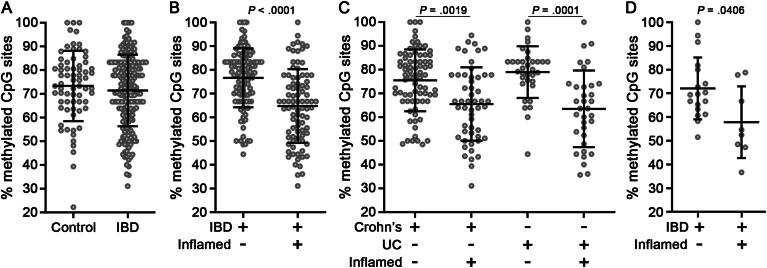
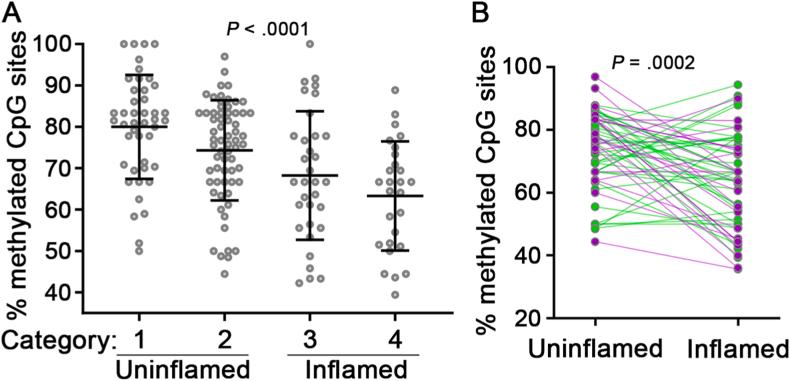
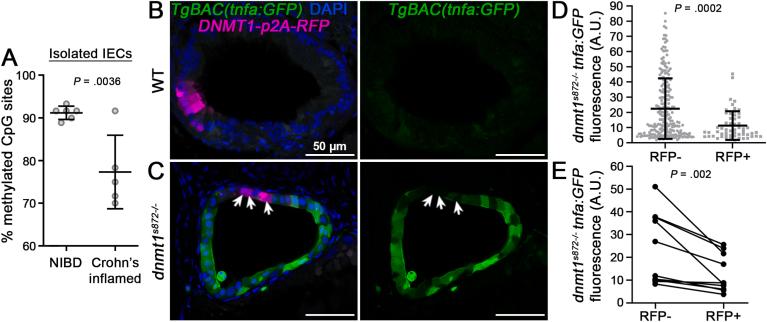
We obtained mucosal biopsies from 200 participants (133 IBDs and 67 controls) and analyzed TNF promoter methylation using bisulfite sequencing, comparing inflamed with uninflamed segments, in addition to paired inflamed/uninflamed samples from individual patients. We conducted similar analyses on purified intestinal epithelial cells from bowel resections. We also compared TNF methylation levels of inflamed and uninflamed mucosa from a separate cohort of 15 anti-TNF responders and 17 nonresponders. Finally, we sequenced DNA methyltransferase genes to identify rare variants in IBD patients and functionally tested them using rescue experiments in a zebrafish genetic model of DNA methylation deficiency.
RESULTS
TNF promoter methylation levels were decreased in inflamed mucosa of IBD patients and correlated with disease severity. Isolated intestinal epithelial cells from inflamed tissue showed proportional decreases in TNF methylation. Anti-TNF nonresponders showed lower levels of TNF methylation than responders in uninflamed mucosa. Our sequencing analysis revealed 2 missense variants in DNA methyltransferase 1, 1 of which had reduced function in vivo.
CONCLUSION
Our study reveals an association of TNF promoter hypomethylation with mucosal inflammation, suggesting that IBD patients may be particularly sensitive to inflammatory environmental insults affecting DNA methylation. Together, our analyses indicate that TNF promoter methylation analysis may aid in the characterization of IBD status and evaluation of anti-TNF therapy response.
背景与目的
炎症性肠病(IBD)是受环境因素严重影响的慢性炎症性疾病。DNA甲基化是一种表观遗传调控形式,将环境刺激与基因表达变化及炎症联系起来。在此,我们研究了肿瘤坏死因子(TNF)启动子的DNA甲基化在IBD患者发炎和未发炎黏膜之间的差异,包括抗TNF治疗反应者和无反应者。
方法
我们从200名参与者(133例IBD患者和67名对照)获取黏膜活检样本,使用亚硫酸氢盐测序分析TNF启动子甲基化,比较发炎与未发炎节段,以及个体患者配对的发炎/未发炎样本。我们对肠切除标本中纯化的肠上皮细胞进行了类似分析。我们还比较了来自另一组15名抗TNF治疗反应者和17名无反应者的发炎和未发炎黏膜的TNF甲基化水平。最后,我们对DNA甲基转移酶基因进行测序,以鉴定IBD患者中的罕见变异,并在DNA甲基化缺陷的斑马鱼遗传模型中通过拯救实验对其进行功能测试。
结果
IBD患者发炎黏膜中TNF启动子甲基化水平降低,且与疾病严重程度相关。来自发炎组织的分离肠上皮细胞显示TNF甲基化呈比例降低。在未发炎黏膜中,抗TNF治疗无反应者的TNF甲基化水平低于反应者。我们的测序分析揭示了DNA甲基转移酶1中的2个错义变异,其中1个在体内功能降低。
结论
我们的研究揭示了TNF启动子低甲基化与黏膜炎症的关联,表明IBD患者可能对影响DNA甲基化的炎性环境损伤特别敏感。总之,我们的分析表明,TNF启动子甲基化分析可能有助于IBD病情的特征化及抗TNF治疗反应的评估。



 Zotero 插件