
基于居住地址的室外空气污染暴露评估是否会导致流行病学研究产生偏倚?
Does residential address-based exposure assessment for outdoor air pollution lead to bias in epidemiological studies?
机构信息
Institute for Risk Assessment Sciences, Utrecht University, Utrecht, The Netherlands.
Swiss Tropical and Public Health Institute, Allschwil, Switzerland.
出版信息
Environ Health. 2024 Sep 17;23(1):75. doi: 10.1186/s12940-024-01111-0.
BACKGROUND
Epidemiological studies of long-term exposure to outdoor air pollution have consistently documented associations with morbidity and mortality. Air pollution exposure in these epidemiological studies is generally assessed at the residential address, because individual time-activity patterns are seldom known in large epidemiological studies. Ignoring time-activity patterns may result in bias in epidemiological studies. The aims of this paper are to assess the agreement between exposure assessed at the residential address and exposures estimated with time-activity integrated and the potential bias in epidemiological studies when exposure is estimated at the residential address.
MAIN BODY
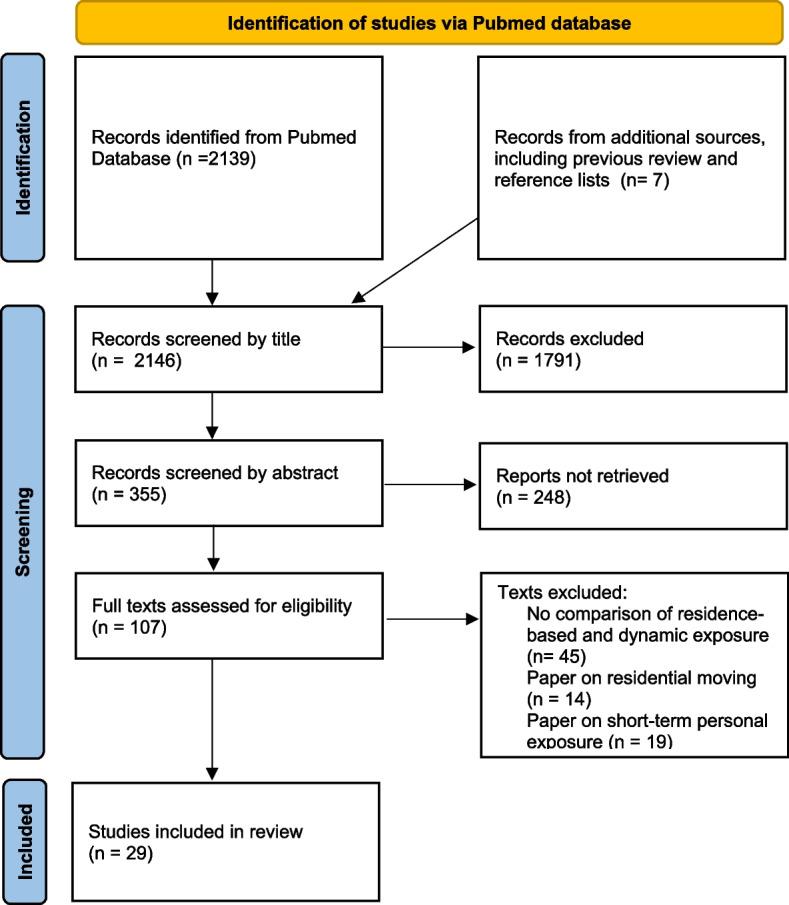
We reviewed exposure studies that have compared residential and time-activity integrated exposures, with a focus on the correlation. We further discuss epidemiological studies that have compared health effect estimates between the residential and time-activity integrated exposure and studies that have indirectly estimated the potential bias in health effect estimates in epidemiological studies related to ignoring time-activity patterns. A large number of studies compared residential and time-activity integrated exposure, especially in Europe and North America, mostly focusing on differences in level. Eleven of these studies reported correlations, showing that the correlation between residential address-based and time-activity integrated long-term air pollution exposure was generally high to very high (R > 0.8). For individual subjects large differences were found between residential and time-activity integrated exposures. Consistent with the high correlation, five of six identified epidemiological studies found nearly identical health effects using residential and time-activity integrated exposure. Six additional studies in Europe and North America showed only small to moderate potential bias (9 to 30% potential underestimation) in estimated exposure response functions using residence-based exposures. Differences of average exposure level were generally small and in both directions. Exposure contrasts were smaller for time-activity integrated exposures in nearly all studies. The difference in exposure was not equally distributed across the population including between different socio-economic groups.
CONCLUSIONS
Overall, the bias in epidemiological studies related to assessing long-term exposure at the residential address only is likely small in populations comparable to those evaluated in the comparison studies. Further improvements in exposure assessment especially for large populations remain useful.
背景
长期暴露于户外空气污染的流行病学研究一致记录了与发病率和死亡率之间的关联。在这些流行病学研究中,空气污染暴露通常是根据居住地址进行评估的,因为在大型流行病学研究中,个人的时间活动模式很少被知晓。忽略时间活动模式可能会导致流行病学研究产生偏差。本文的目的是评估在居住地址评估的暴露与通过时间活动综合评估的暴露之间的一致性,以及当暴露在居住地址评估时,在流行病学研究中可能存在的偏差。
主要内容
我们回顾了比较居住地址和时间活动综合暴露的暴露研究,重点关注相关性。我们进一步讨论了比较健康效应估计值的流行病学研究,这些研究比较了居住地址和时间活动综合暴露之间的健康效应估计值,以及间接估计了忽略时间活动模式与流行病学研究中健康效应估计值相关的潜在偏差的研究。大量研究比较了居住地址和时间活动综合暴露,特别是在欧洲和北美,主要侧重于水平差异。其中 11 项研究报告了相关性,表明基于居住地址的和时间活动综合的长期空气污染暴露之间的相关性通常很高至非常高(R>0.8)。对于个体受试者,在居住地址和时间活动综合暴露之间发现了很大的差异。与高相关性一致,六项已识别的流行病学研究中的五项使用居住地址和时间活动综合暴露发现了几乎相同的健康影响。欧洲和北美的另外六项研究表明,使用基于居住的暴露估计暴露反应函数仅存在小至中度的潜在偏差(9%至 30%的潜在低估)。平均暴露水平的差异通常较小,且在两个方向上均存在。在几乎所有研究中,时间活动综合暴露的暴露对比都较小。暴露差异在人群中分布不均,包括不同社会经济群体之间。
结论
总体而言,在与比较研究中评估的人群相比,仅在居住地址评估长期暴露的流行病学研究中,偏差可能很小。进一步改善暴露评估,特别是对于大型人群,仍然是有用的。
 Zotero 插件