
溶原性丝状噬菌体Pf会减缓黏液纤毛运输。
The lysogenic filamentous bacteriophage phage Pf slows mucociliary transport.
作者信息
Burgener Elizabeth B, Cai Pamela C, Kratochvil Michael J, Rojas-Hernandez Laura S, Joo Nam Soo, Gupta Aditi, Secor Patrick R, Heilshorn Sarah C, Spakowitz Andrew J, Wine Jeffrey J, Bollyky Paul L, Milla Carlos E
机构信息
Department of Pediatrics, Center for Excellence in Pulmonary Biology, Stanford University, Stanford, CA 94305, USA.
Division of Pediatric Pulmonology and Sleep Medicine, Children's Hospital of Los Angeles, Keck School of Medicine, University of Southern California, Los Angeles, CA 90027, USA.
出版信息
PNAS Nexus. 2024 Sep 9;3(9):pgae390. doi: 10.1093/pnasnexus/pgae390. eCollection 2024 Sep.
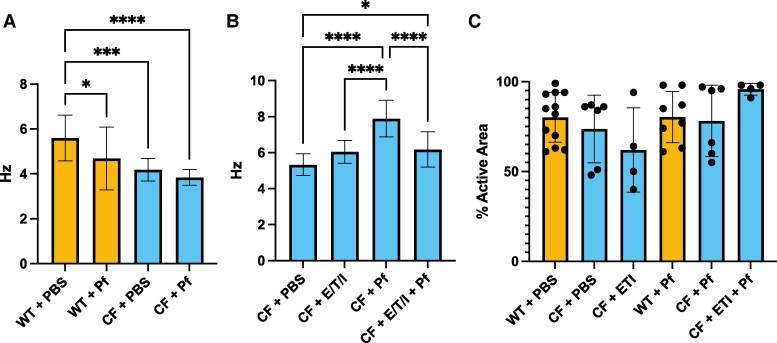
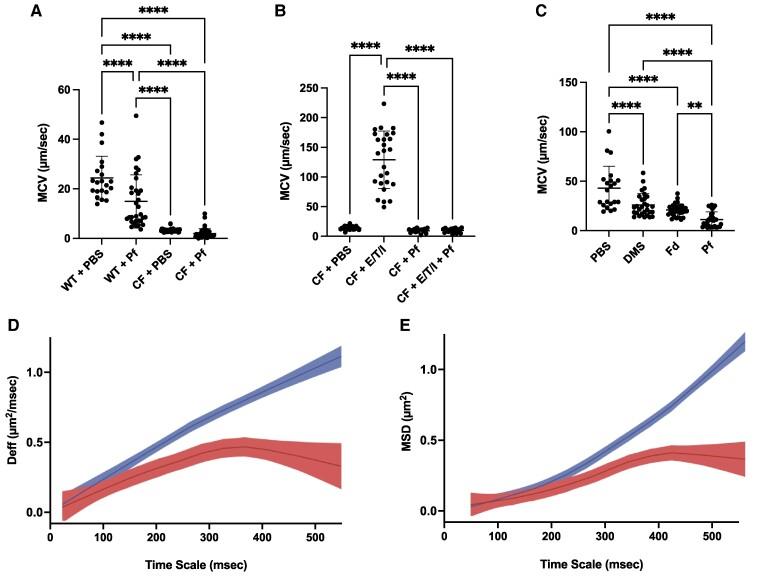
is a major pulmonary pathogen causing chronic pulmonary infections in people with cystic fibrosis (CF). The and lysogenic bacteriophage, Pf phage, is abundant in the airways of many people with CF and has been associated with poor outcomes in a cross-sectional cohort study. Previous studies have identified roles for Pf phage in biofilm formation, specifically forming higher-order birefringent, liquid crystals when in contact with other biopolymers in biofilms. Liquid crystalline biofilms are more adherent and viscous than those without liquid crystals. A key feature of biofilms is to enhance bacterial adherence and resist physical clearance. The effect of Pf phage on mucociliary transport is unknown. We found that primary CF and non-CF nasal epithelial cells cultured at air-liquid interface treated with Pf phage exhibit liquid crystalline structures in the overlying mucus. On these cell cultures, Pf phage entangles cilia but does not affect ciliary beat frequency. In both these in vitro cell cultures and in an ex vivo porcine trachea model, introduction of Pf phage decreases mucociliary transport velocity. Pf phage also blocks the rescue of mucociliary transport by CF transmembrane conductance regulator modulators in CF cultures. Thus, Pf phage may contribute to the pathogenesis of -associated CF lung disease via induction of liquid crystalline characteristics to airway secretions, leading to impaired mucociliary transport. Targeting Pf phage may be useful in treatment CF as well as other settings of chronic infections.
是一种主要的肺部病原体,可导致囊性纤维化(CF)患者发生慢性肺部感染。温和噬菌体Pf噬菌体在许多CF患者的气道中大量存在,并且在一项横断面队列研究中与不良预后相关。先前的研究已经确定了Pf噬菌体在生物膜形成中的作用,特别是当与生物膜中的其他生物聚合物接触时形成高阶双折射液晶。液晶生物膜比没有液晶的生物膜更具粘附性和粘性。生物膜的一个关键特征是增强细菌粘附并抵抗物理清除。Pf噬菌体对黏液纤毛运输的影响尚不清楚。我们发现,在气液界面培养并用Pf噬菌体处理的原发性CF和非CF鼻上皮细胞在上覆黏液中呈现液晶结构。在这些细胞培养物上,Pf噬菌体缠绕纤毛但不影响纤毛摆动频率。在这些体外细胞培养物和离体猪气管模型中,引入Pf噬菌体均可降低黏液纤毛运输速度。Pf噬菌体还可阻断CF培养物中CF跨膜电导调节剂对黏液纤毛运输的挽救作用。因此,Pf噬菌体可能通过诱导气道分泌物的液晶特性,导致黏液纤毛运输受损,从而促进与相关的CF肺部疾病的发病机制。靶向Pf噬菌体可能对治疗CF以及其他慢性感染情况有用。


 Zotero 插件