
采用10千赫兹脊髓刺激治疗疼痛性糖尿病神经病变:2型糖尿病患者在疼痛缓解的同时,糖化血红蛋白、体重和睡眠方面也有长期改善。
Treatment of Painful Diabetic Neuropathy with 10 kHz Spinal Cord Stimulation: Long-Term Improvements in Hemoglobin A1c, Weight, and Sleep Accompany Pain Relief for People with Type 2 Diabetes.
作者信息
Klonoff David C, Levy Brian L, Jaasma Michael J, Bharara Manish, Edgar Deborah R, Nasr Christian, Caraway David L, Petersen Erika A, Armstrong David G
机构信息
Diabetes Research Institute, Mills-Peninsula Medical Center, San Mateo, CA, USA.
New York University Grossman School of Medicine, New York, NY, USA.
出版信息
J Pain Res. 2024 Sep 18;17:3063-3074. doi: 10.2147/JPR.S463383. eCollection 2024.
PURPOSE
The recent SENZA-PDN study showed that high-frequency (10kHz) spinal cord stimulation (SCS) provided significant, durable pain relief for individuals with painful diabetic neuropathy (PDN), along with secondary benefits, including improved sleep quality and HRQoL. Given that metabolic factors and chronic neuropathic pain are related, we evaluated potential secondary effects of 10kHz SCS on hemoglobin A1c (HbA1c) and weight in SENZA-PDN participants with type 2 diabetes (T2D).
PATIENTS AND METHODS
This analysis included 144 participants with T2D and lower limb pain due to PDN who received 10kHz SCS during the SENZA-PDN study. Changes in HbA1c, weight, pain intensity, and sleep were evaluated over 24 months, with participants stratified according to preimplantation HbA1c (>7% and >8%) and body mass index (BMI; ≥30 and ≥35 kg/m).
RESULTS
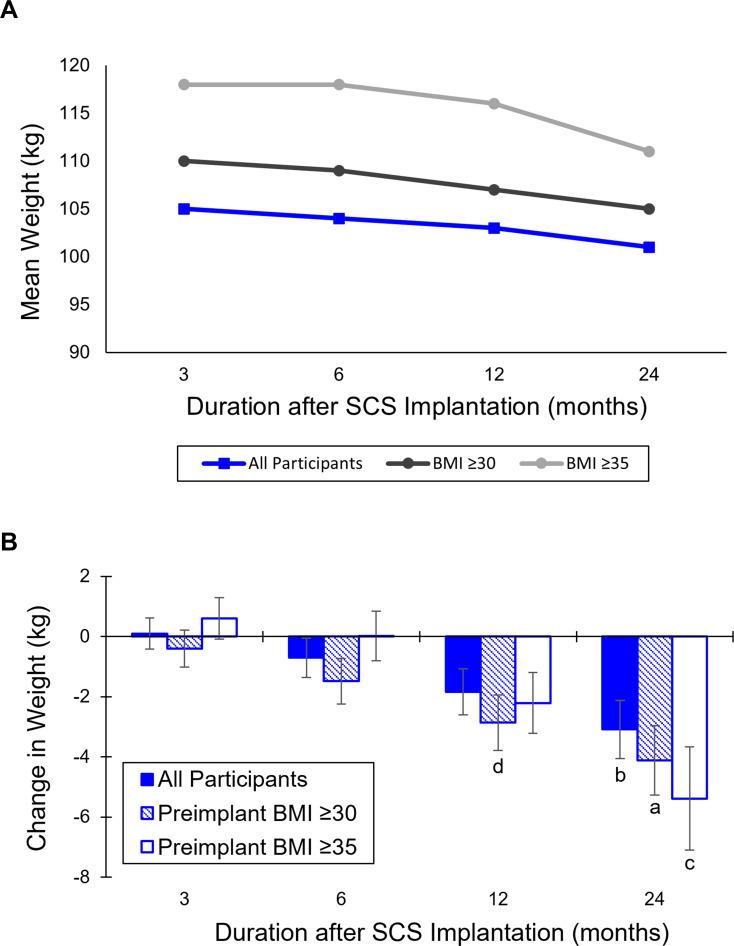
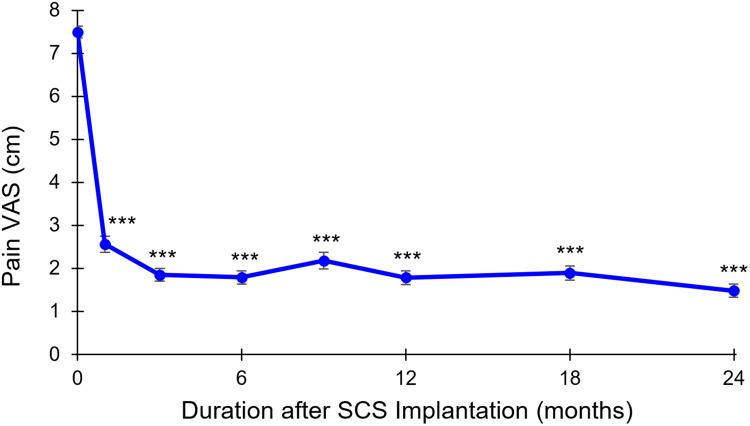
At 24 months, participants with preimplantation HbA1c >7% and >8% achieved clinically meaningful and statistically significant mean reductions in HbA1c of 0.5% ( = 0.031) and 1.1% ( = 0.004), respectively. Additionally, we observed a significant mean weight loss of 3.1 kg ( = 0.003) across all study participants. In subgroups with BMI ≥30 and ≥35 kg/m, weight reductions at 24 months were 4.1 kg ( = 0.001) and 5.4 kg ( = 0.005), respectively. These reductions were accompanied by a mean pain reduction of 79.8% and a mean decrease in pain interference with sleep of 65.2% at 24 months across all cohorts.
CONCLUSION
This is the first study of SCS to demonstrate long-term, significant, and clinically meaningful reductions in HbA1c and weight in study participants with PDN and T2D, particularly among those with elevated preimplantation HbA1c and BMI. Although the mechanism for these improvements has yet to be established, the results suggest possible direct and indirect metabolic benefits with 10kHz SCS in addition to durable pain relief.
TRIAL REGISTRATION
ClincalTrials.gov Identifier, NCT03228420.
目的
近期的SENZA - PDN研究表明,高频(10kHz)脊髓刺激(SCS)为患有疼痛性糖尿病神经病变(PDN)的个体提供了显著、持久的疼痛缓解,以及包括改善睡眠质量和健康相关生活质量(HRQoL)在内的次要益处。鉴于代谢因素与慢性神经病理性疼痛相关,我们评估了10kHz SCS对SENZA - PDN研究中2型糖尿病(T2D)参与者的糖化血红蛋白(HbA1c)和体重的潜在次要影响。
患者与方法
该分析纳入了144名因PDN导致下肢疼痛的T2D患者,这些患者在SENZA - PDN研究期间接受了10kHz SCS。在24个月内评估HbA1c、体重、疼痛强度和睡眠的变化,参与者根据植入前HbA1c(>7%和>8%)和体重指数(BMI;≥30和≥35 kg/m²)进行分层。
结果
在24个月时,植入前HbA1c>7%和>8%的参与者的HbA1c平均降低分别达到具有临床意义且在统计学上显著的0.5%(P = 0.031)和1.1%(P = 0.004)。此外,我们观察到所有研究参与者的平均体重显著减轻3.1 kg(P = 0.003)。在BMI≥30和≥35 kg/m²的亚组中,24个月时体重减轻分别为4.1 kg(P = 0.001)和5.4 kg(P = 0.005)。在所有队列中,这些体重减轻伴随着24个月时平均疼痛减轻79.8%以及疼痛对睡眠干扰的平均减少65.2%。
结论
这是第一项关于SCS的研究,证明了在患有PDN和T2D的研究参与者中,HbA1c和体重出现长期、显著且具有临床意义的降低,特别是在植入前HbA1c和BMI升高的参与者中。尽管这些改善的机制尚未确定,但结果表明10kHz SCS除了能持久缓解疼痛外,还可能带来直接和间接的代谢益处。
试验注册
ClinicalTrials.gov标识符,NCT03228420。


 Zotero 插件