
用于生物系统中双通道成像和优异铁离子传感的L-半胱氨酸封端的二硫化钼量子点
l-cysteine capped MoS QDs for dual-channel imaging and superior Fe ion sensing in biological systems.
作者信息
Takhar Vishakha, Singh Simranjit, Misra Superb K, Banerjee Rupak
机构信息
Department of Physics, Indian Institute of Technology Gandhinagar Palaj Gandhinagar 382355 India
Materials Engineering, Indian Institute of Technology Gandhinagar Palaj Gandhinagar 382355 India.
出版信息
Nanoscale Adv. 2024 Sep 13;6(22):5694-707. doi: 10.1039/d4na00505h.
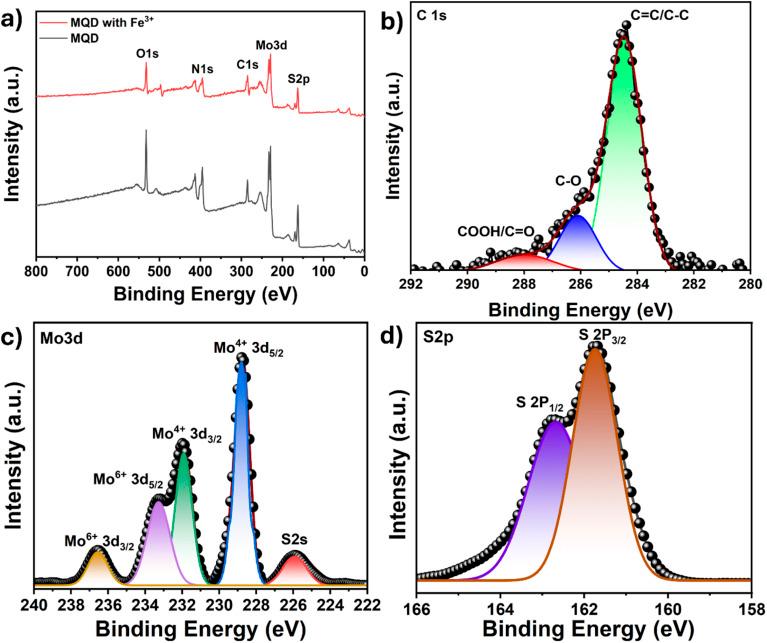
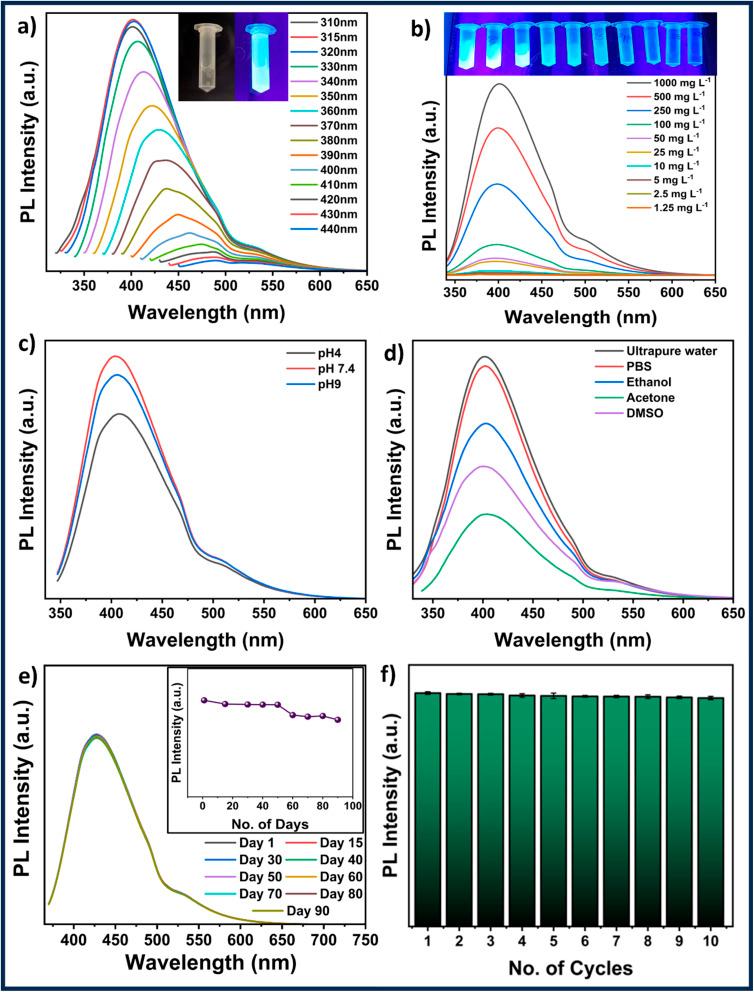
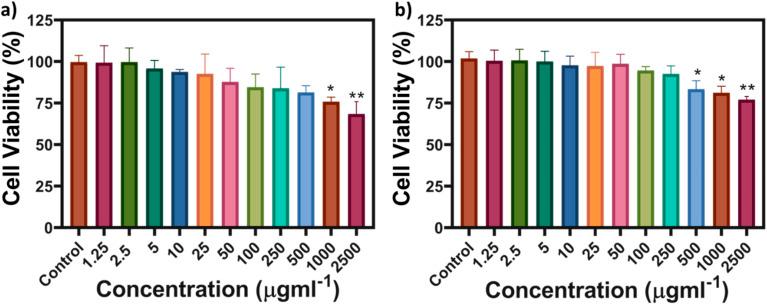
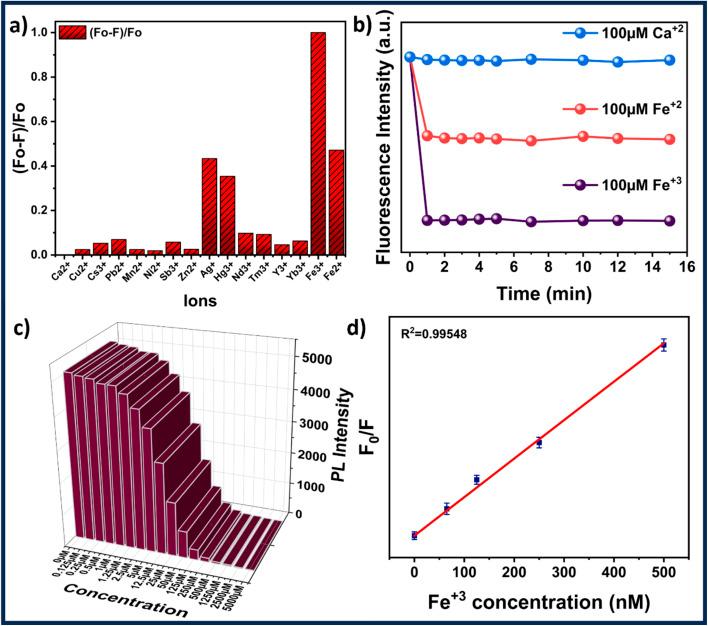
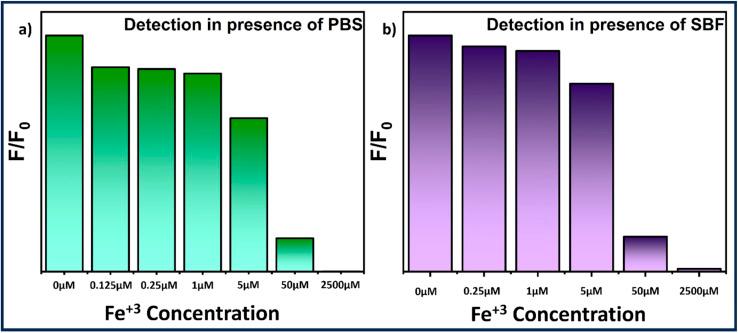
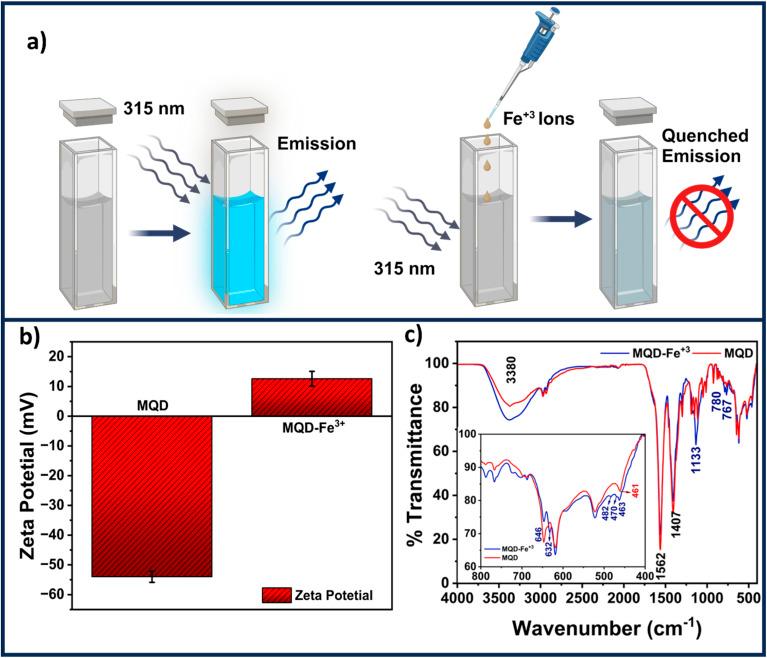
MoS quantum dots (MQDs) with an average size of 1.9 ± 0.7 nm were synthesized using a microwave-assisted method. Absorbance studies confirmed characteristic transitions of MoS, with absorption humps at 260-280 nm and 300-330 nm, and a band gap of 3.6 ± 0.1 eV. Fluorescence emission studies showed dominant blue and some green emissions under 315 nm excitation, with an absolute quantum yield of ∼9%. The MQDs exhibited fluorescence stability over time after repeated quenching cycles across various pH and media systems. toxicity tests indicated cytocompatibility, with around 80% cell survival at 1000 mg L. Confocal imaging demonstrated significant uptake and vibrant fluorescence in cancerous and non-cancerous cell lines. The MQDs showed strong selectivity towards Fe ions, with a detection limit of 27.61 ± 0.25 nM. Recovery rates for Fe in phosphate buffer saline (PBS) and simulated body fluid (SBF) systems were >97% and >98%, respectively, with a relative standard deviation (RSD) within 3%, indicating precision. These findings suggest that MQDs have high potential for diagnostic applications involving Fe detection due to their fluorescence stability, robustness, enhanced cell viability, and dual-channel imaging properties.
采用微波辅助法合成了平均尺寸为1.9±0.7nm的二硫化钼量子点(MQDs)。吸光度研究证实了二硫化钼的特征跃迁,在260 - 280nm和300 - 330nm处有吸收峰,带隙为3.6±0.1eV。荧光发射研究表明,在315nm激发下,主要发射蓝光和一些绿光,绝对量子产率约为9%。在各种pH和介质系统中经过反复猝灭循环后,MQDs随时间表现出荧光稳定性。毒性测试表明其具有细胞相容性,在1000mg/L时细胞存活率约为80%。共聚焦成像显示在癌细胞系和非癌细胞系中均有显著摄取和强烈荧光。MQDs对铁离子表现出很强的选择性,检测限为27.61±0.25nM。在磷酸盐缓冲盐水(PBS)和模拟体液(SBF)系统中铁的回收率分别>97%和>98%,相对标准偏差(RSD)在3%以内,表明具有精密度。这些发现表明,由于其荧光稳定性、稳健性、增强的细胞活力和双通道成像特性,MQDs在涉及铁检测的诊断应用中具有很高的潜力。


 Zotero 插件