
世界过敏组织(WAO)牛奶过敏诊断与治疗指南更新 - XI - 患有牛奶蛋白过敏的婴幼儿的奶粉补充剂/替代配方奶粉 - 系统评价
World Allergy Organization (WAO) Diagnosis and Rationale for Action against Cow's Milk Allergy (DRACMA) guideline update - XI - Milk supplement/replacement formulas for infants and toddlers with CMA - Systematic review.
作者信息
Bognanni Antonio, Firmino Ramon T, Arasi Stefania, Chu Derek K, Chu Alexandro W L, Waffenschmidt Siw, Agarwal Arnav, Dziechciarz Piotr, Horvath Andrea, Mihara Hanako, Roldan Yetiani, Terracciano Luigi, Martelli Alberto, Starok Anna, Said Maria, Shamir Raanan, Ansotegui Ignacio J, Dahdah Lamia, Ebisawa Motohiro, Galli Elena, Kamenwa Rose, Lack Gideon, Li Haiqi, Pawankar Ruby, Warner Amena, Wong Gary Wing Kin, Bozzola Martin, Assa'Ad Amal, Dupont Christophe, Bahna Sami, Spergel Jonathan, Venter Carina, Szajewska Hania, Nowak-Wegrzyn Anna H, Vandenplas Yvan, Papadopoulos Nikolaos G, Waserman Susan, Fiocchi Alessandro, Schünemann Holger J, Brożek Jan L
机构信息
Department of Health Research Methods, Evidence & Impact, McMaster University, Hamilton, Ontario, Canada.
Clinical Epidemiology and Research Center (CERC), Humanitas University & Humanitas Research Hospital, Pieve Emanuele, Milano, Italy.
出版信息
World Allergy Organ J. 2024 Sep 10;17(9):100947. doi: 10.1016/j.waojou.2024.100947. eCollection 2024 Sep.
BACKGROUND
Cow's milk allergy (CMA) is the most complex and common food allergy in infants. Elimination of cow's milk from the diet and replacement with a specialized formula for infants with cow's milk allergy who cannot be breastfed is an established approach to minimize the risk of severe allergic reactions while avoiding nutritional deficiencies. Given the availability of multiple options, such as extensively hydrolyzed cow's milk-based formula (eHF-CM), aminoacid formula (AAF), hydrolyzed rice formula (HRF), and soy formula (SF), there is some uncertainty regarding which formula might represent the most suitable choice with respect to health outcomes. The addition of probiotics to a specialized formula has also been proposed as a potential approach to possibly increase the benefit. We systematically reviewed specialized formulas for infants with CMA to inform the updated World Allergy Organization (WAO) DRACMA guidelines.
OBJECTIVE
To systematically review and synthesize the available evidence about the use of specialized formulas for the management of individuals with CMA.
METHODS
We searched from inception PubMed, Medline, Embase, the Cochrane Central Register of Controlled Trials (CENTRAL), and the websites of selected allergy organizations, for randomized and non-randomized trials of any language investigating specialized formulas with or without probiotics. We included all studies irrespective of the language of the original publication. The last search was conducted in January 2024. We synthesized the identified evidence quantitatively or narratively as appropriate and summarized it in the evidence profiles. We conducted this review following the PRISMA, Cochrane methods, and the GRADE approach.
RESULTS
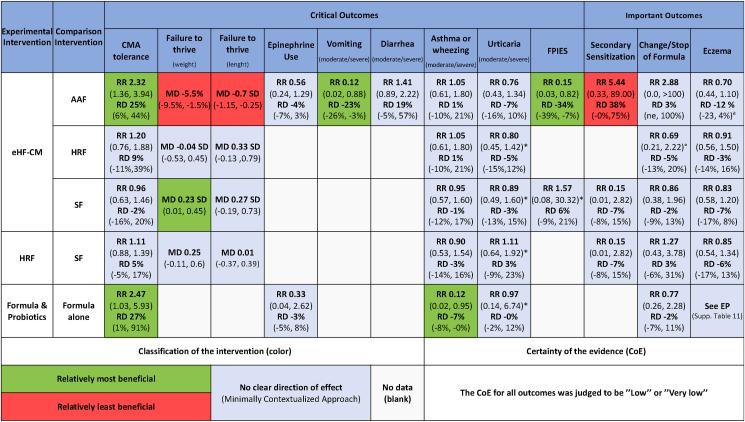
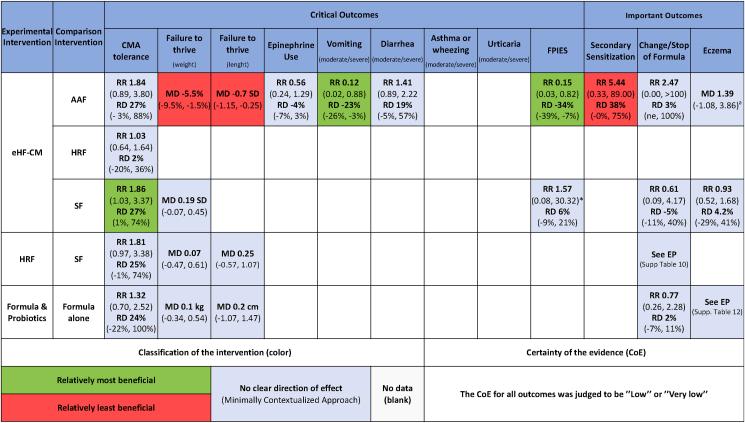
We identified 3558 records including 14 randomized trials and 7 observational studies. Very low certainty evidence suggested that in infants with IgE-mediated CMA, eHF-CM, compared with AAF, might have higher probability of outgrowing CMA (risk ratio (RR) 2.32; risk difference (RD) 25 more per 100), while showing potentially lower probability of severe vomiting (RR 0.12, 95% CI 0.02 to 0.88; RD 23 fewer per 100, 95% CI 3 to 26) and developing food protein-induced enterocolitis syndrome (FPIES) (RR 0.15, 95% CI 0.03 to 0.82; RD 34 fewer per 100, 95% CI 7 to 39). We also found, however, that eHF-CM might be inferior to AAF in supporting a physiological growth, with respect to both weight (-5.5% from baseline, 95%CI -9.5% to -1.5%) and length (-0.7 z-score change, 95%CI -1.15 to -0.25) (very low certainty). We found similar effects for eHF-CM, compared with AAF, also in non-IgE CMA. When compared with SF, eHF-CM might favor weight gain for IgE CMA infants (0.23 z-score change, 95%CI 0.01 to 0.45), and tolerance acquisition (RR 1.86, 95%CI 1.03 to 3.37; RD 27%, 95%CI 1%-74%) for non-IgE CMA (both at very low certainty of the evidence (CoE)). The comparison of eHF-CM vs. HRF, and HRF vs. SF, showed no difference in effect (very low certainty). For IgE CMA patients, low certainty evidence suggested that adding probiotics ( CRL431 Bb-12) might increase the probability of developing CMA tolerance (RR 2.47, 95%CI 1.03 to 5.93; RD 27%, 95%CI 1%-91%), and reduce the risk of severe wheezing (RR 0.12, 95%CI 0.02 to 0.95; RD -23%, 95%CI -8% to -0.4%). However, in non-IgE CMA infants, the addition of probiotics ( GG) showed no significant effect, as supported by low to very low CoE.
CONCLUSIONS
Currently available studies comparing eHF-CM, AAF, HRF, and SF provide very low certainty evidence about their effects in infants with IgE-mediated and non-IgE-mediated CMA. Our review revealed several limitations in the current body of evidence, primarily arising from concerns related to the quality of studies, the limited size of the participant populations and most importantly the lack of diversity and standardization in the compared interventions. It is therefore imperative for future studies to be methodologically rigorous and investigate a broader spectrum of available interventions. We encourage clinicians and researchers to review current World Allergy Organization (WAO) Diagnosis and Rationale for Action against Cow's Milk Allergy (DRACMA) Guidelines for suggestions on how to use milk replacement formulas in clinical practice and what additional research would be the most beneficial.
背景
牛奶过敏(CMA)是婴儿期最复杂且常见的食物过敏。对于无法进行母乳喂养的牛奶过敏婴儿,从饮食中去除牛奶并用特殊配方奶粉替代,是一种既定的方法,可将严重过敏反应的风险降至最低,同时避免营养缺乏。鉴于有多种选择,如深度水解牛奶配方奶粉(eHF-CM)、氨基酸配方奶粉(AAF)、水解大米配方奶粉(HRF)和大豆配方奶粉(SF),关于哪种配方奶粉在健康结果方面可能是最合适的选择存在一些不确定性。在特殊配方奶粉中添加益生菌也被提议作为一种可能增加益处的潜在方法。我们系统回顾了用于CMA婴儿的特殊配方奶粉,以为世界过敏组织(WAO)更新的牛奶过敏诊断与治疗指南(DRACMA)提供参考。
目的
系统回顾和综合关于使用特殊配方奶粉管理CMA患者的现有证据。
方法
我们从创刊号开始检索了PubMed、Medline、Embase、Cochrane对照试验中心注册库(CENTRAL)以及选定过敏组织的网站,以查找任何语言的随机和非随机试验,这些试验研究了含或不含益生菌的特殊配方奶粉。我们纳入了所有研究,无论原始出版物的语言是什么。最后一次检索于2024年1月进行。我们根据情况对已识别的证据进行了定量或叙述性综合,并在证据概况中进行了总结。我们按照PRISMA、Cochrane方法和GRADE方法进行了本综述。
结果
我们识别出3558条记录,包括14项随机试验和7项观察性研究。极低确定性证据表明,在IgE介导的CMA婴儿中,与AAF相比,eHF-CM可能有更高的CMA自愈概率(风险比(RR)2.32;风险差(RD)每100人多25例),同时严重呕吐的概率可能更低(RR 0.12,95%置信区间0.02至0.88;RD每100人少23例,95%置信区间3至26),发生食物蛋白诱导的小肠结肠炎综合征(FPIES)的概率也更低(RR 0.15,95%置信区间0.03至0.82;RD每100人少34例,95%置信区间7至39)。然而,我们还发现,在支持生理生长方面,eHF-CM可能不如AAF,无论是体重(较基线下降5.5%,95%置信区间-9.5%至-1.5%)还是身长(z评分变化-0.7,95%置信区间-1.15至-0.25)(极低确定性)。在非IgE介导的CMA中,与AAF相比,eHF-CM也有类似的效果。与SF相比,eHF-CM可能有利于IgE介导的CMA婴儿体重增加(z评分变化0.23,95%置信区间0.01至0.45),对于非IgE介导的CMA,有利于获得耐受性(RR 1.86,95%置信区间1.03至3.37;RD 27%,95%置信区间1%至74%)(证据的确定性均极低)。eHF-CM与HRF以及HRF与SF的比较显示效果无差异(极低确定性)。对于IgE介导的CMA患者,低确定性证据表明添加益生菌(CRL431 Bb-12)可能增加CMA耐受性形成的概率(RR 2.47,95%置信区间1.03至5.93;RD 27%,95%置信区间1%至91%),并降低严重喘息的风险(RR 0.12,95%置信区间0.02至0.95;RD -23%,95%置信区间-8%至-0.4%)。然而,在非IgE介导的CMA婴儿中,添加益生菌(GG)没有显著效果,证据的确定性为低到极低。
结论
目前比较eHF-CM、AAF、HRF和SF的研究提供了关于它们在IgE介导和非IgE介导的CMA婴儿中效果的极低确定性证据。我们的综述揭示了当前证据体系中的几个局限性,主要源于对研究质量的担忧、参与人群规模有限,最重要的是比较的干预措施缺乏多样性和标准化。因此,未来的研究必须在方法上严谨,并研究更广泛的可用干预措施。我们鼓励临床医生和研究人员查阅世界过敏组织(WAO)的牛奶过敏诊断与治疗指南(DRACMA),以获取关于如何在临床实践中使用牛奶替代配方奶粉以及哪些额外研究最有益的建议。

 Zotero 插件