
优化治疗中的权力关系与抗生素获取公平性(PROTEA)研究:调查社会经济和文化驱动因素在印度和南非对抗菌素耐药性(AMR)的交叉影响及其对医疗服务获取和医疗行为的影响
Power Relations in Optimisation of Therapies and Equity in Access to Antibiotics (PROTEA) Study: investigating the intersection of socio-economic and cultural drivers on antimicrobial resistance (AMR) and its influence on healthcare access and health-providing behaviours in India and South Africa.
作者信息
Charani Esmita, Dlamini Sipho, Koch Anastasia, Singh Sanjeev, Hodes Rebecca, Laxminarayan Ramanan, Batheja Deepshikha, Ramugondo Elelwani, Mukherjee Arunima Sehgal, Mendelson Marc
机构信息
Division of Infectious Diseases and HIV Medicine, Department of Medicine, University of Cape Town, Cape Town, Western Cape, 7925, South Africa.
Faculty of Health and Life Sciences, University of Liverpool, Liverpool, UK.
出版信息
Wellcome Open Res. 2024 Jul 24;9:400. doi: 10.12688/wellcomeopenres.20193.1. eCollection 2024.
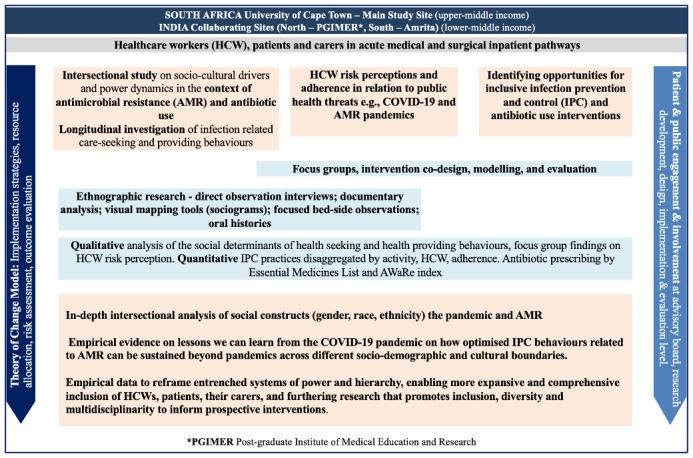
Across social structures within society, including healthcare, power relations manifest according to gender, socioeconomic status, race, ethnicity, and class influencing infection related healthcare access and health providing-behaviours. Therefore, accounting for sociocultural drivers, including gender, race, and class, and their influence on economic status can improve healthcare access and health-providing behaviours in infection prevention and control (IPC) as well as antibiotic use, which in turn helps mitigate the spread of antimicrobial resistance (AMR). This Wellcome funded research will investigate how and why the social determinants of health and economic status influence how people seek, experience, and provide healthcare for suspected or proven (bacterial) infections and how these factors influence antibiotic prescribing and use in South Africa (upper middle-income country) and India (lower middle-income country). The aim of this body of work is to, (1) define and estimate the sociocultural and economic drivers for AMR in different resource settings, (2) design, implement and evaluate context-sensitive IPC and antimicrobial stewardship (AMS) interventions, and (3) inform policy and strategy for AMR mitigation. The population will be healthcare workers (HCWs), patients, and their carers across acute medical and surgical pathways where IPC and antibiotic-related healthcare access and health-providing behaviours will be studied. Qualitative methods will include ethnographic research, semi-structured in-depth interviews, and focus groups with healthcare providers, patients and carers. Quantitative analysis of bedside observational data from hospitals and population level data on antibiotic use will study the various predictors of AMR using bivariable and multivariable regression analyses. The research will provide high-quality evidence on how social determinants intersect with health, social well-being, and vulnerability in IPC practices and antibiotic use. Using this knowledge we will: 1) design, implement, and measure effects of interventions accounting for these factors; 2) provide a toolkit for advocacy for actors in AMR, and healthcare to assist them to promote dialogue, including policy dialogue on this issue. This work directly benefits the target population and informs healthcare services and practice across the participating countries with potential for wider translation. The setting will be hospitals in South Africa (middle-income country) and India (lower middle-income country). The population will be healthcare workers (HCWs), patients, and their carers across acute medical and surgical pathways where IPC and antibiotic-related health-seeking and health-providing behaviours will be studied. These populations represent communities most affected by infections and AMR because existing interventions do not address a) differences in how surgical versus medical teams manage infections; b) the role of the wider social network of individuals on their decision-making, c) intersection of the social determinants of health including race, gender, socioeconomic deprivation with AMR.
在社会中的各种社会结构中,包括医疗保健领域,权力关系会根据性别、社会经济地位、种族、民族和阶层而显现出来,影响着与感染相关的医疗保健获取和健康提供行为。因此,考虑到社会文化驱动因素,包括性别、种族和阶层,以及它们对经济状况的影响,可以改善感染预防与控制(IPC)以及抗生素使用方面的医疗保健获取和健康提供行为,进而有助于减轻抗菌药物耐药性(AMR)的传播。这项由惠康基金会资助的研究将调查健康和经济状况的社会决定因素如何以及为何影响人们针对疑似或确诊(细菌性)感染寻求、体验和提供医疗保健的方式,以及这些因素如何影响南非(中高收入国家)和印度(中低收入国家)的抗生素处方和使用情况。这项工作的目的是:(1)界定并评估不同资源环境下AMR的社会文化和经济驱动因素;(2)设计、实施并评估因地制宜的IPC和抗菌药物管理(AMS)干预措施;(3)为减轻AMR的政策和战略提供信息。研究对象将是急性医疗和手术路径中的医护人员(HCWs)、患者及其护理人员,将对他们在IPC和与抗生素相关的医疗保健获取及健康提供行为方面进行研究。定性方法将包括人种学研究、对医护人员、患者和护理人员进行的半结构化深度访谈以及焦点小组讨论。对来自医院的床边观察数据和关于抗生素使用的人群层面数据进行定量分析,将使用双变量和多变量回归分析研究AMR的各种预测因素。该研究将提供高质量的证据,说明社会决定因素如何与IPC实践和抗生素使用中的健康、社会福祉及脆弱性相互交织。利用这些知识,我们将:1)设计、实施并衡量考虑这些因素的干预措施的效果;2)为AMR相关行为者和医疗保健领域提供一个宣传工具包,以协助他们促进对话,包括就这个问题进行政策对话。这项工作将直接惠及目标人群,并为参与国的医疗服务和实践提供信息,具有更广泛推广的潜力。研究地点将是南非(中收入国家)和印度(中低收入国家)的医院。研究对象将是急性医疗和手术路径中的医护人员(HCWs)、患者及其护理人员,将对他们在IPC和与抗生素相关的求医及健康提供行为方面进行研究。这些人群代表了受感染和AMR影响最严重的社区,因为现有的干预措施没有解决以下问题:a)外科团队与医疗团队在感染管理方式上的差异;b)个人更广泛的社会网络在其决策中的作用;c)包括种族、性别、社会经济剥夺在内的健康社会决定因素与AMR的交叉问题。

 Zotero 插件