
唐氏综合征中人类胎儿血液的单细胞多组学图谱
Single-cell multi-omics map of human fetal blood in Down syndrome.
作者信息
Marderstein Andrew R, De Zuani Marco, Moeller Rebecca, Bezney Jon, Padhi Evin M, Wong Shuo, Coorens Tim H H, Xie Yilin, Xue Haoliang, Montgomery Stephen B, Cvejic Ana
机构信息
Department of Pathology, Stanford University, Stanford, CA, USA.
Department of Haematology, University of Cambridge, Cambridge, UK.
出版信息
Nature. 2024 Oct;634(8032):104-112. doi: 10.1038/s41586-024-07946-4. Epub 2024 Sep 25.
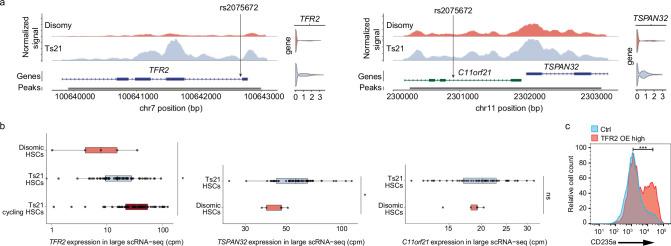
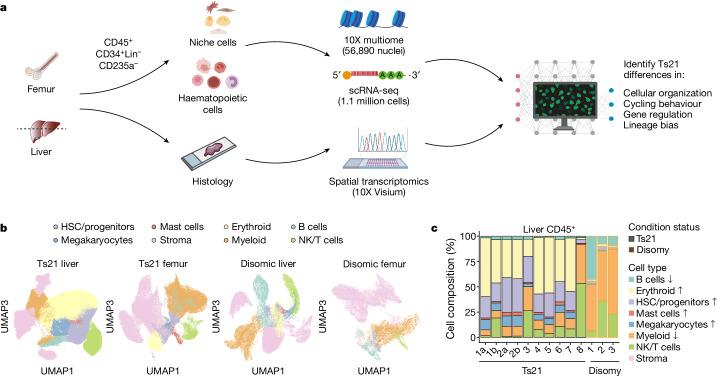
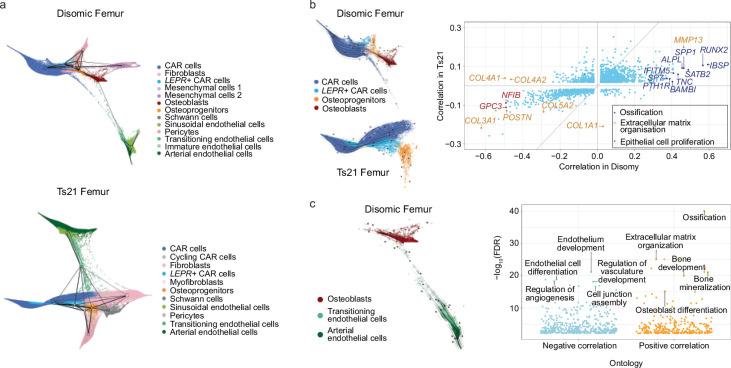
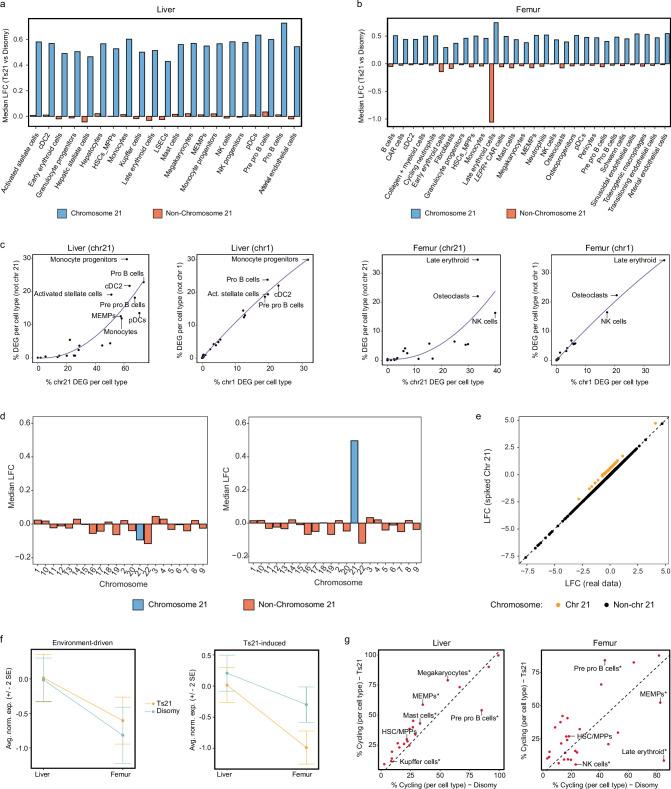
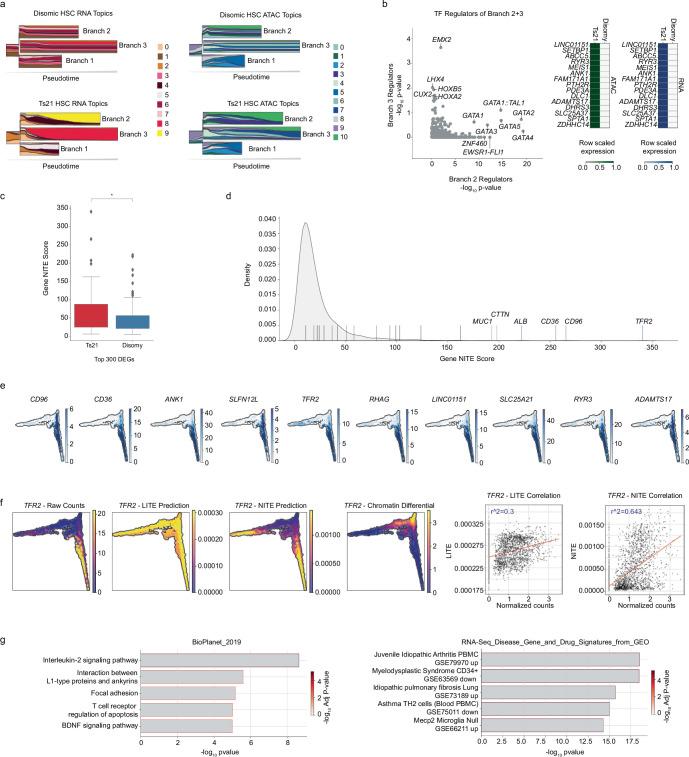
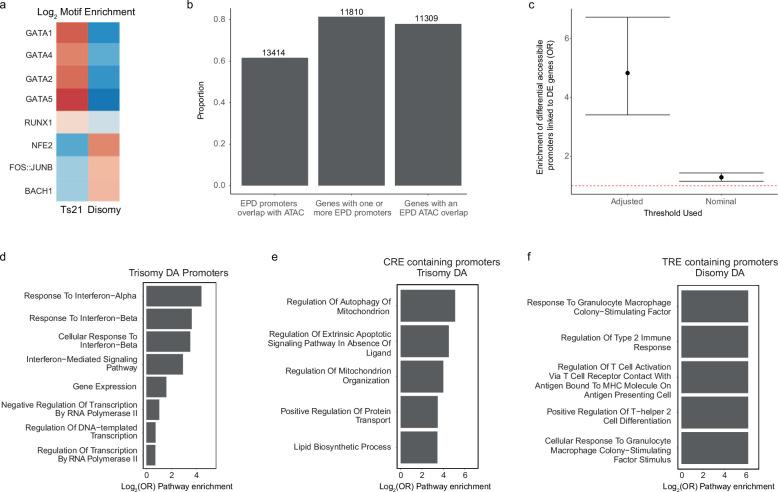
Down syndrome predisposes individuals to haematological abnormalities, such as increased number of erythrocytes and leukaemia in a process that is initiated before birth and is not entirely understood. Here, to understand dysregulated haematopoiesis in Down syndrome, we integrated single-cell transcriptomics of over 1.1 million cells with chromatin accessibility and spatial transcriptomics datasets using human fetal liver and bone marrow samples from 3 fetuses with disomy and 15 fetuses with trisomy. We found that differences in gene expression in Down syndrome were dependent on both cell type and environment. Furthermore, we found multiple lines of evidence that haematopoietic stem cells (HSCs) in Down syndrome are 'primed' to differentiate. We subsequently established a Down syndrome-specific map linking non-coding elements to genes in disomic and trisomic HSCs using 10X multiome data. By integrating this map with genetic variants associated with blood cell counts, we discovered that trisomy restructured regulatory interactions to dysregulate enhancer activity and gene expression critical to erythroid lineage differentiation. Furthermore, as mutations in Down syndrome display a signature of oxidative stress, we validated both increased mitochondrial mass and oxidative stress in Down syndrome, and observed that these mutations preferentially fell into regulatory regions of expressed genes in HSCs. Together, our single-cell, multi-omic resource provides a high-resolution molecular map of fetal haematopoiesis in Down syndrome and indicates significant regulatory restructuring giving rise to co-occurring haematological conditions.
唐氏综合征使个体易患血液学异常,如红细胞数量增加和白血病,这一过程在出生前就已开始,目前尚未完全了解。在此,为了理解唐氏综合征中造血失调的情况,我们将来自3名二体胎儿和15名三体胎儿的人类胎儿肝脏和骨髓样本的超过110万个细胞的单细胞转录组学与染色质可及性和空间转录组学数据集进行了整合。我们发现唐氏综合征中基因表达的差异取决于细胞类型和环境。此外,我们发现了多条证据表明唐氏综合征中的造血干细胞(HSCs)已“准备好”进行分化。随后,我们使用10X多组学数据建立了一个唐氏综合征特异性图谱,将二体和三体HSCs中的非编码元件与基因联系起来。通过将该图谱与与血细胞计数相关的基因变异整合,我们发现三体改变了调控相互作用,从而失调了对红系谱系分化至关重要的增强子活性和基因表达。此外,由于唐氏综合征中的突变表现出氧化应激的特征,我们验证了唐氏综合征中线粒体质量增加和氧化应激,并观察到这些突变优先落在HSCs中表达基因的调控区域。总之,我们的单细胞多组学资源提供了唐氏综合征中胎儿造血的高分辨率分子图谱,并表明存在显著的调控重组,导致了并发的血液学疾病。





 Zotero 插件