
颗粒蛋白前体和FRamides在神经组织与非神经组织中对饮食限制相关的寿命和蛋白质稳态的作用 。
Roles of Progranulin and FRamides in Neural Versus Non-Neural Tissues on Dietary Restriction-Related Longevity and Proteostasis in .
作者信息
Mir Dilawar Ahmad, Cox Matthew, Horrocks Jordan, Ma Zhengxin, Rogers Aric
机构信息
Kathryn W. Davis Center for Regenerative Biology and Aging, Mount Desert Island Biological Laboratory, Maine, United States of America.
出版信息
J Clin Med Sci. 2024;8(2). Epub 2024 May 28.
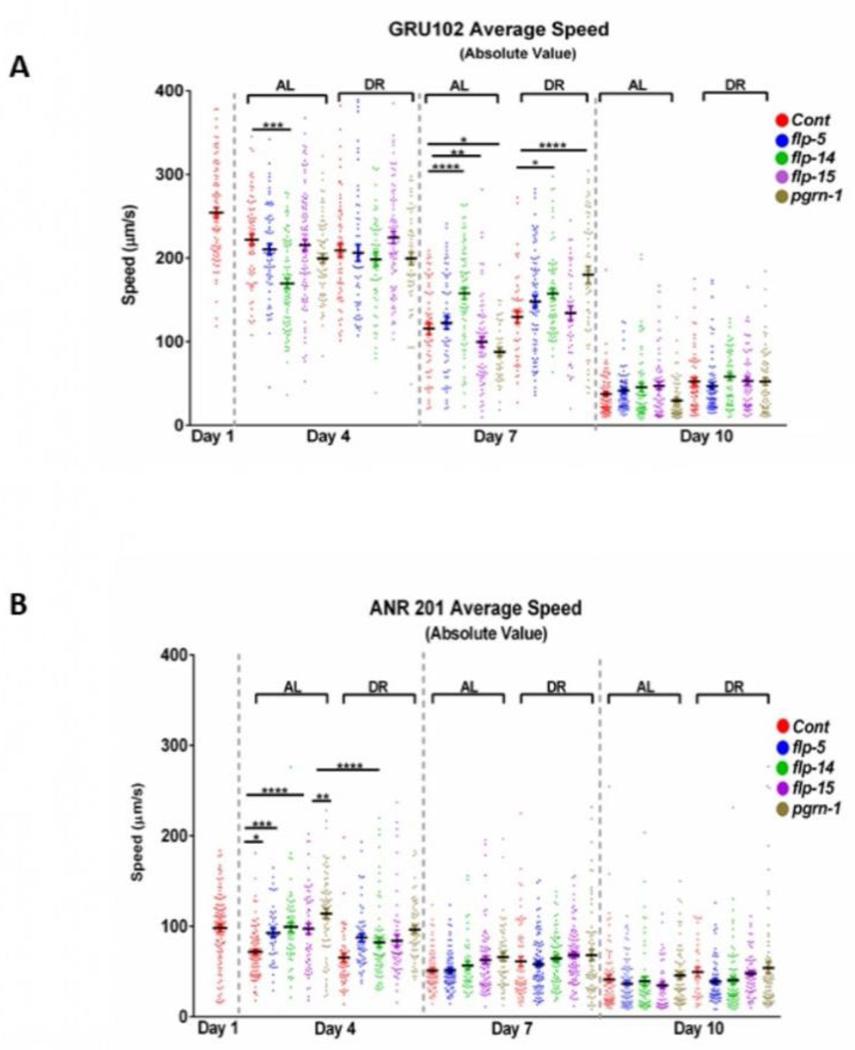
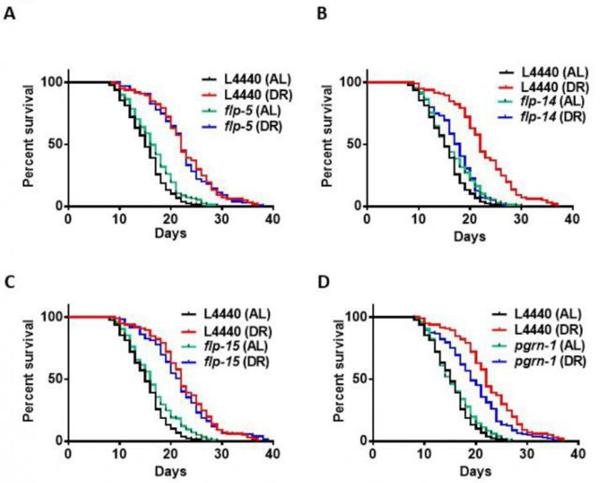
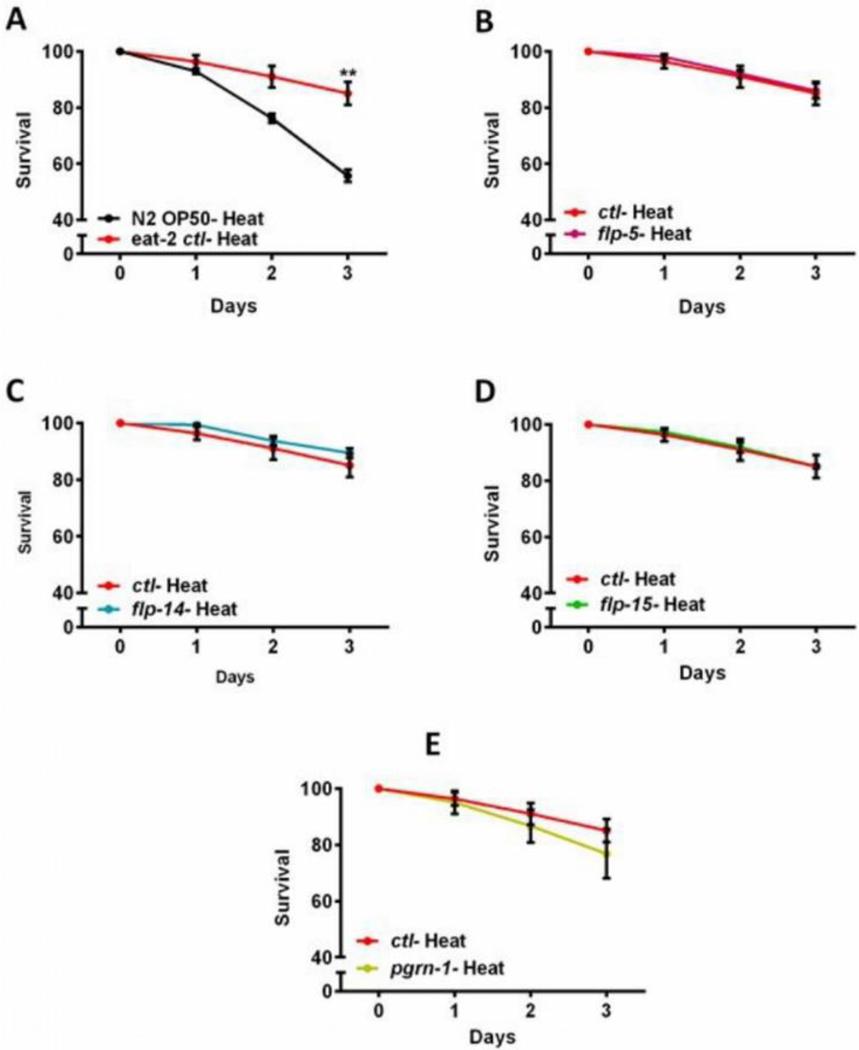
Dietary Restriction (DR) mitigates loss of proteostasis associated with aging that underlies neurodegenerative conditions including Alzheimer's disease and related dementias. Previously, we observed increased translational efficiency of certain FMRFamide-Like neuro-Peptide () genes and the neuroprotective growth factor progranulin gene under dietary restriction in . Here, we tested the effects of , , and on lifespan and proteostasis under both standard and dietary restriction conditions. We also tested and distinguished function based on their expression in either neuronal or non-neuronal tissue. Lowering the expression of and flp genes selectively in neural tissue showed no difference in survival under normal feeding conditions nor under DR in two out of three experiments performed. Reduced expression of in non-neuronal tissue showed decreased lifespan that was not specific to DR. With respect to proteostasis, a genetic model of DR from mutation of the gene that showed increased thermotolerance compared to fully fed wild type animals demonstrated no change in thermotolerance in response to knockdown of or genes. Finally, we tested effects on motility in a neural-specific model of proteotoxicity and found that neuronal knockdown of and genes improved motility in early life regardless of diet. However, knocking these genes down in non-neuronal tissue had variable results. RNAi targeting increased motility by day seven of adulthood regardless of diet. Interestingly, non-neuronal RNAi of decreased motility under standard feeding conditions while DR increased motility for this gene knockdown by day seven (early mid-life). Results show that , , , and do not have major roles in diet-related changes in longevity or whole-body proteostasis. However, reduced expression of these genes in neurons increases motility early in life in a neural-specific model of proteotoxicity, whereas knockdown of non-neuronal expression mostly increases motility in mid-life under the same conditions.
饮食限制(DR)可减轻与衰老相关的蛋白质稳态丧失,而这种丧失是包括阿尔茨海默病及相关痴呆症在内的神经退行性疾病的基础。此前,我们观察到在饮食限制条件下,秀丽隐杆线虫中某些类FMRF酰胺神经肽(FLP)基因和神经保护生长因子颗粒蛋白前体基因(grn-1)的翻译效率有所提高。在此,我们测试了FLP-1、FLP-6、FLP-12和FLP-18在标准和饮食限制条件下对寿命和蛋白质稳态的影响。我们还根据它们在神经元或非神经元组织中的表达来测试和区分其功能。在进行的三个实验中的两个实验里,选择性地降低神经组织中FLP-1和flp基因的表达,在正常喂养条件下以及饮食限制条件下,均未显示出存活率的差异。非神经元组织中FLP-12表达的降低显示出寿命缩短,这并非饮食限制所特有的。关于蛋白质稳态,与完全喂食的野生型动物相比,因eat-2基因突变而呈现出热耐受性增加的饮食限制遗传模型,在敲低FLP-1或FLP-18基因后,热耐受性没有变化。最后,我们在蛋白质毒性的神经特异性模型中测试了对运动能力的影响,发现无论饮食如何,神经元中FLP-1和FLP-18基因的敲低在生命早期均能改善运动能力。然而,在非神经元组织中敲低这些基因则产生了不同的结果。靶向FLP-18的RNA干扰在成年期第7天无论饮食如何均能提高运动能力。有趣的是,在标准喂养条件下,FLP-1的非神经元RNA干扰会降低运动能力,而在饮食限制条件下,对于该基因的敲低,到成年期第7天(生命早期中期)运动能力会增加。结果表明,FLP-1、FLP-6、FLP-12和FLP-18在与饮食相关的寿命变化或全身蛋白质稳态中没有主要作用。然而,在蛋白质毒性的神经特异性模型中,这些基因在神经元中的表达降低会在生命早期增加运动能力,而在相同条件下,非神经元表达的敲低大多会在中年期增加运动能力。

 Zotero 插件