
通过SHAPE检测到的mRNA片段化模式
mRNA Fragmentation Pattern Detected by SHAPE.
作者信息
Feng Shanshan, Chen Ting, Zhang Yunlong, Lu Changrui
机构信息
College of Biological Science and Medical Engineering, Donghua University, Shanghai 201620, China.
出版信息
Curr Issues Mol Biol. 2024 Sep 16;46(9):10249-10258. doi: 10.3390/cimb46090610.
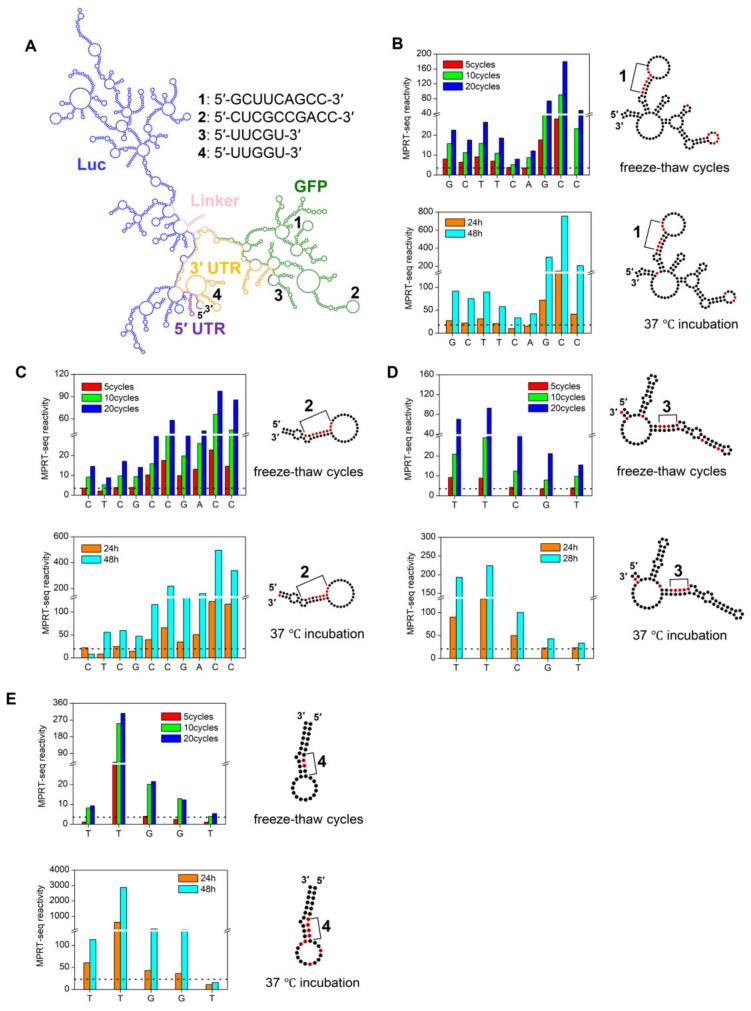
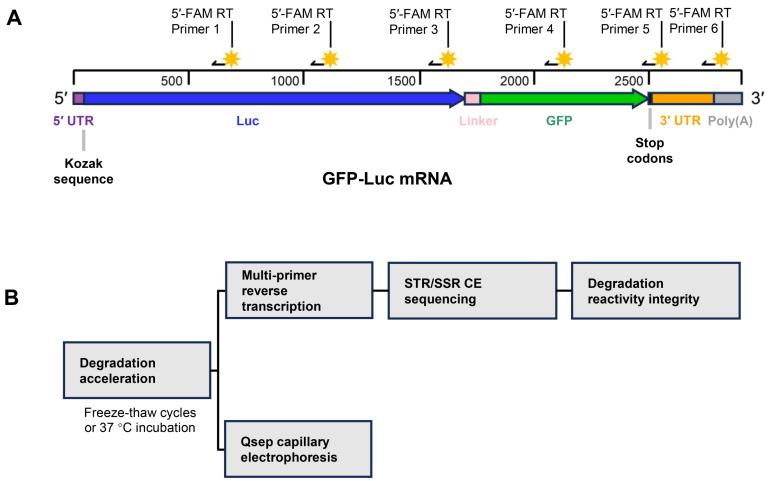
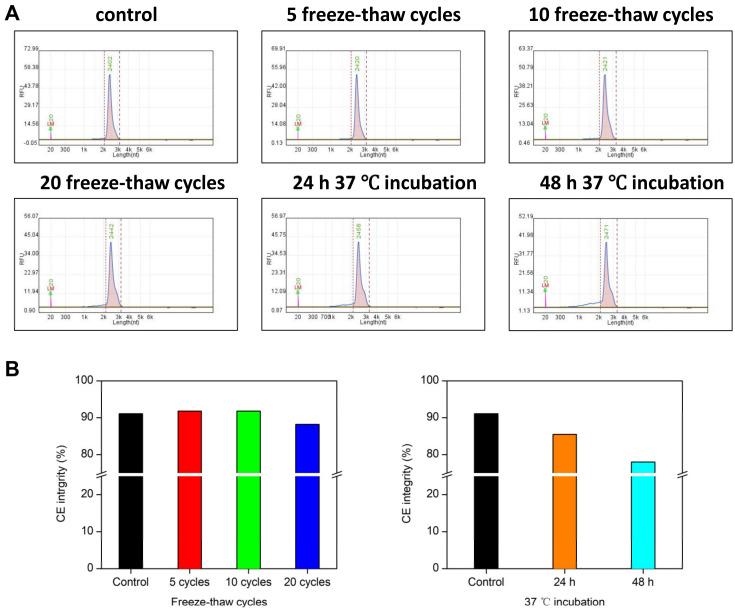
The success of messenger RNA (mRNA) vaccines in controlling COVID-19 has warranted further developments in new technology. Currently, their quality control process largely relies on low-resolution electrophoresis for detecting chain breaks. Here, we present an approach using multi-primer reverse transcription sequencing (MPRT-seq) to identify degradation fragments in mRNA products. Using this in-house-made mRNA containing two antigens and untranslated regions (UTRs), we analyzed the mRNA completeness and degradation pattern at a nucleotide resolution. We then analyzed the sensitive base sequence and its correlation with the secondary structure. Our MPRT-seq mapping shows that certain sequences on the 5' of bulge-stem-loop structures can result in preferential chain breaks. Our results agree with commonly used capillary electrophoresis (CE) integrity analysis but at a much higher resolution, and can improve mRNA stability by providing information to remove sensitive structures or sequences in the mRNA sequence design.
信使核糖核酸(mRNA)疫苗在控制新冠疫情方面的成功促使新技术得到进一步发展。目前,它们的质量控制过程很大程度上依赖于低分辨率电泳来检测链断裂。在此,我们提出一种使用多引物逆转录测序(MPRT-seq)的方法来识别mRNA产物中的降解片段。使用这种包含两种抗原和非翻译区(UTR)的自制mRNA,我们在核苷酸分辨率下分析了mRNA的完整性和降解模式。然后,我们分析了敏感碱基序列及其与二级结构的相关性。我们的MPRT-seq图谱显示,凸起-茎环结构5'端的某些序列可导致优先链断裂。我们的结果与常用的毛细管电泳(CE)完整性分析结果一致,但分辨率要高得多,并且可以通过提供信息以去除mRNA序列设计中的敏感结构或序列来提高mRNA的稳定性。

 Zotero 插件