
五项与HBM4EU协作的欧洲儿童研究中尿邻苯二甲酸酯代谢物与脑源性神经营养因子及行为功能之间的关联
Associations between Urinary Phthalate Metabolites with BDNF and Behavioral Function among European Children from Five HBM4EU Aligned Studies.
作者信息
Salamanca-Fernández Elena, Espín-Moreno Lydia, Olivas-Martínez Alicia, Pérez-Cantero Ainhoa, Martín-Rodríguez José L, Poyatos Rafael M, Barbone Fabio, Rosolen Valentina, Mariuz Marika, Ronfani Luca, Palkovičová Murínová Ľubica, Fábelová Lucia, Szigeti Tamás, Kakucs Réka, Sakhi Amrit K, Haug Line S, Lindeman Birgitte, Snoj Tratnik Janja, Kosjek Tina, Jacobs Griet, Voorspoels Stefan, Jurdáková Helena, Górová Renáta, Petrovičová Ida, Kolena Branislav, Esteban Marta, Pedraza-Díaz Susana, Kolossa-Gehring Marike, Remy Sylvie, Govarts Eva, Schoeters Greet, Fernández Mariana F, Mustieles Vicente
机构信息
Biomedical Research Center (CIBM), Department of Radiology and Physical Medicine, University of Granada, 18012 Granada, Spain.
Instituto de Investigación Biosanitaria (ibs.GRANADA), 18012 Granada, Spain.
出版信息
Toxics. 2024 Aug 31;12(9):642. doi: 10.3390/toxics12090642.
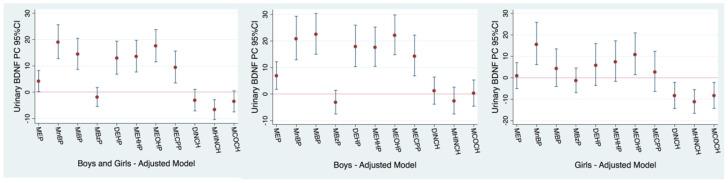
Based on toxicological evidence, children's exposure to phthalates may contribute to altered neurodevelopment and abnormal regulation of brain-derived neurotrophic factor (BDNF). We analyzed data from five aligned studies of the Human Biomonitoring for Europe (HBM4EU) project. Ten phthalate metabolites and protein BDNF levels were measured in the urine samples of 1148 children aged 6-12 years from Italy (NACII-IT cohort), Slovakia (PCB-SK cohort), Hungary (InAirQ-HU cohort) and Norway (NEBII-NO). Serum BDNF was also available in 124 Slovenian children (CRP-SLO cohort). Children's total, externalizing and internalizing behavioral problems were assessed using the Child Behavior Checklist at 7 years of age (only available in the NACII-IT cohort). Adjusted linear and negative binomial regression models were fitted, together with weighted quantile sum (WQS) regression models to assess phthalate mixture associations. Results showed that, in boys but not girls of the NACII-IT cohort, each natural-log-unit increase in mono-n-butyl phthalate (MnBP) and Mono(2-ethyl-5-oxohexyl) phthalate (MEOHP) was cross-sectionally associated with higher externalizing problems [incidence rate ratio (IRR): 1.20; 95% CI: 1.02, 1.42 and 1.26; 95% CI: 1.03, 1.55, respectively]. A suggestive mixture association with externalizing problems was also observed per each tertile mixture increase in the whole population (WQS-IRR = 1.15; 95% CI: 0.97, 1.36) and boys (IRR = 1.20; 95% CI: 0.96, 1.49). In NACII-IT, PCB-SK, InAirQ-HU and NEBII-NO cohorts together, urinary phthalate metabolites were strongly associated with higher urinary BDNF levels, with WQS regression confirming a mixture association in the whole population (percent change (PC) = 25.9%; 95% CI: 17.6, 34.7), in girls (PC = 18.6%; 95% CI: 7.92, 30.5) and mainly among boys (PC = 36.0%; 95% CI: 24.3, 48.9). Among CRP-SLO boys, each natural-log-unit increase in ∑DINCH concentration was associated with lower serum BDNF levels (PC: -8.8%; 95% CI: -16.7, -0.3). In the NACII-IT cohort, each natural-log-unit increase in urinary BDNF levels predicted worse internalizing scores among all children (IRR: 1.15; 95% CI: 1.00, 1.32). Results suggest that (1) children's exposure to di-n-butyl phthalate (DnBP) and di(2-ethylhexyl) phthalate (DEHP) metabolites is associated with more externalizing problems in boys, (2) higher exposure to DINCH may associate with lower systemic BDNF levels in boys, (3) higher phthalate exposure is associated with higher urinary BDNF concentrations (although caution is needed since the possibility of a "urine concentration bias" that could also explain these associations in noncausal terms was identified) and (4) higher urinary BDNF concentrations may predict internalizing problems. Given this is the first study to examine the relationship between phthalate metabolite exposure and BDNF biomarkers, future studies are needed to validate the observed associations.
基于毒理学证据,儿童接触邻苯二甲酸盐可能会导致神经发育改变以及脑源性神经营养因子(BDNF)的调节异常。我们分析了欧洲人类生物监测(HBM4EU)项目的五项匹配研究的数据。在来自意大利(NACII - IT队列)、斯洛伐克(PCB - SK队列)、匈牙利(InAirQ - HU队列)和挪威(NEBII - NO)的1148名6至12岁儿童的尿液样本中,测量了十种邻苯二甲酸酯代谢物和蛋白质BDNF水平。124名斯洛文尼亚儿童(CRP - SLO队列)也提供了血清BDNF数据。使用儿童行为检查表在7岁时评估儿童的总体、外化和内化行为问题(仅在NACII - IT队列中可用)。拟合了调整后的线性和负二项回归模型,以及加权分位数和(WQS)回归模型,以评估邻苯二甲酸酯混合物关联。结果表明,在NACII - IT队列的男孩而非女孩中,邻苯二甲酸单正丁酯(MnBP)和邻苯二甲酸单(2 - 乙基 - 5 - 氧代己基)酯(MEOHP)每增加一个自然对数单位,与更高的外化问题呈横断面关联[发病率比(IRR):1.20;95%置信区间:1.02,1.42和1.26;95%置信区间:1.03,1.55]。在整个人口中,每增加三分位数混合物,也观察到与外化问题有提示性的混合物关联(WQS - IRR = 1.15;95%置信区间:0.97,1.36),在男孩中(IRR = 1.20;95%置信区间:0.96,1.49)。在NACII - IT、PCB - SK、InAirQ - HU和NEBII - NO队列中,尿邻苯二甲酸酯代谢物与更高的尿BDNF水平密切相关,WQS回归证实了整个人口中的混合物关联(百分比变化(PC)= 25.9%;95%置信区间:17.6,34.7),在女孩中(PC = 18.6%;95%置信区间:7.92,30.5),主要在男孩中(PC = 36.0%;95%置信区间:24.3,48.9)。在CRP - SLO男孩中,∑DINCH浓度每增加一个自然对数单位,与较低的血清BDNF水平相关(PC: - 8.8%;95%置信区间: - 16.7, - 0.3)。在NACII - IT队列中,尿BDNF水平每增加一个自然对数单位,预测所有儿童的内化得分更差(IRR:1.15;95%置信区间:1.00,1.32)。结果表明:(1)儿童接触邻苯二甲酸二正丁酯(DnBP)和邻苯二甲酸二(2 - 乙基己基)酯(DEHP)代谢物与男孩更多的外化问题相关;(2)男孩中更高的DINCH暴露可能与较低的全身BDNF水平相关;(3)更高的邻苯二甲酸酯暴露与更高的尿BDNF浓度相关(尽管需要谨慎,因为发现了“尿液浓度偏差”的可能性,这也可能以非因果关系解释这些关联);(4)更高的尿BDNF浓度可能预测内化问题。鉴于这是第一项研究邻苯二甲酸酯代谢物暴露与BDNF生物标志物之间关系的研究,未来需要进行研究来验证观察到的关联。


 Zotero 插件