
基于蚀刻诱导的局域表面等离子体共振调制和表面增强拉曼光谱的铁(III)双模式传感
Dual-Mode Sensing of Fe(III) Based on Etching Induced Modulation of Localized Surface Plasmon Resonance and Surface Enhanced Raman Spectroscopy.
作者信息
Parmigiani Miriam, Albini Benedetta, Galinetto Pietro, Taglietti Angelo
机构信息
Department of Chemistry, University of Pavia, Viale Taramelli 12, 27100 Pavia, Italy.
Department of Physics, University of Pavia, Via Bassi 6, 27100 Pavia, Italy.
出版信息
Nanomaterials (Basel). 2024 Sep 10;14(18):1467. doi: 10.3390/nano14181467.
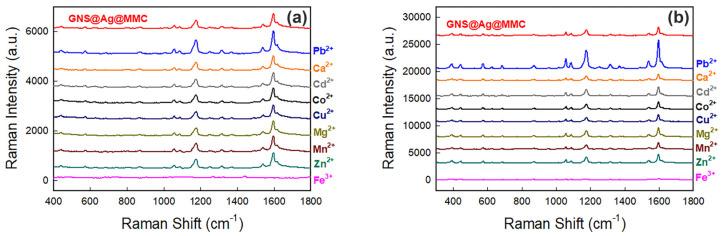
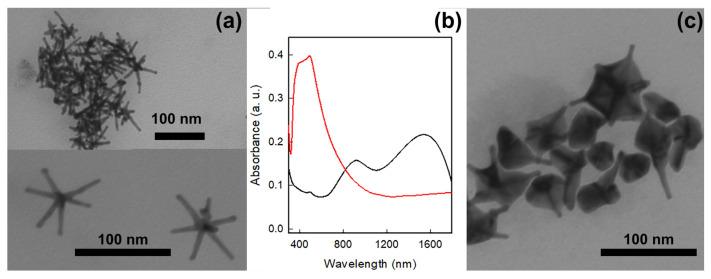
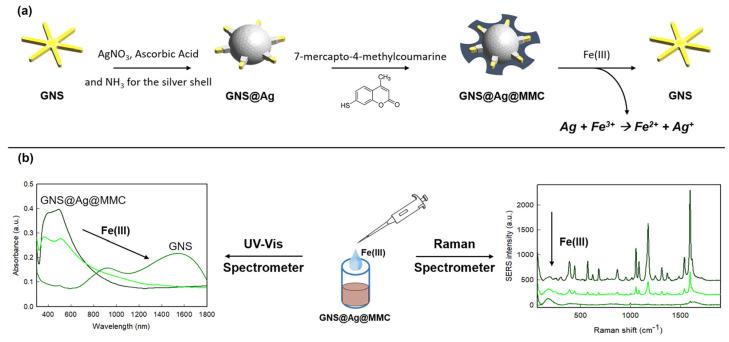
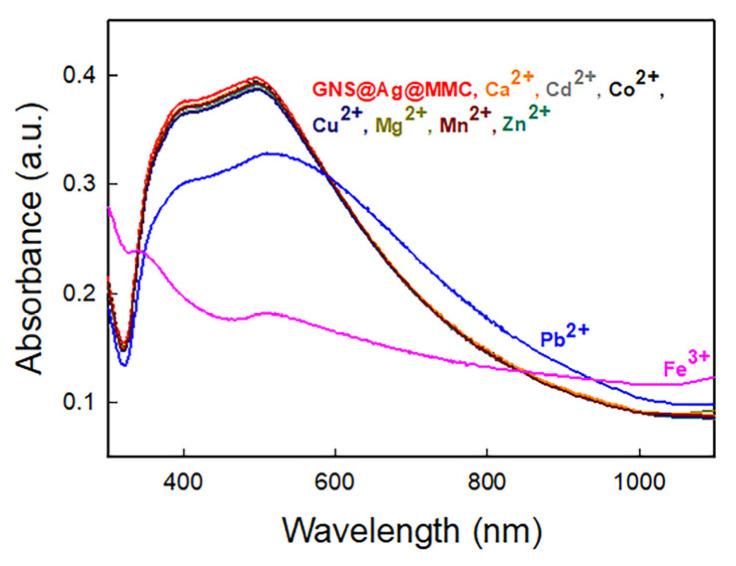
Convenient, rapid, highly sensitive and on-site iron determination is important for environmental safety and human health. We developed a sensing system for the detection of Fe(III) in water based on 7-mercapto-4-methylcoumarine (MMC)-stabilized silver-coated gold nanostars (GNS@Ag@MMC), exploiting a redox reaction between the Fe(III) cation and the silver shell of the nanoparticles, which causes a severe transformation of the nanomaterial structure, reverting it to pristine GNSs. This system works by simultaneously monitoring changes in the Localized Surface Plasmon Resonance (LSPR) and Surface-Enhanced Raman Spectroscopy (SERS) spectra as a function of added Fe(III). The proposed sensing system is able to detect the Fe(III) cation in the 1.0 × 10-1.5 × 10 M range, and its selectivity of the GNS@Ag@MMC sensor toward iron has been verified monitoring the LSPR and the SERS response to other cations with a clear selectivity toward Fe(III).
便捷、快速、高灵敏度且可现场进行的铁测定对于环境安全和人类健康至关重要。我们基于7-巯基-4-甲基香豆素(MMC)稳定的包覆银的金纳米星(GNS@Ag@MMC)开发了一种用于检测水中Fe(III)的传感系统,利用Fe(III)阳离子与纳米颗粒银壳之间的氧化还原反应,该反应会导致纳米材料结构发生严重转变,使其恢复为原始的金纳米星。该系统通过同时监测局域表面等离子体共振(LSPR)和表面增强拉曼光谱(SERS)光谱随添加的Fe(III)的变化来工作。所提出的传感系统能够检测1.0×10⁻¹⁵至1.5×10⁻¹⁵M范围内的Fe(III)阳离子,并且通过监测LSPR和SERS对其他阳离子的响应,验证了GNS@Ag@MMC传感器对铁具有明显的选择性。


 Zotero 插件