
达雷妥尤单抗联合来那度胺用于新诊断多发性骨髓瘤移植后维持治疗:AURIGA研究
Daratumumab with lenalidomide as maintenance after transplant in newly diagnosed multiple myeloma: the AURIGA study.
作者信息
Badros Ashraf, Foster Laahn, Anderson Larry D, Chaulagain Chakra P, Pettijohn Erin, Cowan Andrew J, Costello Caitlin, Larson Sarah, Sborov Douglas W, Shain Kenneth H, Silbermann Rebecca, Shah Nina, Chung Alfred, Krevvata Maria, Pei Huiling, Patel Sharmila, Khare Vipin, Cortoos Annelore, Carson Robin, Lin Thomas S, Voorhees Peter
机构信息
Greenebaum Comprehensive Cancer Center, University of Maryland, Baltimore, MD.
Division of Hematology and Oncology, University of Virginia, Charlottesville, VA.
出版信息
Blood. 2025 Jan 16;145(3):300-310. doi: 10.1182/blood.2024025746.
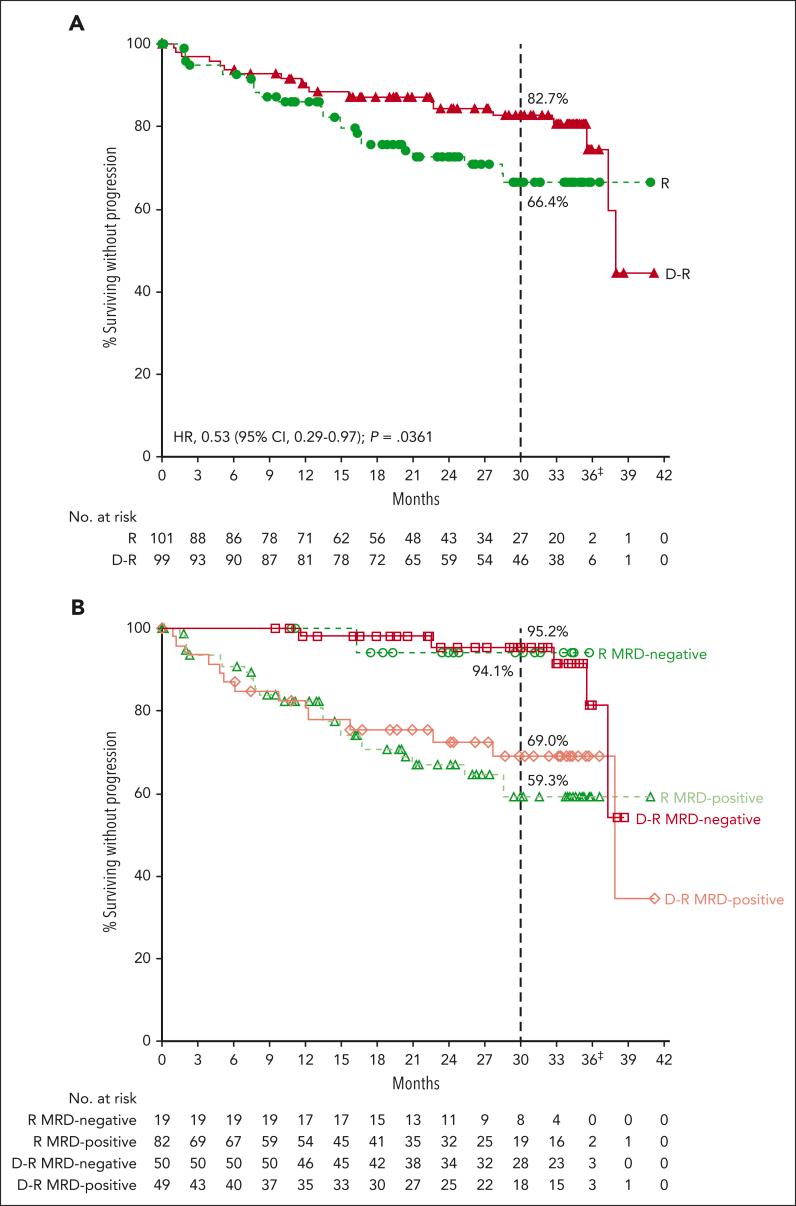
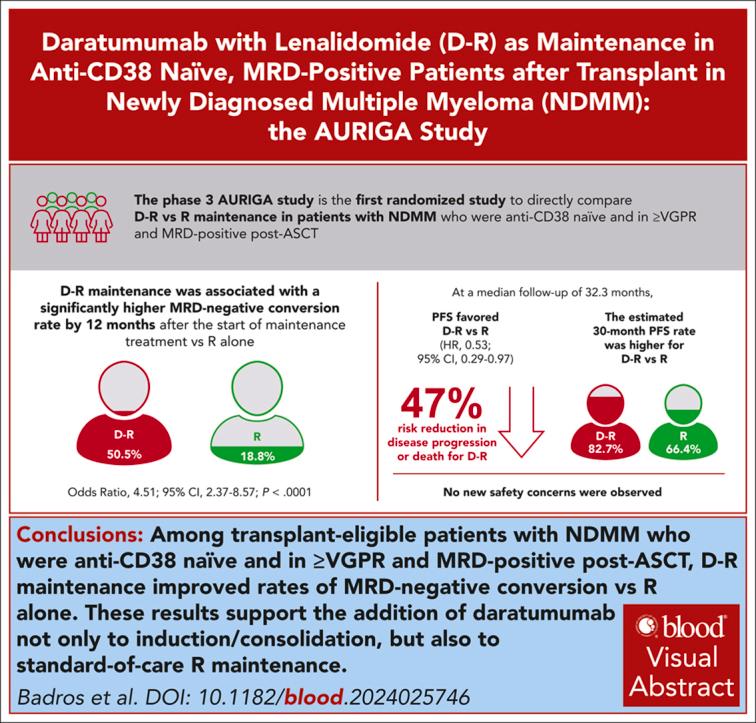
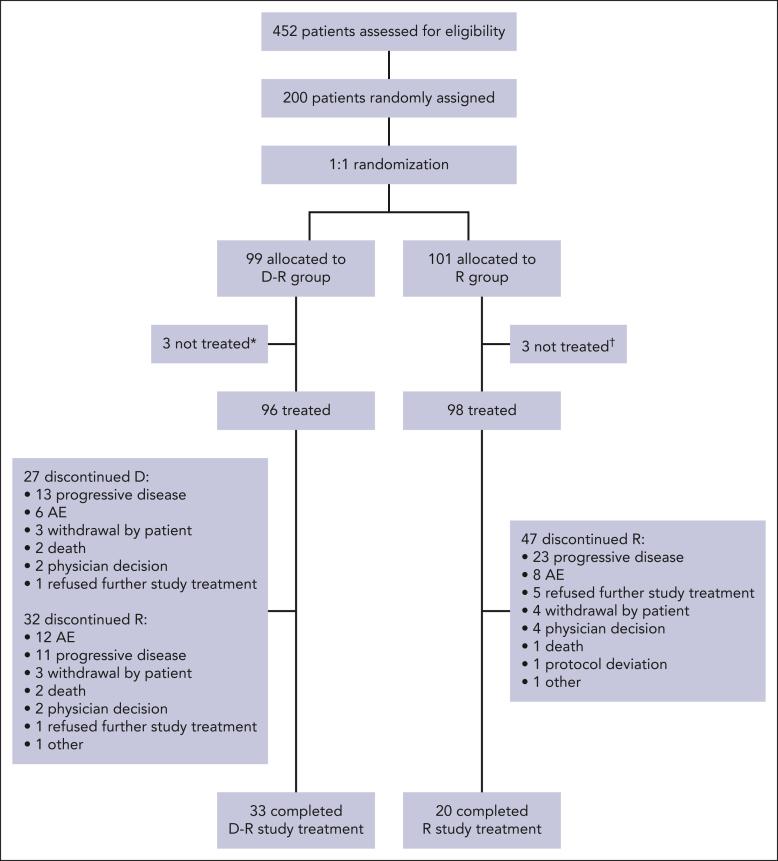
No randomized trial has directly compared daratumumab and lenalidomide (D-R) maintenance with standard-of-care lenalidomide (R) alone after transplant. Herein, we report the primary results of the phase 3 AURIGA study evaluating D-R vs R maintenance in patients with newly diagnosed multiple myeloma (NDMM) who had very good or better partial response, were minimal residual disease (MRD)-positive (10-5) and anti-CD38-naïve after transplant. Two hundred patients were randomly assigned (1:1) to D-R (n = 99) or R (n = 101) maintenance for up to 36 cycles. The MRD-negative (10-5) conversion rate by 12 months from start of maintenance (primary end point) was significantly higher for D-R than R (50.5% vs 18.8%; odds ratio [OR], 4.51; 95% confidence interval [CI], 2.37-8.57; P < .0001). MRD-negative (10-6) conversion rate was similarly higher with D-R (23.2% vs 5.0%; OR, 5.97; 95% CI, 2.15-16.58; P = .0002). At median follow-up (32.3 months), D-R achieved a higher overall MRD-negative (10-5) conversion rate (D-R, 60.6% vs R, 27.7%; OR, 4.12; 95% CI, 2.26-7.52; P < .0001) and complete response rate or better (75.8% vs 61.4%; OR, 2.00; 95% CI, 1.08-3.69; P = .0255) vs R. Progression-free survival (PFS) favored D-R vs R (hazard ratio, 0.53; 95% CI, 0.29-0.97); estimated 30-month PFS rates were 82.7% for D-R and 66.4% for R. Incidences of grade 3/4 cytopenias (54.2% vs 46.9%) and infections (18.8% vs 13.3%) were slightly higher with D-R than R. In conclusion, D-R maintenance achieved a higher MRD-negative conversion rate and improved PFS after transplant vs R, with no new safety concerns. This trial was registered at www.clinicaltrials.gov as #NCT03901963.
尚无随机试验直接比较达雷妥尤单抗与来那度胺(D-R)维持治疗与移植后单纯使用标准治疗来那度胺(R)的疗效。在此,我们报告了3期AURIGA研究的主要结果,该研究评估了新诊断的多发性骨髓瘤(NDMM)患者在移植后获得非常好或更好的部分缓解、微小残留病(MRD)呈阳性(10-5)且未接受过抗CD38治疗的情况下,D-R与R维持治疗的疗效。200例患者被随机分配(1:1)接受D-R(n = 99)或R(n = 101)维持治疗,最长36个周期。从维持治疗开始12个月时的MRD阴性(10-5)转化率(主要终点),D-R组显著高于R组(50.5%对18.8%;优势比[OR],4.51;95%置信区间[CI],2.37-8.57;P <.0001)。D-R组的MRD阴性(10-6)转化率同样更高(23.2%对5.0%;OR,5.97;95% CI,2.15-16.58;P =.0002)。在中位随访期(32.3个月)时,D-R组的总体MRD阴性(10-5)转化率更高(D-R组为60.6%,R组为27.7%;OR,4.12;95% CI,2.26-7.52;P <.0001),完全缓解率或更好缓解率也更高(75.8%对61.4%;OR,2.00;95% CI,1.08-3.69;P =.0255)。无进展生存期(PFS)方面,D-R组优于R组(风险比,0.53;95% CI,0.29-0.97);估计30个月的PFS率,D-R组为82.7%,R组为66.4%。3/4级血细胞减少症(54.2%对46.9%)和感染(18.8%对13.3%)的发生率,D-R组略高于R组。总之,与R组相比,D-R维持治疗在移植后实现了更高的MRD阴性转化率并改善了PFS,且没有新的安全问题。该试验已在www.clinicaltrials.gov上注册,注册号为#NCT03901963。


 Zotero 插件