
一线免疫单药治疗后进展的晚期非小细胞肺癌的失败模式和后续治疗:一项回顾性研究。
Patterns of failure and the subsequent treatment after progression on first-line immunotherapy monotherapy in advanced non-small cell lung cancer: a retrospective study.
机构信息
School of Medicine, South China University of Technology, Guangzhou, Guangdong, 511400, China.
Guangdong Lung Cancer Institute, Guangdong Provincial People's Hospital (Guangdong Academy of Medical Sciences), Southern Medical University, Guangzhou, 510030, China.
出版信息
BMC Cancer. 2024 Sep 27;24(1):1190. doi: 10.1186/s12885-024-12888-1.
BACKGROUND
Immune checkpoint inhibitors (ICIs) have become the recommended first-line treatment for advanced non-small cell lung cancer (NSCLC) without driver gene mutations. However, data on the failure patterns of first-line ICIs monotherapy is limited, and the optimal strategy for subsequent treatment remains controversial.
METHODS
Advanced NSCLC patients receiving first-line ICIs monotherapy at Guangdong Lung Cancer Institute between December 2017 and October 2021 were identified. The progressive sites were recorded to analyze failure patterns. Post-progression survival (PPS) was compared between different treatment regimens.
RESULTS
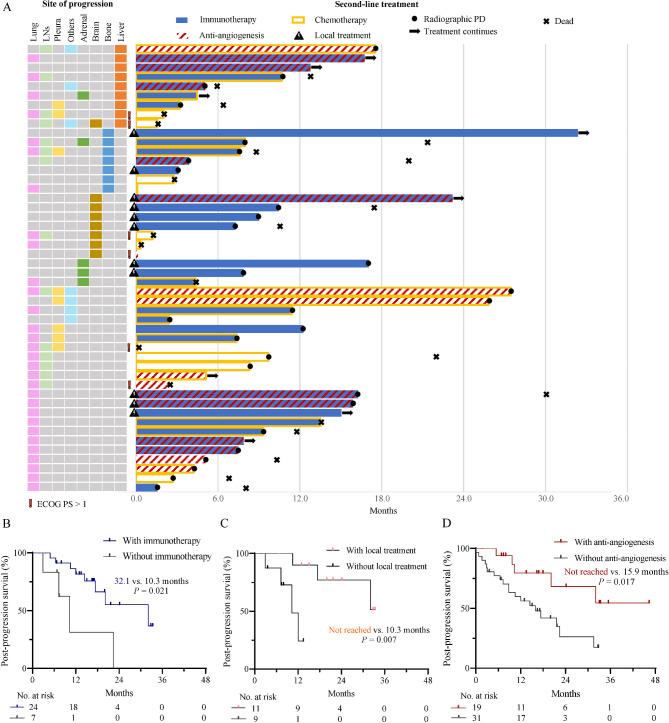
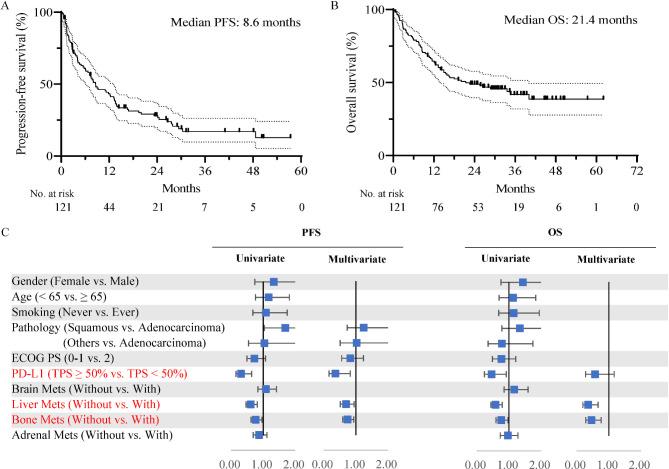
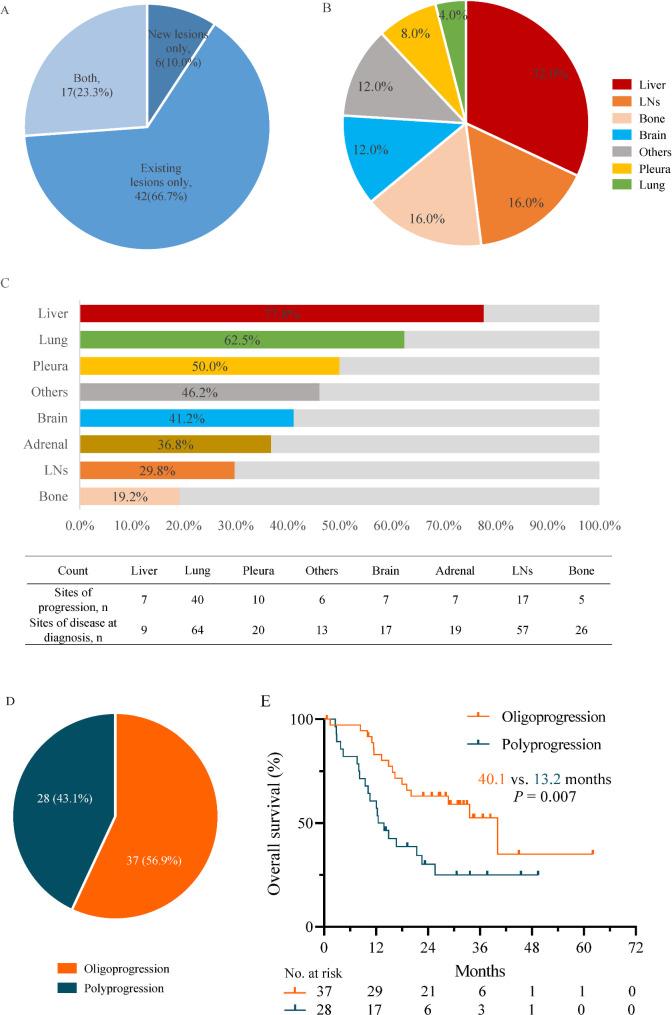
A total of 121 patients receiving first-line ICIs monotherapy were identified, with a median progression-free survival of 8.6 months. Sixty-five patients had available imaging at diagnosis as well as progressive disease, with 56.9% showing oligoprogression. For those with progression in existing lesions, the most common sites were the liver (77.8%) and lung parenchyma (62.5%), while progression with new lesions frequently occurred in the liver (32.0%). Fifty patients with recorded subsequent treatment were included in the analysis of subsequent treatment patterns. Patients treated with anti-angiogenesis therapy could get better PPS (HR: 0.275, P = 0.013). Isolated oligoprogression occurred most often in the lung parenchyma and intracranial lesions. More than half of these patients continued immunotherapy after local treatment, with a 2.5-year PPS rate of 51.4%.
CONCLUSION
The liver was the most common site of progression on first-line ICIs monotherapy. Anti-angiogenesis-based therapy might be an optimal regimen at the time of progression. Patients with isolated oligoprogressive could still benefit from immunotherapy after local treatment.
背景
免疫检查点抑制剂(ICI)已成为无驱动基因突变的晚期非小细胞肺癌(NSCLC)的首选一线治疗方法。然而,关于一线 ICI 单药治疗失败模式的数据有限,后续治疗的最佳策略仍存在争议。
方法
回顾性分析 2017 年 12 月至 2021 年 10 月在广东省肺癌研究所接受一线 ICI 单药治疗的晚期 NSCLC 患者。记录进展部位,分析失败模式。比较不同治疗方案的后进展生存(PPS)。
结果
共纳入 121 例接受一线 ICI 单药治疗的患者,中位无进展生存期为 8.6 个月。65 例患者在诊断时及疾病进展时均有可评估的影像学资料,其中 56.9%表现为寡进展。对于现有病灶进展的患者,最常见的进展部位是肝脏(77.8%)和肺实质(62.5%),而新病灶进展则常发生在肝脏(32.0%)。50 例有记录的后续治疗患者纳入后续治疗模式分析。接受抗血管生成治疗的患者 PPS 更好(HR:0.275,P=0.013)。孤立性寡进展最常发生于肺实质和颅内病变。这些患者中超过一半在局部治疗后继续接受免疫治疗,2.5 年 PPS 率为 51.4%。
结论
一线 ICI 单药治疗后肝脏是最常见的进展部位。抗血管生成治疗可能是进展时的最佳方案。孤立性寡进展患者经局部治疗后仍能从免疫治疗中获益。
 Zotero 插件