
一般人群中饮食质量、睡眠时长与抑郁症状之间的关联:来自横断面 NHANES 研究的结果。
The association between dietary quality, sleep duration, and depression symptoms in the general population: findings from cross-sectional NHANES study.
机构信息
Mental Health Center and Laboratory of Psychiatry, West China Hospital of Sichuan University, Chengdu, 610041, China.
出版信息
BMC Public Health. 2024 Sep 27;24(1):2588. doi: 10.1186/s12889-024-20093-9.
BACKGROUND
Unhealthy lifestyles, which include unhealthy diet and unhealthy sleep duration, have been widely recognized as modifiable risk factors for depressive symptoms. This study aims to explore the associations between dietary quality, sleep duration, and depression symptoms, as well as their combined effects.
METHODS
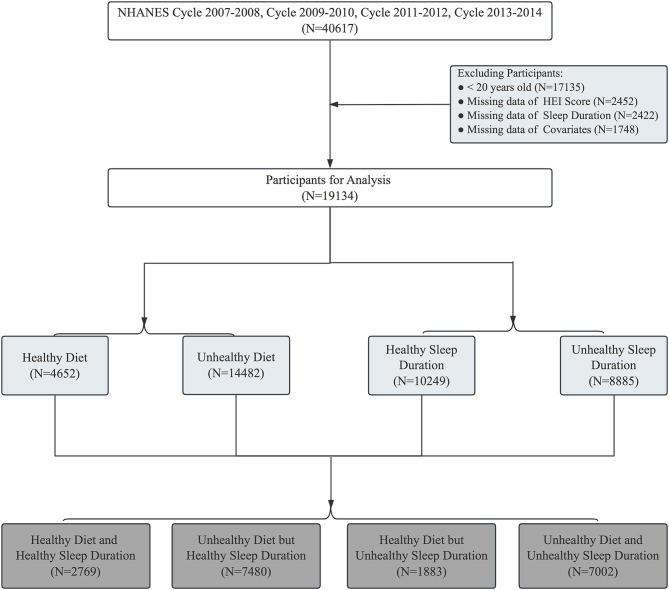
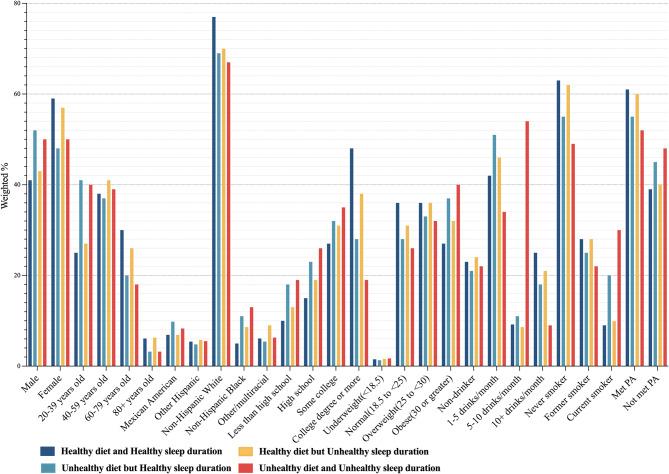
The NHANES 2007 to 2014 cycles provided the data for this study, in which 19,134 adults aged 20 years and older were included. Unhealthy diet, measured using an average Healthy Eating Index (HEI)-2015 score below the 60th percentile, and unhealthy sleep duration, measured as sleep duration at night less than 7 h or greater than/equal to 9 h, were the primary exposures. Then participants were divided into four different lifestyles. A weighted-multivariable logistic regression was employed, controlling for relevant variables. Furthermore, stratified analyses were conducted to assess the robustness of the findings and identify potential high-risk groups.
RESULTS
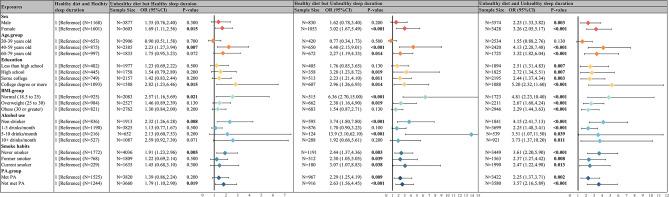
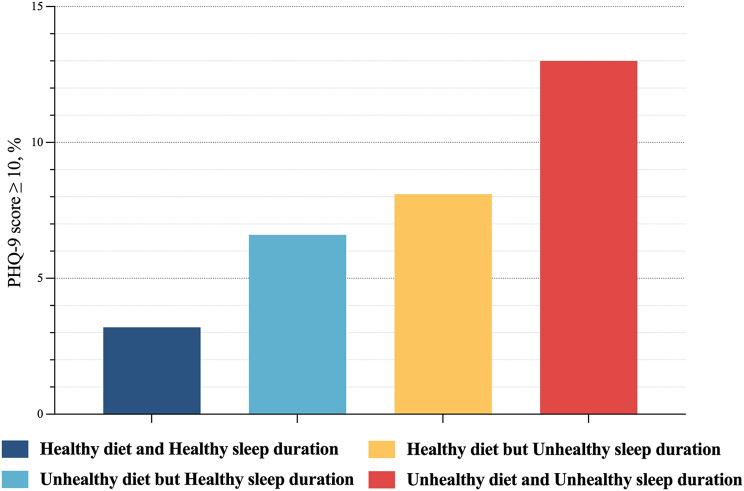
The overall prevalence of depressive symptoms among all participants was 8.44%. Among the participants, 56.58% met the criteria for healthy sleep duration, and 24.83% scored at or above the 60th percentile on the HEI-2015. Unhealthy diet (OR: 1.40, 95% CI: 1.18-1.67, p < 0.001) and unhealthy sleep duration (OR: 1.94, 95% CI: 1.63-2.31, p < 0.001) exhibited positive associations with depression symptoms. Individuals who maintained an unhealthy diet but healthy sleep duration (OR: 1.60, 95% CI: 1.20-2.13, p = 0.002), healthy diet but unhealthy sleep duration (OR: 2.50, 95% CI: 1.64-3.80, p < 0.001), or an unhealthy diet and unhealthy sleep duration (OR: 2.91, 95% CI: 2.16-3.92, p < 0.001) were significantly associated with depressive symptoms compared to those with a healthy diet and healthy sleep duration, respectively. In stratified analyses, females, middle-aged individuals, those with a college degree or higher education, and individuals who do not meet the recommended level of physical activity exhibit heightened susceptibility to depressive symptoms when exposed to unhealthy diet and unhealthy sleep duration.
CONCLUSION
In summary, our study suggests that individuals affected by the individual and synergistic effect of an unhealthy diet and unhealthy sleep duration are more susceptible to experiencing depressive symptoms.
背景
不健康的生活方式,包括不健康的饮食和睡眠时间过长或过短,已被广泛认为是抑郁症状的可改变风险因素。本研究旨在探讨饮食质量、睡眠时间与抑郁症状之间的关联,以及它们的联合作用。
方法
本研究使用了 2007 年至 2014 年 NHANES 周期的数据,其中包括 19134 名 20 岁及以上的成年人。不健康的饮食是通过平均健康饮食指数(HEI-2015)得分低于第 60 百分位来衡量的,而不健康的睡眠时间则是指夜间睡眠时间少于 7 小时或大于等于 9 小时。参与者随后被分为四种不同的生活方式。采用加权多变量逻辑回归,控制相关变量。此外,还进行了分层分析,以评估研究结果的稳健性,并确定潜在的高危人群。
结果
所有参与者的总体抑郁症状患病率为 8.44%。在参与者中,56.58%符合健康睡眠时间标准,24.83%的人在 HEI-2015 中得分达到或高于第 60 百分位。不健康的饮食(OR:1.40,95%CI:1.18-1.67,p<0.001)和不健康的睡眠持续时间(OR:1.94,95%CI:1.63-2.31,p<0.001)与抑郁症状呈正相关。与饮食健康且睡眠健康的人相比,那些饮食不健康但睡眠健康(OR:1.60,95%CI:1.20-2.13,p=0.002)、饮食健康但睡眠不健康(OR:2.50,95%CI:1.64-3.80,p<0.001)或饮食和睡眠均不健康(OR:2.91,95%CI:2.16-3.92,p<0.001)的人患抑郁症状的风险显著增加。在分层分析中,女性、中年人群、具有大学学历或以上的人群以及未达到推荐体力活动水平的人群,在暴露于不健康的饮食和睡眠时间时,更容易出现抑郁症状。
结论
总之,我们的研究表明,同时受到不健康的饮食和睡眠持续时间的个体和协同作用影响的个体更容易出现抑郁症状。

 Zotero 插件