
代谢功能障碍相关脂肪性肝病与肾癌风险增加相关:一项全国性研究。
Metabolic Dysfunction-Associated Steatotic Liver Disease Is Associated with Increased Risk of Kidney Cancer: A Nationwide Study.
作者信息
Oh Juyeon, Kim Beom Kyung, Yoon Jin-Ha, Lee Hyung Ho, Park Heejoo, Lee Jian, Park Youngsun, Yun Byungyoon, Chung Jinsoo
机构信息
Department of Public Health, Graduate School, Yonsei University, Seoul 03722, Republic of Korea.
Department of Internal Medicine, Yonsei University College of Medicine, Seoul 03722, Republic of Korea.
出版信息
Cancers (Basel). 2024 Sep 15;16(18):3161. doi: 10.3390/cancers16183161.
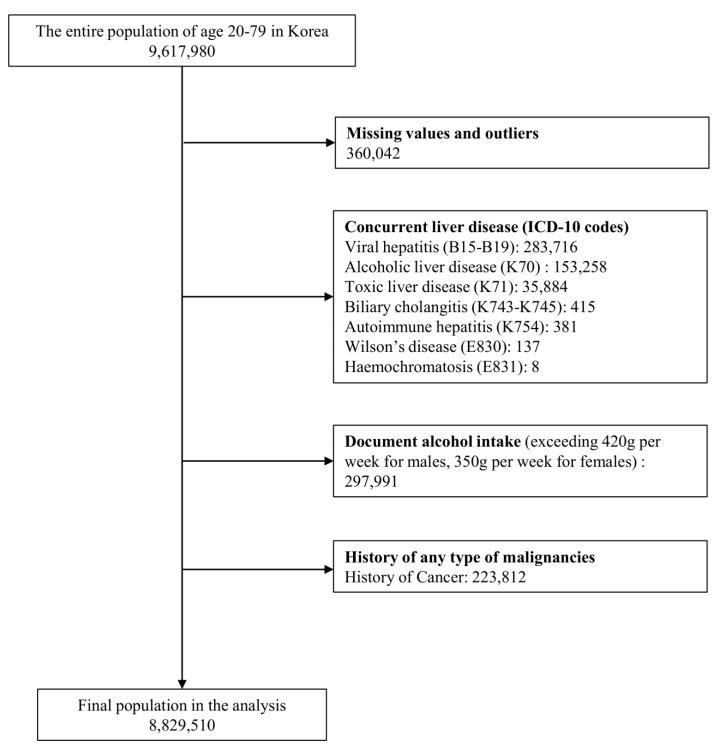
: This study investigated the association between metabolic dysfunction-associated steatotic liver disease (MASLD) and Kidney Cancer Risk, as the incidence of both diseases gradually increases owing to metabolic health issues. : Participants (aged 20-79) undergoing a national health examination between 2009 and 2010 were monitored for new-onset kidney cancer. The MASLD spectrum was classified as non-MASLD, MASLD, or MASLD with increased alcohol uptake (MetALD). Kidney Cancer Risk associated with the MASLD spectrum was estimated using multivariate Cox proportional hazard models. Age- and sex-stratified analyses were also performed. : Among 8,829,510 participants (median follow-up 13.3 years), the proportion of non-MASLD, MASLD, and MetALD was 64.9%, 30.3%, and 4.7%, respectively, with newly developed kidney cancer in 17,555 participants. Kidney cancer was significantly increased with MASLD (adjusted hazard ratio [aHR] 1.51, 95% confidence interval [CI] 1.46-1.56) and MetALD (aHR 1.51, 95% CI 1.42-1.61), compared with the non-MASLD group. Kidney Cancer Risk was the highest among young populations (aHR 1.93, 95% CI 1.77-2.11 for MASLD and aHR 1.91, 95% CI 1.65-2.22 for MetALD), according to stratification analysis. Furthermore, the cumulative relationship between metabolic dysfunction and Kidney Cancer Risk was confirmed across all MASLD spectra. : Our study highlights the positive association between MASLD and Kidney Cancer Risk, emphasizing a comprehensive approach to metabolic health. This also serves as a call to devote closer attention to the metabolic health of younger patients.
本研究调查了代谢功能障碍相关脂肪性肝病(MASLD)与肾癌风险之间的关联,因为由于代谢健康问题,这两种疾病的发病率都在逐渐上升。对2009年至2010年间接受全国健康检查的参与者(年龄在20 - 79岁之间)进行新发肾癌监测。MASLD谱被分类为非MASLD、MASLD或酒精摄入量增加的MASLD(MetALD)。使用多变量Cox比例风险模型估计与MASLD谱相关的肾癌风险。还进行了年龄和性别分层分析。在8829510名参与者中(中位随访13.3年),非MASLD、MASLD和MetALD的比例分别为64.9%、30.3%和4.7%,17555名参与者出现了新发肾癌。与非MASLD组相比,MASLD(调整后风险比[aHR] 1.51,95%置信区间[CI] 1.46 - 1.56)和MetALD(aHR 1.51,95% CI 1.42 - 1.61)的肾癌发病率显著增加。根据分层分析,肾癌风险在年轻人群中最高(MASLD的aHR 1.93,95% CI 1.77 - 2.11;MetALD的aHR 1.91,95% CI 1.65 - 2.22)。此外,在所有MASLD谱中都证实了代谢功能障碍与肾癌风险之间的累积关系。我们的研究强调了MASLD与肾癌风险之间的正相关关系,强调了对代谢健康采取综合方法的重要性。这也呼吁更加密切关注年轻患者的代谢健康。


 Zotero 插件