
靶向严重急性呼吸综合征冠状病毒2受体结合域/人血管紧张素转换酶2相互作用的潜在阻断肽的研究
Study of Potential Blocking Peptides Targeting the SARS-CoV-2 RBD/hACE2 Interaction.
作者信息
Villada-Troncoso Sara M, Arévalo-Romero Jenny Andrea, Hernández Rivera Vanessa, Pedraza-Escalona Martha, Pérez-Tapia Sonia M, Espejo-Mojica Angela Johana, Alméciga-Díaz Carlos Javier
机构信息
Institute for the Study in Inborn Errors of Metabolism-IEIM, Faculty of Science, Pontificia Universidad Javeriana, Bogotá 110231, Colombia.
Instituto Distrital de Ciencia, Biotecnología e Innovación en Salud-IDCBIS, Bogotá 111611, Colombia.
出版信息
Pharmaceuticals (Basel). 2024 Sep 20;17(9):1240. doi: 10.3390/ph17091240.
BACKGROUND/OBJECTIVES: Severe acute respiratory syndrome coronavirus 2 (SARS-CoV-2), the causative agent of COVID-19, was declared a public health emergency in early 2020. The infection initiates when the receptor-binding domain (RBD) of the viral spike protein binds to human angiotensin-converting enzyme 2 (ACE2). Despite the success of vaccination efforts, the emergence of new variants highlights the ongoing need for treatments targeting these evolving strains. In silico methods previously identified peptides BP2, BP9, and BP11 as being capable of disrupting the RBD-ACE2 interaction, though their efficacy has not been experimentally validated until now.
METHODS
In this study, these peptides were recombinantly produced in the yeast , and the activity was assessed in vitro using binding assays with multiple RBD variants and the inhibition of the RBD-ACE2 interaction.
RESULTS
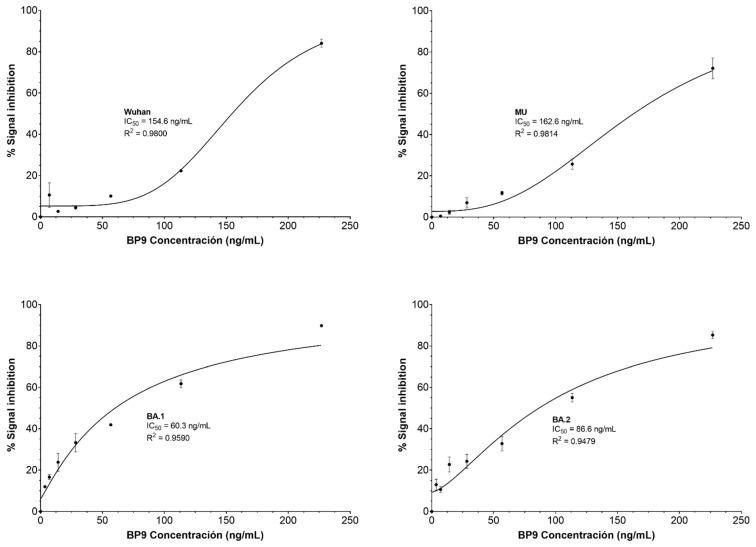
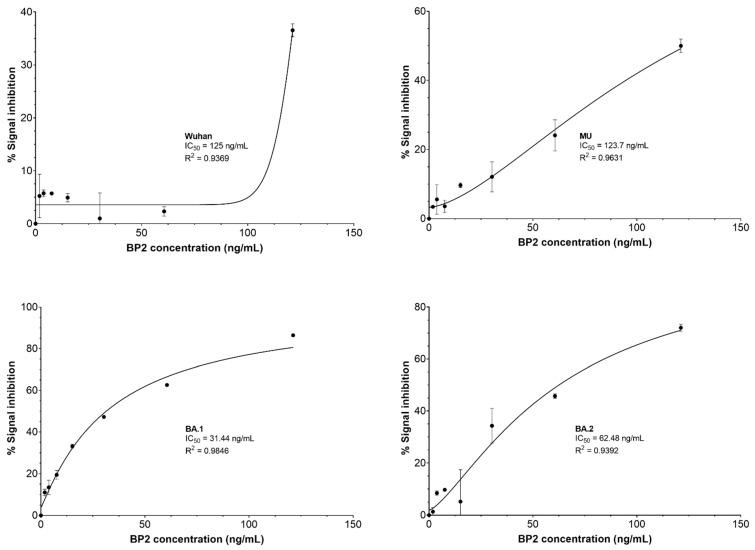
The production yield for BP2, BP9, and BP11 was 14.34, 4.01, and 1.35 mg per culture liter, respectively. Noteworthy, the three BPs interacted with the RBD of SARS-CoV-2 variants of concern, with BP2 showing higher recognition. Finally, the BPs showed an RBD/hACE2 interaction blocking capacity with IC values between 1.03 and 5.35 nM, with BP2 showing the lowest values among the evaluated peptides.
CONCLUSIONS
These results demonstrate that BP2, specifically, is a promising candidate for the development of novel therapeutic interventions targeting SARS-CoV-2 and other coronaviruses that use hACE2 for cellular entry.
背景/目的:2020年初,新型冠状病毒2(SARS-CoV-2),即COVID-19的病原体,被宣布为突发公共卫生事件。当病毒刺突蛋白的受体结合域(RBD)与人血管紧张素转换酶2(ACE2)结合时,感染就会开始。尽管疫苗接种工作取得了成功,但新变种的出现凸显了针对这些不断演变的毒株进行治疗的持续需求。此前,计算机模拟方法已确定肽BP2、BP9和BP11能够破坏RBD-ACE2相互作用,不过到目前为止,它们的疗效尚未得到实验验证。
方法
在本研究中,这些肽在酵母中重组产生,并使用针对多种RBD变体的结合试验和对RBD-ACE2相互作用的抑制在体外评估其活性。
结果
BP2、BP9和BP11的产量分别为每升培养物14.34、4.01和1.35毫克。值得注意的是,这三种BP与关注的SARS-CoV-2变种的RBD相互作用,其中BP2表现出更高的识别能力。最后,这些BP表现出RBD/hACE2相互作用阻断能力,IC值在1.03至5.35纳摩尔之间,在评估的肽中,BP2的值最低。
结论
这些结果表明,特别是BP2,是开发针对SARS-CoV-2和其他利用hACE2进入细胞的冠状病毒的新型治疗干预措施的有前景的候选物。


 Zotero 插件