
冷等离子体电离器与静电除尘器联用对生物气溶胶的灭活作用
Bioaerosol Inactivation by a Cold Plasma Ionizer Coupled with an Electrostatic Precipitator.
作者信息
Lim Samuel Wei Yang, Ow Sian Yang, Sutarlie Laura, Lee Yeong Yuh, Suwardi Ady, Tan Chee Kiang Ivan, Cheong Wun Chet Davy, Loh Xian Jun, Su Xiaodi
机构信息
Institute of Materials Research and Engineering (IMRE), Agency for Science, Technology and Research (A*STAR), 2 Fusionopolis Way, Innovis, #08-03, Singapore 138634, Singapore.
出版信息
Microorganisms. 2024 Sep 21;12(9):1923. doi: 10.3390/microorganisms12091923.
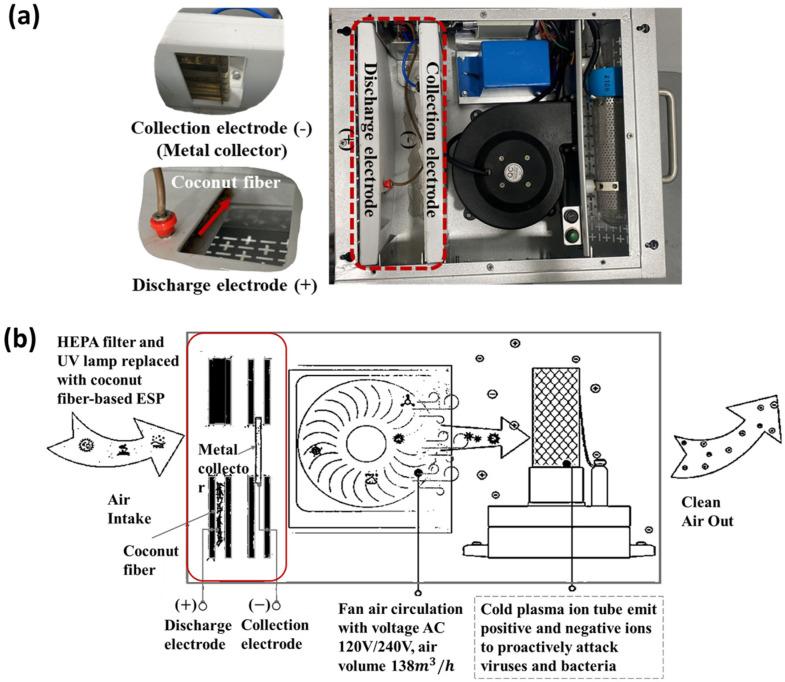
Despite best efforts in air purification, airborne infectious diseases will continue to spread due to the continuous emission of bioaerosols by the host/infected person. Hence, a shift in focus from air purification to bioaerosol inactivation is urgently needed. To explore the potential of the cold plasma technology for preventing rapid spread of airborne infectious diseases, we studied a cold plasma ionizer (CPI) device and an electrostatic precipitator (ESP)-coupled CPI (CPI-ESP) device for the inactivation and cleaning of surface-spread microorganisms and bioaerosols, using porcine respiratory coronavirus (PRCV), (), and aerosolized as representatives. We firstly demonstrated that CPI coupled with ESP is an effective technology for inactivating virus and bacteria spread on surfaces in an in-house test chamber. We then demonstrated the efficacy of CPI-coupled ESP for the inactivation of aerosolized in the same chamber. Furthermore, we have demonstrated the efficiency of a CPI-ESP coupled device for the inactivation of naturally occurring airborne microbials in a few indoor settings (i.e., a living room, a discussion room, a schoolroom, and an office) to determine the treatment duration- and human activity-dependent efficacy. To understand the disinfection mechanism, we conducted a fluorescence microscopy study to reveal different degrees of bacteria cell membrane damage under CPI treatment.
尽管在空气净化方面已做出最大努力,但由于宿主/感染者持续排放生物气溶胶,空气传播的传染病仍将继续传播。因此,迫切需要将重点从空气净化转向生物气溶胶灭活。为了探索冷等离子体技术在预防空气传播传染病快速传播方面的潜力,我们研究了一种冷等离子体电离器(CPI)装置和一种与静电除尘器(ESP)耦合的CPI(CPI-ESP)装置,以猪呼吸道冠状病毒(PRCV)、()和气溶胶化的作为代表,用于灭活和清洁表面传播的微生物和生物气溶胶。我们首先证明,在室内测试室中,CPI与ESP耦合是一种灭活表面传播病毒和细菌的有效技术。然后,我们在同一测试室中证明了CPI-ESP对气溶胶化的灭活效果。此外,我们还证明了CPI-ESP耦合装置在一些室内环境(即客厅、会议室、教室和办公室)中灭活自然存在的空气微生物的效率,以确定处理持续时间和人类活动相关的效果。为了了解消毒机制,我们进行了荧光显微镜研究,以揭示在CPI处理下细菌细胞膜不同程度的损伤。
 Zotero 插件