
融合自然杀伤细胞质膜蛋白的脂质纳米颗粒用于三阴性乳腺癌治疗
Lipid-Based Nanoparticles Fused with Natural Killer Cell Plasma Membrane Proteins for Triple-Negative Breast Cancer Therapy.
作者信息
Won Eun-Jeong, Lee Myungchul, Lee Eui-Kyung, Baek Seung-Hoon, Yoon Tae-Jong
机构信息
Research Institute of Pharmaceutical Science and Technology (RIPST), Department of Pharmacy, Ajou University, 206 Worldcup-ro, Yeongtong-gu, Suwon 16499, Republic of Korea.
Nucleic Acid Therapeutics Research Center, Korea Research Institute of Bioscience and Biotechnology (KRIBB), 30 Yeongudanji-ro, Ochang, Cheongwon, Cheongju 28116, Republic of Korea.
出版信息
Pharmaceutics. 2024 Aug 29;16(9):1142. doi: 10.3390/pharmaceutics16091142.
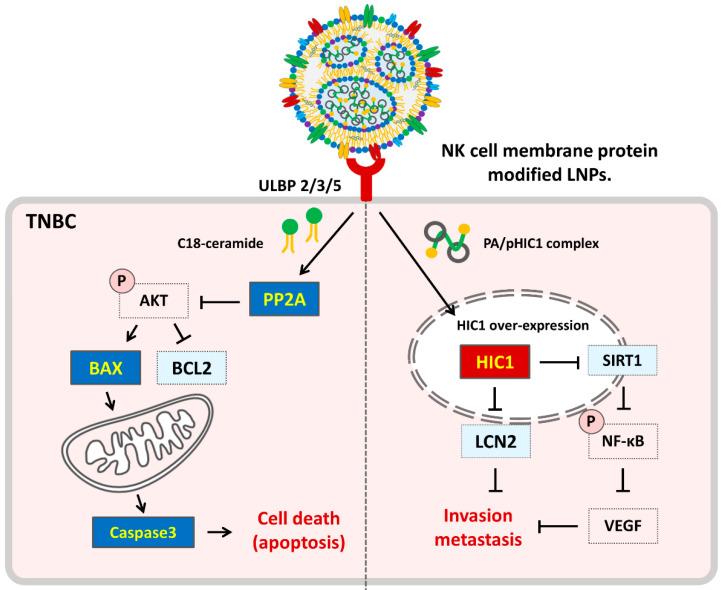
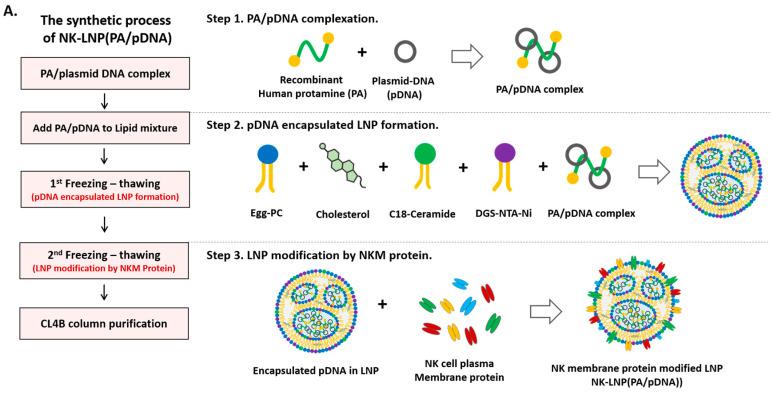
Immunotherapy combined with chemicals and genetic engineering tools is emerging as a promising strategy to treat triple-negative breast cancer (TNBC), which is more aggressive with poorer progress than other breast cancer subtypes. In this study, lipid-based nanoparticles (LNPs) possessed an NK cell-like function that could deliver tumor-specific therapeutics and inhibit tumor growth. LNPs fused with an NK cell membrane protein system (NK-LNP) have three main features: (i) hydrophilic plasmid DNA can inhibit TNBC metastasis when encapsulated within LNPs and delivered to cells; (ii) the lipid composition of LNPs, including C18 ceramide, exhibits anticancer effects; (iii) NK cell membrane proteins are immobilized on the LNP surface, enabling targeted delivery to TNBC cells. These particles facilitate the targeted delivery of HIC1 plasmid DNA and the modulation of immune cell functions. Delivered therapeutic genes can inhibit metastasis of TNBC and then induce apoptotic cell death while targeting macrophages to promote cytokine release. The anticancer effect is expected to be applied in treating various difficult-to-treat cancers with LNP fused with NK cell plasma membrane proteins, which can simultaneously deliver therapeutic chemicals and genes.
免疫疗法与化学物质和基因工程工具相结合,正成为一种治疗三阴性乳腺癌(TNBC)的有前景的策略,三阴性乳腺癌比其他乳腺癌亚型更具侵袭性,进展更差。在本研究中,基于脂质的纳米颗粒(LNPs)具有类似自然杀伤(NK)细胞的功能,可递送肿瘤特异性治疗药物并抑制肿瘤生长。与NK细胞膜蛋白系统融合的LNPs(NK-LNP)具有三个主要特征:(i)亲水质粒DNA封装在LNPs内并递送至细胞时,可抑制TNBC转移;(ii)LNPs的脂质成分,包括C18神经酰胺,具有抗癌作用;(iii)NK细胞膜蛋白固定在LNP表面,能够靶向递送至TNBC细胞。这些颗粒有助于HIC1质粒DNA的靶向递送和免疫细胞功能的调节。递送的治疗基因可抑制TNBC转移,然后诱导凋亡性细胞死亡,同时靶向巨噬细胞以促进细胞因子释放。预计这种抗癌作用可应用于用与NK细胞质膜蛋白融合的LNP治疗各种难治性癌症,其可同时递送治疗性化学物质和基因。



 Zotero 插件