
在西班牙加泰罗尼亚引入 nirsevimab:描述 2023/2024 季节毛细支气管炎和呼吸道合胞病毒的发病率。
Introduction of nirsevimab in Catalonia, Spain: description of the incidence of bronchiolitis and respiratory syncytial virus in the 2023/2024 season.
机构信息
Computational Biology and Complex Systems (BIOCOM-SC) Group, Department of Physics, Universitat Politècnica de Catalunya (UPC), Castelldefels, Barcelona, Catalonia, Spain.
Primary Care Services Information System (SISAP), Institut Català de La Salut (ICS), Barcelona, Catalonia, Spain.
出版信息
Eur J Pediatr. 2024 Dec;183(12):5181-5189. doi: 10.1007/s00431-024-05779-x. Epub 2024 Sep 28.
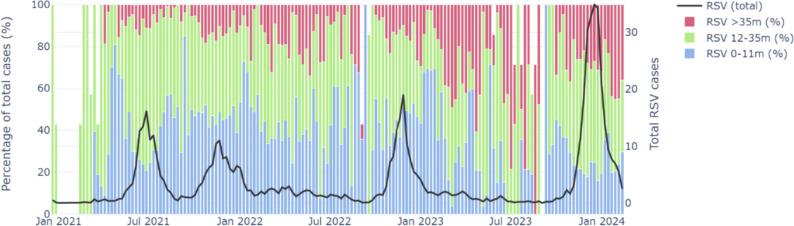
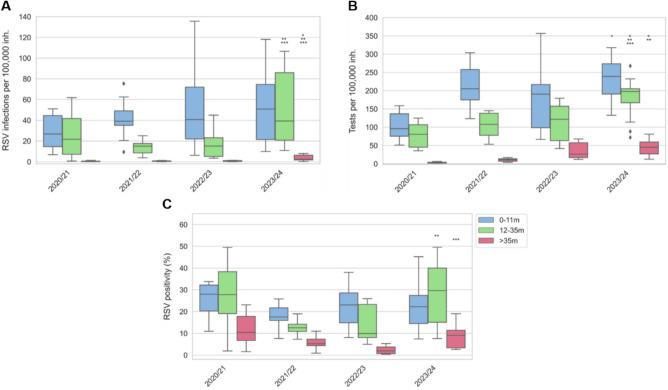
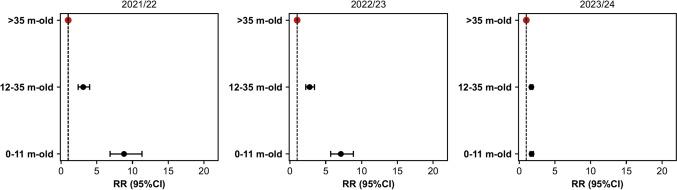
Respiratory syncytial virus (RSV) causes most of the cases of bronchiolitis and thousands of deaths annually, particularly in infants less than 6 months old. In Catalonia (Spain), infants born between April 2023 and March 2024 aged 0-6 months during their first RSV season have been candidates to receive nirsevimab, the novel monoclonal antibody against RSV, since October 2023. We aimed to analyse the dynamics of all-causes bronchiolitis diagnoses and RSV community infections in the current season and compare them to pre-nirsevimab epidemics. We collected epidemiological data from the Information System for Surveillance of Infections in Catalonia (SIVIC) on daily all-causes bronchiolitis clinical diagnoses and RSV-confirmed cases provided by rapid antigen tests in primary care practices. We calculated the rate ratio (RR) for the incidence of all-causes bronchiolitis for children aged 0-11 m-old with respect to 12-35 m-old between September 2014 and January 2024. We analysed the RR of the incidence of RSV-confirmed infection for 0-11 m-old and 12-35 m-old with respect to the > 35 m-old, from January 2021 to January 2024. We then computed the relative difference of the RR, designated as percentage of reduction of risk, between season 2023/2024 and former epidemics. With a global coverage recorded rate for nirsevimab of 82.2% in January 2024, the age-specific 0-11 m-old RR (95% CI) of RSV infection incidence for > 35 m-old was 1.7 (1.5-2.0) in season 2023/2024. The RR (95% CI) had been 7.4 (5.6-9.9), 8.8 (6.9-11.3), and 7.1 (5.7-8.9) in 2020/2021, 2021/2022, and 2022/2023, respectively. Regarding the incidence of all-causes bronchiolitis for the 0-11 m-old group compared to the 12-35 m-old, the pre-pandemic (2014/2015-2019/2020) and 2022/2023 RR (95% CI) were 9.4 (9.2-9.6) and 6.0 (5.7-6.2), respectively, significantly higher than the RR of 3.6 (3.4-3.8) for the most recent season, 2023/2024. Conclusion: Concurring with the introduction of nirsevimab, the risk of RSV infection for infants aged 0-11 m-old compared to > 35 m-old has been reduced by 75.6% (73.4-77.5) in last season, and the risk for all-causes bronchiolitis for 12-35 m-old by 61.9% (60.9-62.9) from the pre-pandemic period and by 39.8% (39.3-40.2) from the 2022/2023 epidemic, despite high RSV community transmission, especially in older infants What is Known: • RSV is responsible for approximately 70% of bronchiolitis cases and causes severe disease, particularly in infants < 6 months of age. • Nirsevimab effectiveness against RSV-associated disease, particularly hospitalisations, was expected to be around 80%; other Spanish regions, such as Galicia and Valencia, and European countries including Luxembourg and Germany, have already reported good results in implementing nirsevimab to prevent RSV-associated hospitalisations and PICU stays. What is New: • We provide insight into the community incidence of RSV and all-causes bronchiolitis for season 2023/2024, when nirsevimab has been introduced to the Catalan population, using. primary healthcare data, which enabled us to assess the burden of RSV infections and bronchiolitis in the commonly seasonally saturated primary healthcare practices. • Our study reveals that the risk of all-causes bronchiolitis for infants aged 0-11 m-old compared to older infants was reduced by 40% compared to the previous season and 62% compared to pre-pandemic standards, and for RSV infection it was reduced by 76%.
呼吸道合胞病毒(RSV)导致了大多数毛细支气管炎病例,并导致每年数千人死亡,尤其是在不到 6 个月大的婴儿中。在加泰罗尼亚(西班牙),2023 年 4 月至 2024 年 3 月期间出生的婴儿,在其首个 RSV 季节期间,6 个月以下的 0-6 个月大婴儿已成为接受 nirsevimab 的候选者,nirsevimab 是一种针对 RSV 的新型单克隆抗体。我们旨在分析当前季节所有原因毛细支气管炎诊断和 RSV 社区感染的动态,并将其与前 nirsevimab 流行期进行比较。我们从加泰罗尼亚传染病监测信息系统(SIVIC)收集流行病学数据,包括每日所有原因毛细支气管炎临床诊断和初级保健实践中快速抗原检测确认的 RSV 病例。我们计算了 0-11 个月大儿童与 12-35 个月大儿童之间因所有原因毛细支气管炎的发病率比率(RR),从 2014 年 9 月到 2024 年 1 月。我们分析了 0-11 个月大儿童和 12-35 个月大儿童与 >35 个月大儿童之间 RSV 确诊感染的 RR,从 2021 年 1 月到 2024 年 1 月。然后,我们计算了 RR 的相对差异,指定为风险降低的百分比,比较 2023/2024 赛季和前几季的差异。在 2024 年 1 月记录的 nirsevimab 全球覆盖率为 82.2%的情况下,2023/2024 赛季 >35 个月大儿童 RSV 感染发病率的特定年龄 0-11 个月大儿童 RR(95%CI)为 1.7(1.5-2.0)。在 2020/2021、2021/2022 和 2022/2023 年,RR(95%CI)分别为 7.4(5.6-9.9)、8.8(6.9-11.3)和 7.1(5.7-8.9)。对于 0-11 个月大儿童组与 12-35 个月大儿童组之间的所有原因毛细支气管炎发病率,大流行前(2014/2015-2019/2020)和 2022/2023 年的 RR(95%CI)分别为 9.4(9.2-9.6)和 6.0(5.7-6.2),显著高于最近一个季节(2023/2024 年)的 RR 3.6(3.4-3.8)。结论:与 nirsevimab 的引入一致,0-11 个月大婴儿的 RSV 感染风险与 >35 个月大婴儿相比已降低 75.6%(73.4-77.5),而 12-35 个月大婴儿的所有原因毛细支气管炎风险比大流行前降低了 61.9%(60.9-62.9),比 2022/2023 年流行期降低了 39.8%(39.3-40.2),尽管 RSV 社区传播率很高,尤其是在较大的婴儿中。已知:• RSV 导致大约 70%的毛细支气管炎病例,并导致严重疾病,尤其是在 6 个月以下的婴儿中。• nirsevimab 对 RSV 相关疾病的有效性,特别是住院治疗,预计约为 80%;西班牙的其他地区,如加利西亚和瓦伦西亚,以及包括卢森堡和德国在内的欧洲国家,已经报告了使用 nirsevimab 预防 RSV 相关住院和 PICU 入住的良好效果。新内容:• 我们使用初级保健数据提供了有关 2023/2024 赛季 RSV 和所有原因毛细支气管炎社区发病率的信息,nirsevimab 已在加泰罗尼亚人群中引入,这使我们能够评估 RSV 感染和毛细支气管炎在通常季节性饱和的初级保健实践中的负担。• 我们的研究表明,与前一个季节相比,0-11 个月大婴儿的所有原因毛细支气管炎发病率与较大婴儿相比降低了 40%,与大流行前标准相比降低了 62%,而 RSV 感染的发病率降低了 76%。

 Zotero 插件