
二肽基肽酶-4 标记具有不同肝细胞分化和免疫调节特性的人脂肪基质/干细胞的不同亚型。
Dipeptidyl peptidase-4 marks distinct subtypes of human adipose stromal/stem cells with different hepatocyte differentiation and immunoregulatory properties.
机构信息
Department of Cell Biology, School of Basic Medical Science, Capital Medical University, Beijing, 100069, China.
Biomedical Innovation Center, Beijing Shijitan Hospital, Capital Medical University, Beijing, 100038, China.
出版信息
Stem Cell Res Ther. 2024 Sep 29;15(1):338. doi: 10.1186/s13287-024-03950-7.
BACKGROUND
Human adipose-derived stromal/stem cells (hASCs) play important roles in regenerative medicine and numerous inflammatory diseases. However, their cellular heterogeneity limits the effectiveness of treatment. Understanding the distinct subtypes of hASCs and their phenotypic implications will enable the selection of appropriate subpopulations for targeted approaches in regenerative medicine or inflammatory diseases.
METHODS
hASC subtypes expressing dipeptidyl peptidase-4 (DPP4) were identified via fluorescence-activated cell sorting (FACS) analysis. DPP4 expression was knocked down in DPP4 hASCs via DPP4 siRNA. The capacity for proliferation, hepatocyte differentiation, inflammatory factor secretion and T-cell functionality regulation of hASCs from DPP4, DPP4, and control siRNA-treated DPP4 hASCs and DPP4 siRNA-treated DPP4 hASCs were assessed.
RESULTS
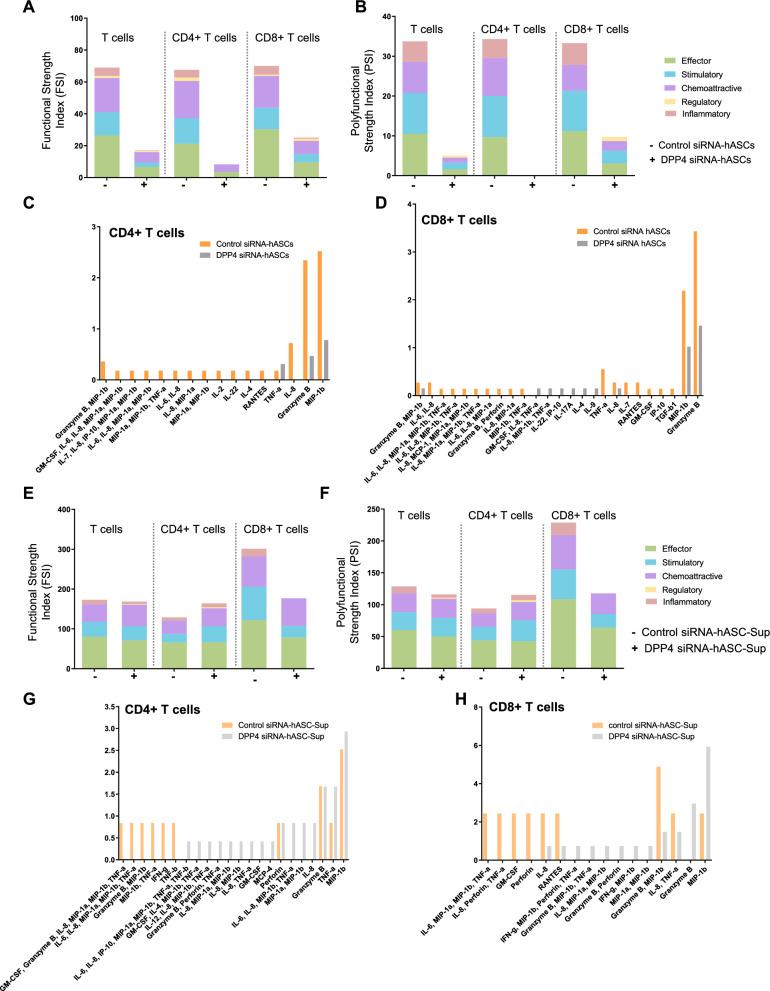
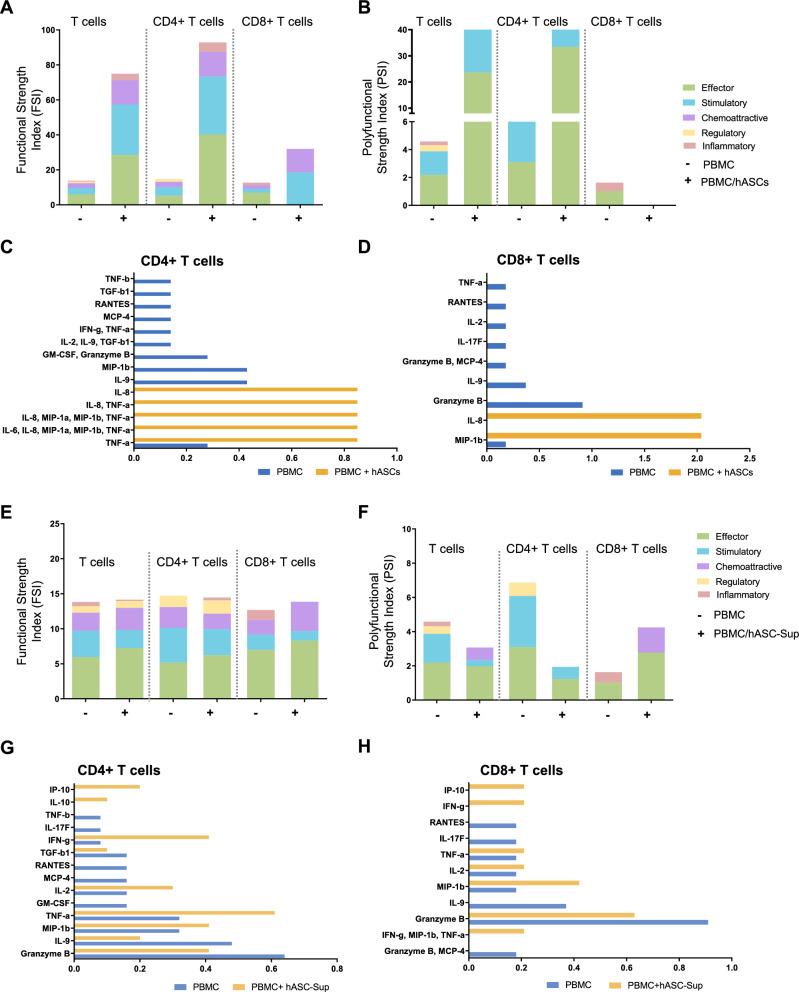
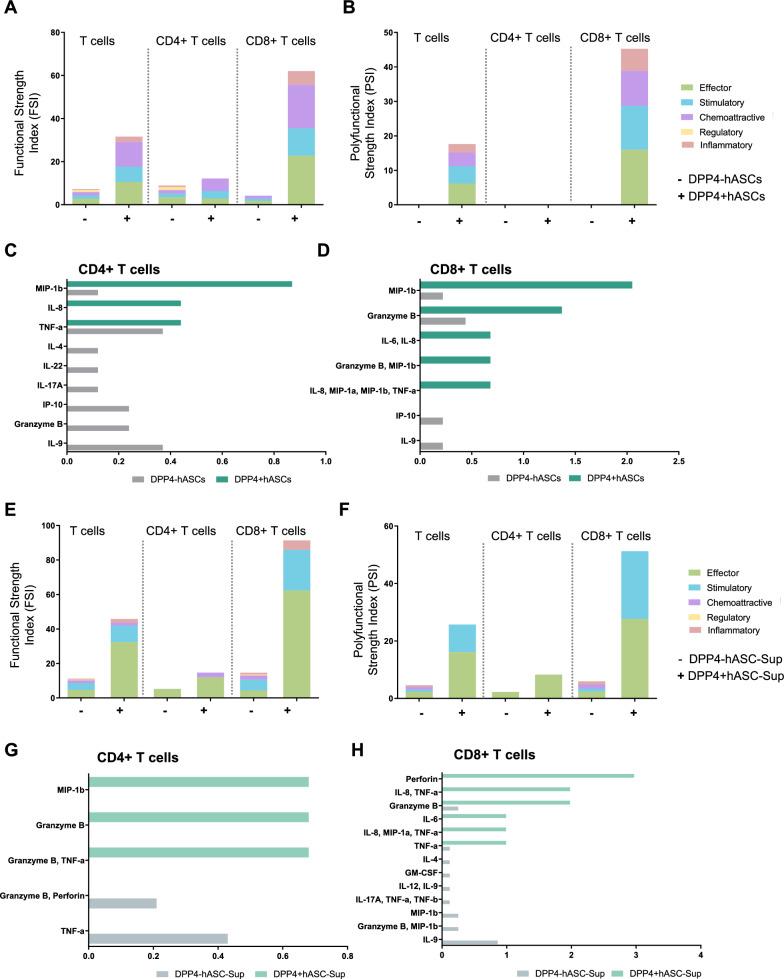
DPP4 hASCs and control siRNA-treated DPP4 hASCs presented a lower proliferative capacity but greater hepatocyte differentiation capacity than DPP4 hASCs and DPP4 siRNA-treated DPP4 hASCs. Both DPP4 hASCs and DPP4 hASCs secreted high levels of vascular endothelial growth factor-A (VEGF-A), monocyte chemoattractant protein-1 (MCP-1), and interleukin 6 (IL-6), whereas the levels of other factors, including matrix metalloproteinase (MMP)-1, eotaxin-3, fractalkine (FKN, CX3CL1), growth-related oncogene-alpha (GRO-alpha, CXCL1), monokine induced by interferon-gamma (MIG), macrophage inflammatory protein (MIP)-1beta, and macrophage colony-stimulating factor (M-CSF), were significantly greater in the supernatants of DPP4 hASCs than in those of DPP4 hASCs. Exposure to hASC subtypes and their conditioned media triggered changes in the secreted cytokine profiles of T cells from healthy donors. The percentage of functional T cells that secreted factors such as MIP-1beta and IL-8 increased when these cells were cocultured with DPP4 hASCs. The percentage of polyfunctional CD8 T cells that secreted multiple factors, such as IL-17A, tumour necrosis factor alpha (TNF-α) and TNF-β, decreased when these cells were cocultured with supernatants derived from DPP4 hASCs.
CONCLUSIONS
DPP4 may regulate proliferation, hepatocyte differentiation, inflammatory cytokine secretion and T-cell functionality of hASCs. These data provide a key foundation for understanding the important role of hASC subpopulations in the regulation of T cells, which may be helpful for future immune activation studies and allow them to be customized for clinical application.
背景
人脂肪来源的基质/干细胞(hASCs)在再生医学和许多炎症性疾病中发挥着重要作用。然而,它们的细胞异质性限制了治疗效果。了解 hASC 的不同亚型及其表型意义,将有助于为再生医学或炎症性疾病的靶向治疗选择合适的亚群。
方法
通过荧光激活细胞分选(FACS)分析鉴定表达二肽基肽酶-4(DPP4)的 hASC 亚型。通过 DPP4 siRNA 敲低 DPP4 hASCs 中的 DPP4 表达。评估 DPP4、DPP4 和对照 siRNA 处理的 DPP4 hASCs 以及 DPP4 siRNA 处理的 DPP4 hASCs 中 hASCs 的增殖能力、肝细胞分化能力、炎症因子分泌和 T 细胞功能调节能力。
结果
与 DPP4 hASCs 和 DPP4 siRNA 处理的 DPP4 hASCs 相比,DPP4 hASCs 和对照 siRNA 处理的 DPP4 hASCs 的增殖能力较低,但肝细胞分化能力较强。DPP4 hASCs 和 DPP4 hASCs 均分泌高水平的血管内皮生长因子-A(VEGF-A)、单核细胞趋化蛋白-1(MCP-1)和白细胞介素 6(IL-6),而其他因子(包括基质金属蛋白酶(MMP)-1、嗜酸粒细胞趋化因子-3、趋化因子(FKN、CX3CL1)、生长相关癌基因-α(GRO-α、CXCL1)、干扰素-γ诱导的单核细胞趋化蛋白(MIG)、巨噬细胞炎症蛋白(MIP)-1β和巨噬细胞集落刺激因子(M-CSF)的水平在 DPP4 hASCs 的上清液中明显高于 DPP4 hASCs。健康供体的 T 细胞暴露于 hASC 亚型及其条件培养基中,会改变其分泌的细胞因子谱。当这些细胞与 DPP4 hASCs 共培养时,分泌 MIP-1β 和 IL-8 等因子的功能性 T 细胞的百分比增加。当这些细胞与源自 DPP4 hASCs 的上清液共培养时,分泌多种因子(如 IL-17A、肿瘤坏死因子-α(TNF-α)和 TNF-β)的多效性 CD8 T 细胞的百分比降低。
结论
DPP4 可能调节 hASCs 的增殖、肝细胞分化、炎症细胞因子分泌和 T 细胞功能。这些数据为了解 hASC 亚群在 T 细胞调节中的重要作用提供了关键基础,这可能有助于未来的免疫激活研究,并使其能够为临床应用定制。


 Zotero 插件